


Youth Risk Behavior Survey: Substance Use
This is the second brief in a three-part series that summarizes the key findings from the Youth Risk Behavior Survey (YRBS) for high school students in the Houston Independent School District (HISD). The first brief focused on student mental health, while this examines trends in the use of tobacco, alcohol, and illicit substances among Houston and U.S. students from 2011 to 2023.
The YRBS data shows multidirectional trends in substance use. Drinking alcohol, smoking cigarettes, and use of marijuana and cocaine declined among Houston and U.S. students from 2011 to 2023. However, nicotine vaping and methamphetamine, inhalant, and opioid use have increased among HISD students. Notably, after years of decline there was an increase in the use of several substances in HISD from 2021 to 2023.
The following sections discuss these trends in further detail. The brief concludes with recommendations as to how policymakers may better support students who use substances.
About the Survey
The YRBS is a federally supported representative survey that provides school administrators, teachers, and parents with information about student behavior across a range of topics, including substance use, school environment, sexual behavior, unintentional injuries, and dietary behaviors. Importantly, the YRBS allows respondents to report their behaviors anonymously and without fear of punishment, increasing the likelihood that policymakers and educators receive a more accurate picture of student conduct. The survey is not without limitations:
- It only includes those actively attending public schools, excluding those who have dropped out or attend alternative schools.
- It does not provide respondents with definitions of a variety of behaviors, which may lead to confusion.
- It relies on self-reported data, which can be affected by students’ willingness or ability to answer honestly.
Despite those limitations, it remains one of the most consistent measures of student behavior in U.S. schools.
Substance Use: HISD and US Trends
Alcohol
The YRBS reports an encouraging long-term decline in alcohol use among HISD and U.S. students (Figure 1). The number of HISD students who reported drinking alcohol in the last 30 days has dropped significantly, from 33% in 2011 to 19.9% in 2023. This most recent figure is lower than the national average of 22.1%. The number of students who reported binge drinking — defined as four or more drinks within a couple of hours for females and five or more drinks for males — has also decreased among the HISD and national samples since 2017, the first year for which YRBS reported this behavior.
Decreases in teen drinking captured in the YRBS data are consistent with other surveys finding long-term declines in teen drinking and binge drinking, both in the U.S. and other western countries. Though precise causes are unclear, contributing factors may include shifting cultural perceptions of alcohol, changing parental practices, delayed participation in adult activities, and increased emphasis on health and wellness.
Figure 1 — HISD and US High School Alcohol Consumption 2011–23

Tobacco
Cigarette Smoking
Cigarette use among high school students has steadily declined at both the local and national levels (Figure 2). This long-term pattern may partially reflect the positive impacts of anti-smoking public health campaigns. In 2023, 15% of HISD respondents reported having ever smoked a cigarette, a rate similar to the national average. That same year, the percentage of HISD and U.S. students who reported currently smoking cigarettes — defined as having smoked in the past 30 days — was relatively similar, at 4.3% and 3.5% respectively.
Few HISD students (less than 1%) reported daily smoking. However, 7.1% of past-30 day smokers reported smoking more than 10 cigarettes on days they smoked. This quantity indicates heavy use. While this rate is lower than the 10.1% peak in 2013, the relative stability of this trend despite decreases in overall cigarette exposure underscores the challenges of reducing one of the most harmful cigarette use patterns.
Figure 2 — HISD and US Cigarette Smoking 2011–23
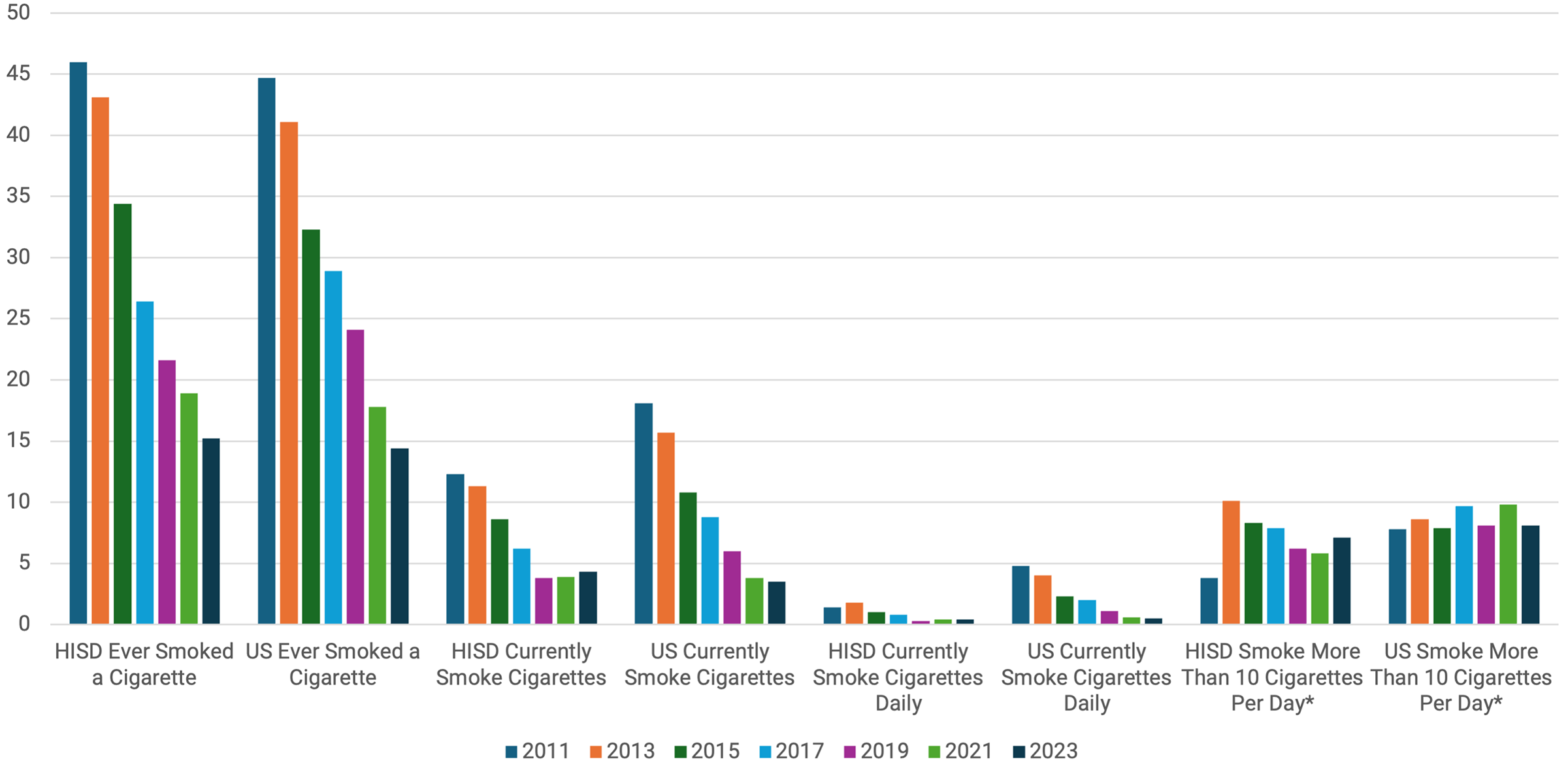
Note: * (Of Those Who Smoked in the Past 30 Days).
Electronic Vaping
As social acceptance of cigarette smoking has declined, nicotine vaping has grown in popularity. There has been a slight uptick in the percentage of HISD students reporting frequent use of electronic vaping products (such as e-cigarettes, vapes, and mods), defined as using electronic vaping products on at least 20 days during the 30 days prior to the survey (Figure 3). This increase is relatively consistent from 2015 to 2023, though the Houston rate of 3.9% is notably lower than the national average of 6.4%.
In Texas, the legal age for purchasing tobacco products, including e-cigarettes and other vaping devices, is 21. However, 10.7% of HISD students reported purchasing electronic vapor products themselves in 2023, compared to 7.3% of U.S. students. While this figure represents a minority of students who report vaping, it suggests that some retailers selling tobacco products may not be adequately verifying customers’ ages.
Figure 3 — HISD and US Electronic Vapor Product Use on 20 or More Days During the 30 Days Before the Survey

Marijuana
YRBS asks students if they have ever used marijuana, currently use marijuana, and whether they tried marijuana for the first time before the age of 13. Rates of students who report having ever used marijuana are relatively similar between HISD and national samples (Figure 4). In 2023, 28.9% of HISD students said they tried marijuana at least once in their lifetime, compared to 29.5% nationally. Houston and the U.S. have both experienced a 10-year decline in the frequency of lifetime marijuana use, from 2013 highs of 43.6% and 40.7%, respectively.
Current marijuana use — defined as having used at least once in the 30 days prior to the survey — has also declined in Houston and the U.S. over this period.
- In 2013, 23.4% of Houston and U.S. students reported current marijuana use.
- In 2023, 14.9% of HISD students and 17% of U.S. students reported current use.
- In 2013, 12.7% of HISD students reported trying marijuana before age 13, compared to 7.4% in 2023.
The decline in early initiation is a positive development, as earlier onset of substance use raises the risk for developing substance use disorders later in life.
The 2023 YRBS questionnaire directs respondents to not count “CBD-only or hemp products” when responding to questions about marijuana use. However, many widely available hemp products contain THC, the main psychoactive ingredient typically associated with marijuana. Hemp products can be sold to minors in Texas and some contain enough THC to cause impairment similar to the effects of traditional marijuana. Other analyses have found use of hemp-derived THC products among youth is higher in states that, like Texas, prohibit marijuana and have few regulations on the hemp industry. This suggests that there may be an increase in use of hemp-derived THC products among HISD and U.S. students that is not captured in this survey data.
Figure 4 — HISD and US High School Marijuana Use 2011–23

Opioid Use
Since 2017 the YRBS has asked students, “how many times have you taken prescription pain medicine without a doctor’s prescription or differently than how a doctor told you to use it?” (Figure 5). Codeine, Vicodin, OxyContin, hydrocodone, and Percocet are provided as examples.
- In 2017, HISD students reported lower rates of prescription painkiller misuse than the U.S. average, 12.9% compared to 14%.
- While the national average has since declined to 11.6% in 2023, the rate among HISD students increased to 18.8%.
- The percentage of students who have ever tried heroin in HISD was approximately four times higher in 2023 than the U.S. average, 6.6% compared to 1.6%.
The reported increases in opioid use among HISD students are particularly concerning given the proliferation of fentanyl in the illicit drug supply. Fentanyl is a synthetic opioid 100 times more potent than morphine that increases the risk for overdose and other serious health consequences. It has largely replaced heroin in the U.S. Counterfeit pills made to look like prescription opioids also frequently contain fentanyl or other potentially lethal substances. The number of pills containing fentanyl seized by law enforcement increased from fewer than 50,000 in 2017 to more than 115 million in 2023, highlighting the growing severity of this problem.
Students who may believe they are using heroin or prescription opioids are at high risk for exposure to fentanyl. While adolescents have lower overdose rates than adults, youth have been more acutely affected by the presence of fentanyl, possibly because they are more likely to rely on social media sources for procuring drugs. From 2018 to 2022, as fentanyl became dominant in the illicit opioid supply, drug-related deaths among 15- to 19-year-olds in Harris County, which includes Houston and HISD, increased by 544% compared to a 65% increase among adults aged 20 and older.
Figure 5 — HISD and US High School Opioid Use Trends 2011–23
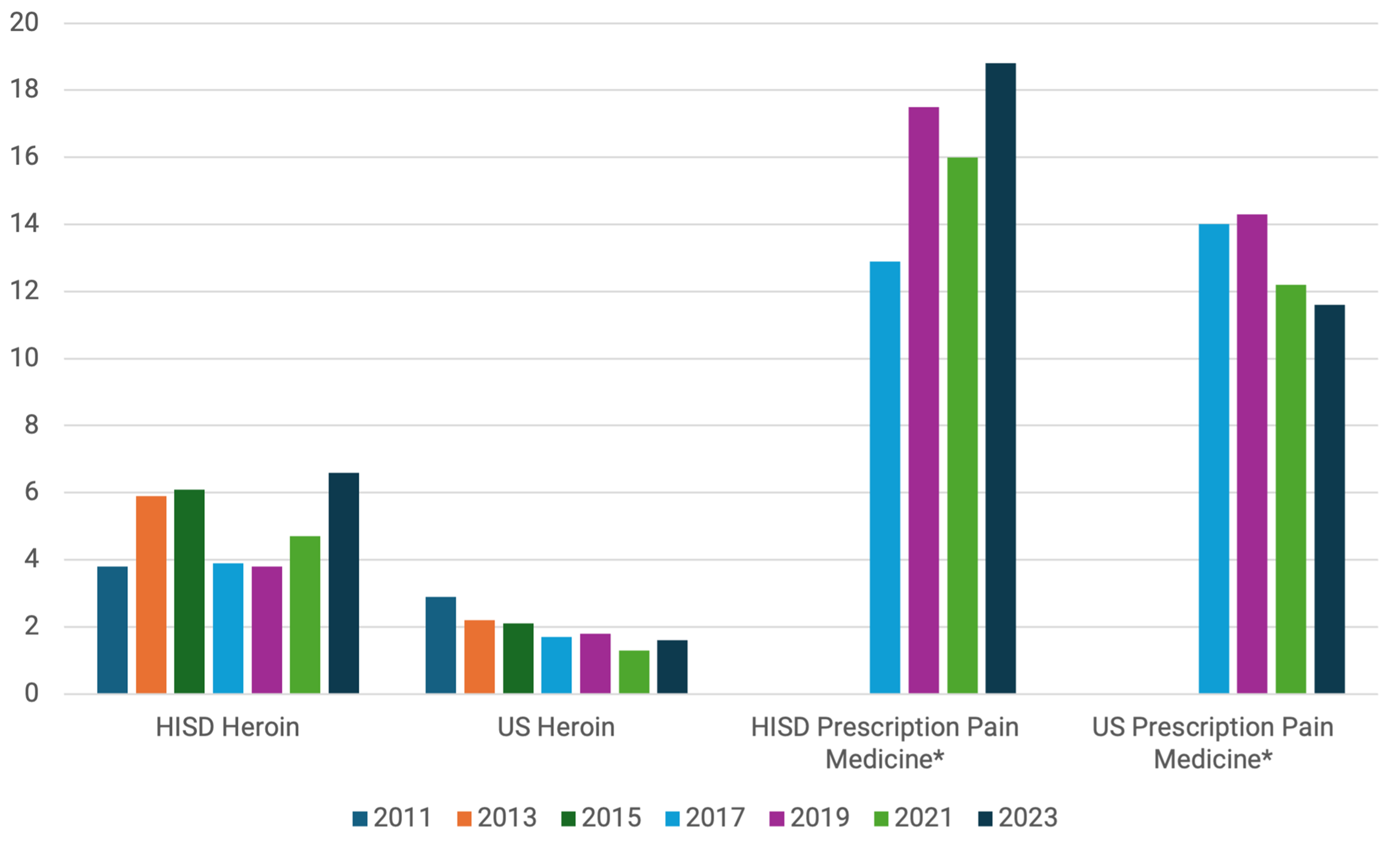
Note: *Question asked: How many times have you taken prescription pain medicine without a doctor’s prescription or differently than how a doctor told you to use it?
Other Substances
From 2013 to 2019, HISD experienced declines in the percentage of students reporting lifetime use of illicit substances, including cocaine, methamphetamine, and ecstasy (Figure 6). However, use rates for several substances increased from 2019 to 2023. For example, inhalant use — defined as having “sniffed glue, breathed the contents of aerosol spray cans, or inhaled any paints or sprays to get high” — increased from 7.6% in 2019 to 11.4% in 2023. This is double the rate of inhalant use in the U.S. sample.
Reported cocaine use, which includes powder and crack cocaine, has also increased among HISD students in recent years, though it is still lower than in 2013. In 2023, 6.6% of HISD students said they had tried cocaine at least once, more than twice the national average. Methamphetamine use among HISD students increased from 4.8% in 2021 to 6.9% in 2023. For comparison, less than 2% of U.S. high school students reported lifetime methamphetamine use in 2023.
Overdoses involving cocaine and methamphetamine increased for the period 2010–2024. Unlike opioids, there are no medications to reverse an overdose or to treat addiction involving these substances. While cocaine and methamphetamine alone are involved in fatal overdoses less frequently than opioids, they may be adulterated with fentanyl, which increases the risk for overdose and other serious health consequences.
It is important to note that lifetime use cannot be equated with problematic use or addiction. The majority of individuals who try illicit substances try them only once. For example, the 2023 National Survey on Drug Use and Health estimates that close to 42.3 million Americans aged 12 and older had tried cocaine at least once in their lifetime, but only around 1.8 million had used it in the past 30 days. Adolescence is a time marked by experimentation, and most HISD students who report having ever used a substance likely do not use it regularly. At the same time, it is estimated that 90% of adults with substance use disorders began using as adolescents, making this time a critical point of intervention. Moreover, the introduction of fentanyl into the illicit market has significantly increased the risks associated with more casual drug experimentation.
Figure 6 — HISD and US High School Substance Use Trends 2011–23

Policy Recommendations
1. Ensure That Naloxone Is Accessible on All Campuses to All Students
An analysis of data from the Harris County Institute of Forensic Sciences found that opioids were involved in 88.6% of drug-related deaths among 11- to 19-year-olds from 2022 to 2024. Naloxone is an opioid antagonist that reverses an opioid overdose. It was first approved by the Food and Drug Administration in 1971 and approved for over-the-counter sale in 2023 (in nasal administration form). Naloxone cannot be misused and administering it to someone who is not experiencing an opioid overdose does not cause harm.
In 2023 the Texas Legislature passed SB 629, requiring public school districts to implement policies covering the maintenance, administration, and disposal of opioid antagonists for all middle and high school campuses. As of May 2025, naloxone was not available on all HISD campuses, though district representatives have said that policy implementation is in process.
Several resources exist to help school districts comply with SB 629. Texas A&M and the Houston High Intensity Drug Trafficking Area (HIDTA) offer free training on how to use naloxone and model policy that schools can adapt to their needs. Naloxone is available for free through UT Health San Antonio, which in 2024 was awarded a $25 million grant by the Texas Opioid Abatement Fund Council to distribute naloxone across the state.
Equipping all HISD middle and high school campuses with naloxone is urgently needed to ensure that students do not experience a fatal overdose on campus. At the same time, most overdoses will occur off school grounds, making it equally important that the district work with its local and state partners to ensure that naloxone is accessible in the community and encourage all households to have it on hand.
2. Implement Evidence-Based Substance Use Prevention Programs
School is the main place where teens receive drug and alcohol prevention messages. In 2023, the Texas Legislature passed HB 3908 — known as Tucker’s Law — requiring school-based drug prevention programs to incorporate research-based information on the dangers of fentanyl.
When HB 3908 was enacted, the state did not have evidence-based, opioid-specific prevention programs. In January 2025, the Texas Opioid Abatement Fund Council awarded the Texas A&M University Health Science Center $25 million to implement an education program for school students, parents, and caregivers. Texas Opioid Prevention for Students (TOPS) delivers Think Smart, an opioid prevention education program with age-specific curriculums that is easily adaptable to different classroom needs. In addition to providing information about the risks of fentanyl exposure and how to administer naloxone, the program is grounded in principles of behavioral change management and social inoculation, making it applicable to broader substance use prevention efforts. The program is offered to school districts free of charge.
While teens are more likely to use illicit substances than younger children, prevention programming can be more effective when it is initiated sooner, especially for children exposed to environments that increase the risks for future substance use. The Council on Recovery offers local schools several prevention and intervention programs that focus on developing prosocial behavioral skills. While it currently offers prevention programs in just two HISD schools, McNamara Elementary and Hogg Middle schools, council staff report capacity to take on additional HISD schools, elementary schools in particular.
3. Prioritize Supportive Interventions Over Zero-Tolerance Policies for Substance Use
Students found using or in possession of tobacco, alcohol, and illicit substances in school may be subject to a range of disciplinary measures. A 2023 Texas law removed a provision requiring schools to expel students in possession of marijuana, but it also enhanced disciplinary measures for students in possession of nicotine vaping devices. HB 114 requires school districts to place students found with e-cigarettes, vapes, or THC-containing substances within a 300 ft radius of school grounds into a disciplinary alternative education program (DAEP). DAEPs are alternative educational environments for 3rd- to 12th-grade students with disciplinary infractions. In the event that a district’s DAEPs are at capacity, HB 114 allows administrators to suspend students for vaping-related infractions.
This law was intended, in part, to provide schools with an alternative to expulsion for students in violation of substance-related policies. However, DAEP placement and other forms of exclusionary discipline — which disproportionately affect Black and Hispanic students — are associated with negative outcomes, including lower graduation rates and increased risk for future legal system involvement.
HB 114 went into effect in September 2023. This was followed by an increase in vaping-related DAEP placements, and Texas school districts have struggled to contend with the costs associated with disciplinary transfers, limited DAEP space, and disrupted learning for students. An analysis of HISD’s implementation of HB 114 found that the zero-tolerance approach did not reduce vaping and that students adapted by using vape products more discreetly.
In early 2024, HISD used its status as a District of Innovation to exempt itself from enforcing HB 114. The district now considers vaping cases on an individual basis. The number of students referred to DAEPs due to vaping has since declined; 216 students were referred during the entire spring 2024 semester, compared to 370 referrals from September–December 2023.
Some HISD schools have additional alternatives to punishment-based responses to substance use that may be considered for expansion. Lamar High School’s Bridge Program provides an alternative class for students found under the influence of or in possession of substances. During the 45-day program, students receive counseling from licensed therapists, group therapy sessions, and more individualized assistance with academics. They also have to complete community service. Upon completion, students return to regular classes but are encouraged to attend monthly meetings and can receive follow-up support from program counselors. A provider familiar with HISD and its behavioral health programming referred to the Bridge Program as the “gold standard.”
Another model program is the Innovative Healing Centered Project (IHCP). The Council on Recovery operates the IHCP in five area high schools, including two HISD schools (Lamar and Milby). This program, funded by Texas’ Health and Human Services Commission, provides peer support as well as screening, programming, and referrals. Peer support services leverage the knowledge of individuals with lived experience of substance use to guide others through the recovery process. Peer recovery programs are beneficial for adolescents, who are highly influenced by the behavior of their peers.
The Houston Independent School District should continue to consider implementing and expanding evidence-based responses to substance use that keep students out of DAEPs and the legal system.
4. Leverage Existing Community Resources To Meet Students’ Substance Use and Mental Health Needs
A previous Baker Institute brief on HISD students’ mental health highlighted the need for the district to invest in sustainable, permanent mental health services on campuses. The YRBS findings on substance use reinforce the importance of investing in student mental health.
As noted above, the majority of HISD students who report lifetime use of any substance likely do not use them regularly. However, the minority who do may also be more likely to experience mental health challenges. Teens struggling with anxiety, trauma, ADHD, and other mental health problems have a greater risk for substance use. Adolescents aged 12–17 who report having experienced a major depressive episode in the past year are more than twice as likely to drink alcohol, vape nicotine, and use illicit substances compared to their peers who did not experience a major depressive episode. While youth may use drugs in an attempt to self-medicate, substance use can exacerbate underlying mental health problems.
Students at greatest risk for problematic substance use may have complex needs that are beyond the school’s ability to address. Some HISD campuses partner with agencies that specialize in coordinating services for young people with complex needs. For example, Communities in Schools (CIS) has long worked with HISD and school districts in the greater Houston area to provide evidence-based mental health support. CIS offers schools on-campus licensed mental health professionals who can identify, assess, and make referrals for individuals struggling with mental health, substance use, or other issues.
While CIS historically has had a large presence in HISD schools, in recent years its footprint has shrunk. In the 2023–24 school year CIS had providers embedded in 42 schools and six Sunrise Centers. In the 2024–25 school year this was reduced to 25 schools and three Sunrise Centers. Budget cuts, changes in campus leadership, the length of time needed to get contracts approved, and shifting priorities, particularly at New Education System schools, are possible reasons for the declining presence of organizations like CIS in HISD schools.
Another provider that specializes in coordinating care for youth with complex needs is Harris County’s Community Resource Coordination Group (CRCG), which is run by Harris County Resources for Children and Adults (HCRCA). The CRCG brings providers together to serve families and children that need services in multiple areas, including intellectual development and disabilities, mental health, behavioral health, substance use, and legal representation. HCRCA has contracts with several area school districts to house on-campus social workers who conduct needs assessments, crisis interventions, and resource referrals. HISD does not have a contract with HCRCA, though one school (Westbury High School), does contract with the county agency for an on-site social worker.
While there is no one-size-fits-all model for addressing students’ behavioral health, having licensed mental health and social work staff on-campus can increase a school’s ability to respond to student needs effectively. Permanent staff dedicated to behavioral health can also help build trust between students and the outside providers to whom students are referred. This is critical to engaging young people in treatment services, particularly those who have had mostly negative experiences with adults in positions of authority.
Additionally, allowing providers on campus to deliver services would remove the barriers of time and transportation that impede care for so many youth. The district could consider expanding flexibility in this area to adapt to the needs of its student population. Such an approach is not without challenges, however, youth will have a harder time succeeding academically and into adulthood if their mental health and substance use issues are not addressed.
Conclusion
The YRBS data indicates improvements in some areas of substance use among HISD students, particularly alcohol, cigarettes, and marijuana. Trends involving the use of illicit drugs suggest a need to boost efforts to prevent and reduce the use of other harmful substances.
Many environmental factors that may contribute to student substance use, including poverty, neighborhood exposure, family substance use, and Houston’s position as a major drug trafficking hub, are beyond the district’s control. Yet school remains one of the most stable parts of many youth’s lives, making it imperative that the district work with community partners to ensure student mental health and substance use needs are met. Much of this work is already underway, and the district’s efforts in this challenging domain should not be overlooked. At the same time, the extreme lethality of today’s illicit drugs heightens the urgency of coordinated efforts to make sure that life saving measures, such as naloxone access, are available to everyone in the Houston community.
This publication was produced on behalf of Rice University’s Baker Institute for Public Policy. Wherever feasible, the material was reviewed by external experts prior to its release. Any errors are the responsibility of the author(s) alone.
This material may be quoted or reproduced without prior permission, provided appropriate credit is given to the author(s) and Rice University’s Baker Institute for Public Policy. The views expressed herein are those of the individual author(s) and do not necessarily represent the views of Rice University’s Baker Institute for Public Policy.


