


Executive Summary
Premature infants face significant challenges compared to full-term. Infants born before 28 weeks of gestation are classified as extremely premature and have particularly high morbidity and mortality rates. In recent years, artificial womb technology (AWT) has advanced rapidly. Designed to replicate the womb, AWT allows extremely premature infants to develop more fully, especially their lungs. Despite this technology’s progress, the United States currently lacks a regulatory framework governing the use of AWT, leaving researchers and manufacturers uncertain as to when and how to proceed with human trials. This report examines AWT as a potential intervention for extreme prematurity by focusing on ways to approach the transition from preclinical research to first-in-human (FIH) trials. Analyzing the regulatory, ethical, and clinical challenges associated with its implementation, this report offers the recommendation to reconvene the Pediatric Advisory Committee (PAC) to guide the safe and equitable development of this technology.
Extreme Prematurity and Artificial Womb Technology
Health Outcomes of Extreme Prematurity
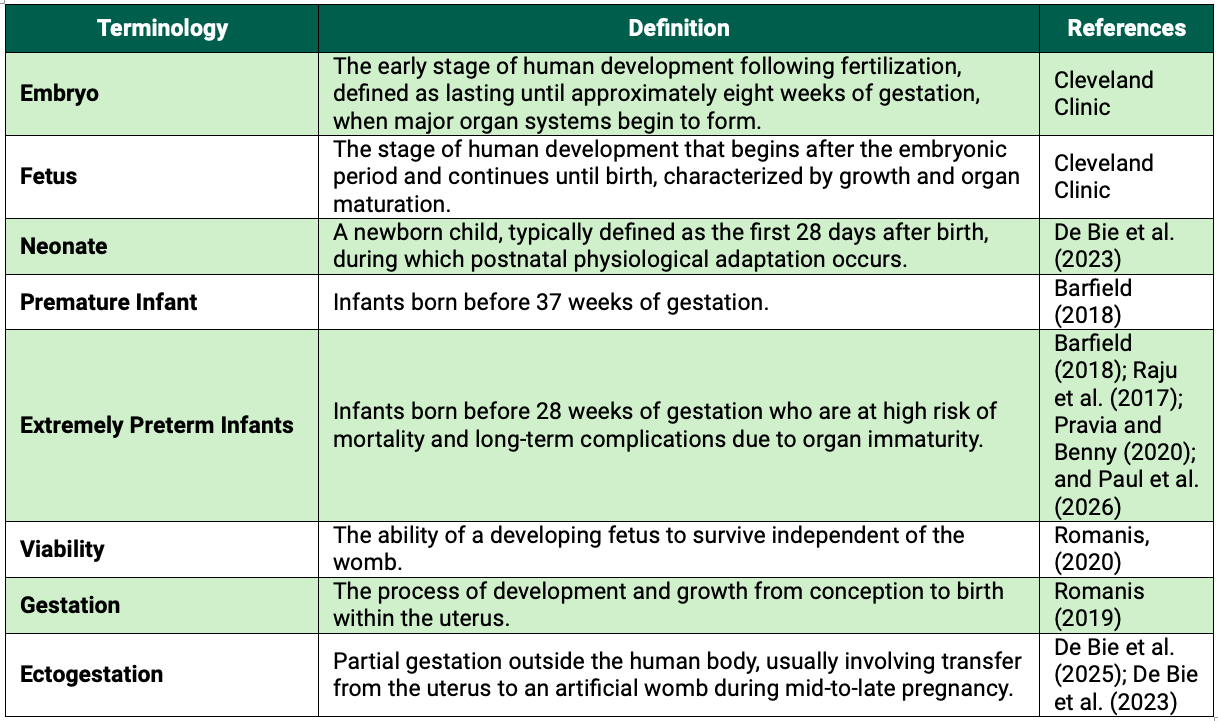
Globally, an estimated 15 million infants are born preterm each year, with related complications resulting in approximately 1 million annual deaths among children under the age of five.[1] In the United States, nearly 400,000 preterm births occur annually, and while premature birth is defined as a birth before 37 weeks, extreme prematurity typically is before 28 weeks of gestation.[2] Table 1 provides a complete list of key terms and their definitions as noted this report.[3]
Extreme prematurity remains a major contributor to neonatal morbidity and mortality worldwide. While the broader category of very preterm births — less than 32 weeks — constitutes a small percentage of total live births, it accounts for a disproportionate share of medical costs across preterm infant care and over half of all infant deaths.[4] Despite advances in neonatal intensive care, infants born at these early gestational ages continue to face significant health risks.
Table 1 — Definitions of Key Terms Related to Artificial Womb Technologies
In the immediate period after birth, extremely premature infants often experience complications related to underdeveloped organ systems, particularly the lungs, leading to respiratory distress and the need for intensive medical support.[5] Access to this level of care, however, is not uniform. Outcomes are influenced by medical complexity as well as the availability and accessibility of specialized neonatal intensive care units (NICUs), both geographically and financially.[6] Among survivors, extreme prematurity is strongly associated with long-term disabilities, such as cerebral palsy, cognitive impairment, chronic lung disease, and developmental delays.[7] These outcomes are partly driven by disrupted organ development during critical periods of growth, resulting in lasting physiologic vulnerabilities.[8]
Beyond early life, individuals born preterm face an increased risk of chronic conditions such as cardiovascular disease, diabetes, and pulmonary dysfunction.[9] These risks demonstrate that the effects of prematurity extend across the lifespan. These outcomes not only affect quality of life for individuals and their families but also contribute to a broader public health costs due to increased healthcare utilization and long-term support needs.[10] As a result, extreme prematurity remains a critical and largely unresolved challenge in neonatal care, underscoring the need for innovative approaches that can more fully and effectively support early human development.
Rationale for AWT
Current neonatal interventions for extreme prematurity have limited effectiveness because traditional hospital equipment cannot replicate the womb’s biological functions and conditions.[11] Existing approaches are designed to sustain life outside the womb rather than replicate the intrauterine environment required for continued organ maturation. For example, mechanical ventilation, while often necessary, can disrupt regular lung development and lead to injuries in immature lungs that are not yet structurally prepared for gas exchange. Prolonged exposure to mechanical ventilation is also associated with increased risk of bronchopulmonary dysplasia and adverse long-term health outcomes.[12] Similarly, incubators provide supportive care but cannot recreate the fluid-filled, low-resistance conditions essential for physiologic growth and continued development.[13] As a result, neonatal care often focuses on managing complications rather than preventing them, highlighting a fundamental gap in current treatment strategies.
Artificial womb technology (AWT) has emerged as a potential solution by aiming to replicate key aspects of the intrauterine environment and preserve fetal physiology during this critical developmental period.[14] These systems are designed to support the premature infant in a controlled, fluid-filled environment while providing oxygen and nutrients in a way that more closely mimics the physiology of gestation.[15] This allows for continued organ maturation, particularly in the lungs. By avoiding premature exposure to gas ventilation and supporting development in conditions that resemble the womb, AWT has the potential to reduce complications associated with extreme prematurity.[16] However, AWT is still an untested technology on humans, and due to the regulatory landscape and ethical questions, device manufacturers are unsure of how to proceed with clinical research.
AWT is distinctly designed for ectogestation or the continuation of development outside the womb after pregnancy has already begun.[17] It will not replace pregnancy entirely or sustain the complete development of a fetus — from conception to birth — outside the human womb. Thus, AWT is a tool to extend gestation and improve outcomes for extremely preterm infants.
Current State of AWT’s Functions and Models
AWT is intended to support extremely premature infants during a critical window when they are not yet ready to function independently.[18] Instead of relying on early ventilation and intensive support after birth, AWT maintains a form of continued gestational support that delays this transition. This has been described as providing a “bridge” to care, as it extends development beyond premature delivery until the infant is better equipped to tolerate standard neonatal treatment.[19]
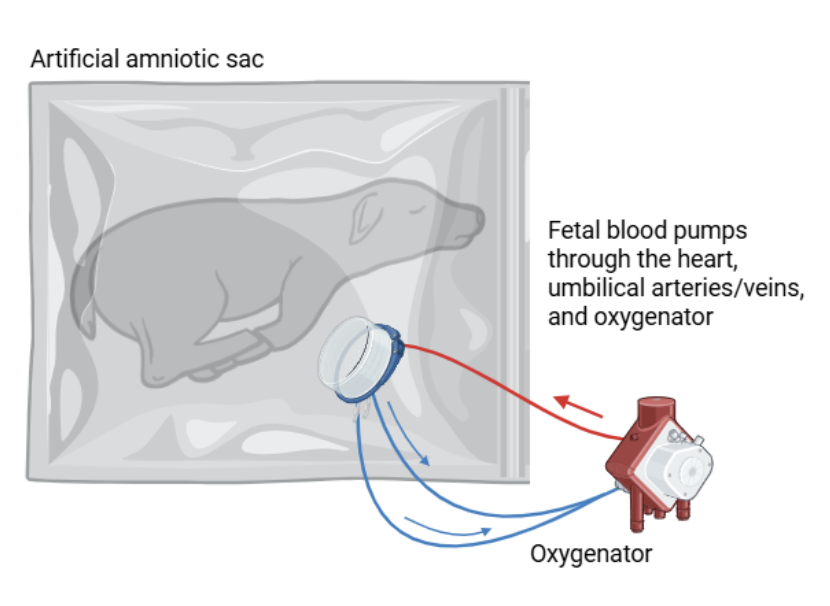
AWT keeps the infant in a sealed, fluid environment while circulating oxygen through the blood via the umbilical cord, without requiring the lungs to function immediately.[20] In comparison to currently available neonatal interventions, the system allows the heart and circulation to operate more akin to how they would during pregnancy, supporting ongoing organ development before full adaptation to life outside the womb. By shifting when and how this transition occurs, AWT offers a different, potentially less invasive approach from conventional neonatal care and may reduce the risks associated with extreme prematurity.[21]
AWT’s effectiveness has been demonstrated through preclinical studies using animal models. One of the most well-known AWT systems is the EXTra-uterine Environment for Neonatal Development (EXTEND), which was tested on fetal lambs to model human extreme prematurity.[22] In the EXTEND system, a fetal lamb was placed in a sealed, fluid-filled environment designed to mimic amniotic fluid and maintain regular fetal conditions during pregnancy (Figure 1).[23] This fluid environment helps preserve fluid-filled lungs and supports normal lung growth and development. The lamb is then connected through the umbilical cord to a pumpless system that supports circulation and oxygen exchange without requiring immediate lung function. Lambs were supported for up to four weeks with stable circulation, normal oxygenation, and continued growth and organ development. Researchers successfully transitioned some of the animals from the EXTEND system to conventional neonatal support. While the transitions demonstrated short-term survival after removal, long-term outcomes were not consistently achieved.
In addition to the EXTEND model, other research groups in countries such as Spain, Japan, Australia, Singapore, and the Netherlands are actively developing similar AWT systems, reflecting growing global interests in this field.[24] These findings suggest that AWT can maintain physiological stability and support ongoing development outside the womb. However, results remain limited to animal models.
Figure 1 — Diagram of the EXTra-uterine Environment for Neonatal Development (EXTEND) System Being Used on a Fetal Lamb
Despite promising progress, AWT remains in the early stages of development. Current systems require further refinement in circulation support and vascular access to ensure stable, long-term use.[25] For instance, the fluid environment does not yet fully replicate amniotic fluid within the womb and requires further optimization to better incorporate nutrients and bioactive growth factors important for fetal development. Furthermore, AWT has primarily been evaluated in otherwise healthy fetal lambs that are more developmentally mature than extremely premature infants that would receive this treatment.
Beyond AWT’s technical challenges, ethical concerns remain, including questions around consent, clinical decision-making, and its potential effects on the existing boundaries of viability and neonatal care. First-in-human (FIH) trials are expected within the next decade but will require careful oversight to ensure safety and ethical integrity.[26] As a result, the advancement of AWT raises critical questions that extend beyond scientific development and into policy and regulation.
Questions and Concerns for First-In-Human Trials
Expectations and Designations for FIH Clinical Trials
The U.S. Food and Drug Administration’s (FDA) Center for Devices and Radiological Health (CDRH) acts as the primary body responsible for the regulation of medical devices sold in the United States.[27] The FDA uses a three-tier classification system to define appropriate regulatory controls for devices. Regulatory controls are tightened from Class I to Class III.[28] AWT, categorized as Class III devices due to its nature as “a life supporting or life sustaining device,” would be subject to the highest level of scrutiny.[29] Class III devices require premarket approval by the FDA, issued on the basis of “sufficient valid scientific evidence to assure that the device is safe and effective for its intended use(s).”[30] The approval process also calls for the submission of evidence from nonclinical laboratory studies as well as clinical investigations.[31]
Current animal models of AWT have resulted in mixed safety and efficacy data.[32] Significant revisions to leading AWT models such as EXTEND are still needed prior to proceeding to FIH trials.[33] It is also unlikely that FIH trials will be or, even, could be implemented on a large-scale. Final refinements of the technology can only occur in human trials; however, the use of experimental technology on extremely premature infants remains ethically and socially controversial.
The CDRH’s Early Feasibility Study Program provides an alternate framework for FIH trials better suited to devices still in development, such as AWT.[34] Through the program, an early feasibility study is conducted with a small number of initial participants when a device cannot be further developed in nonclinical trials.[35] Yet, even under an early feasibility study, FIH trials of AWT are still expected to raise ethical, legal, and technical concerns.
Anticipated Challenges and Ambiguities for FIH Trials
As an innovative technology, AWT carries the potential to both benefit and harm extremely premature infants. AWT provides an alternative to continued gestation in the uterus in the event of health complications. However, the technology requires surgical extraction of the developing fetus, which carries risk. In addition, long-term implications of extra-uterine gestation using AWT are unknown.[36] In order to proceed with FIH trials, the potential benefits must outweigh the risks of harm.
Other ethical concerns are equity and access to care, as AWT may widen existing disparities in neonatal care.[37] Economic status or proximity to academic hospitals could affect individual and community inclusion in AWT FIH trials. With developing technologies such as AWT, no populations are intentionally or unintentionally excluded from data collection to ensure not only equitable access to testing but also further support the broad applicability of the study’s findings, even when the sample size is small. AWT can increase the chance of survival of extremely preterm infants; thus, increased consideration and awareness is needed when deciding which patients have access to this technology during FIH trials.
The regulatory framework and legal definitions established to guide FIH clinical trials of AWT also have the potential to affect reproductive autonomy and abortion access downstream. For example, defining viability in clinical trials could shape or be shaped by abortion and fetal personhood laws. Several states’ abortion laws, such as those in Missouri, permit the termination of pregnancy before a fetus is deemed viable, or at “that state of fetal development when life of the unborn child may be continued indefinitely outside the womb by natural or artificial life-supportive systems.”[38] While not designed for this purpose, AWT could lower the limit of viability, limiting individuals’ access to legal abortion and reproductive autonomy.[39] If able to survive independently of the womb, fetuses could be assigned a different legal status, depending on state and federal legislative interpretations.
Clear definitions of study protocols would alleviate many of these ethical concerns. Monitoring outcomes and choosing investigators with expertise in neonatal care are critical to minimizing harm to infants and pregnant individuals. Defining clear patient selection criteria could promote equitable access to AWT care, and selecting specific study sites for FIH trials could help mitigate potential impacts on the reproductive rights of women.
Recent Dialogue and Regulatory Standstill
One of the most notable technical challenges that must be addressed before conducting an early feasibility study for FIH trials of AWT is study design. The FDA encouraged further discussions on specific aspects of AWT FIH study design components: patient selection criteria; study site identification and choice of clinical investigators; scheduling of follow-up assessments; expectations for reporting adverse events to the FDA; and procedures for assessing patient outcomes.[40]
These considerations were previously discussed during the FDA Pediatric Advisory Committee (PAC) meeting in 2023, but no consensus was reached.[41] Reconvening the PAC for further discussion would help experts reach consensus on early feasibility study design, a necessary first step toward FIH trials for AWT.
Recommendations
The FDA interdisciplinary PAC should convene to address concerns and determine methods for transitioning from animal to FIH trials.
In the 2023 PAC meeting, the goal was to “discuss considerations for development plans for establishing safety and effectiveness of [AWT] devices intended to treat extremely premature infants, including regulatory and ethical considerations for [FIH] studies.”[42] However, their work remains incomplete. A second PAC meeting is needed to fully develop a framework for FIH trials for AWT.
1. AWT poses several biological, logistical, and ethical questions; therefore, diverse perspectives should be represented and considered in the PAC meeting.
For continuity, those participants of the 2023 PAC should be invited to continue the dialogue pertaining to AWT. In addition, other interested stakeholders that should be included in the committee or as an observers, including, but not limited to: members of Vitara Biomedical, Inc. (a private medical technology company aiming to translate AWT from academic research to clinical use); members of the EXTEND team; neonatal care providers (such as neonatal-perinatologists, obstetricians, and NICU nurses who would be responsible for the use and implementation of AWT); bioethicists; Institutional Review Board (IRB) members; potential candidates and families; insurance companies; and hospital administration.[43]
2. The PAC chairperson should compile and disseminate relevant literature and established committee goals prior to the meeting.
The majority of the materials for the 2023 PAC meeting focused on introducing members to the current standard of care, providing background information on AWT, and briefly considering some of its ethical implications. To further develop the PAC’s consideration of AWT, briefing materials for the second meeting should be updated to provide context and support for how an early feasibility study for AWT can be implemented.
Prior to meeting, committee members should be well-informed of AWT. To accomplish this, both returning and new committee members should review the 2023 meeting materials and more recent literature prior to the meeting. Areas of focus that should be highlighted include: the scientific methodology of AWT, AWT in animal models, medical considerations for AWT transitioning to humans, and ethical considerations for a FIH trial of AWT.
By providing committee members with comprehensive materials prior to the meeting, committee members should be knowledgeable of the current state of AWT, its implications, and its potential benefits and harms. This approach would allow the PAC members to have enhanced brainstorming sessions about the feasibility and implementation of FIH trials for AWT.
3. The PAC should identify the range of appropriate FIH early feasibility study participants (e.g., gestational age, clinical criteria, and exclusionary criteria).
Given the high likelihood of human trials, the PAC should focus on specifying participant parameters for clinical trials. The reason for focusing on this protocol detail is twofold.
First, the answer, or range of potential answers, to what participants should be included in human clinical trials will inform current animal trials and elucidate the most appropriate data to collect. For example, if the first human trials are limited to 22–23-week-old fetuses, rather than 24–25 weeks, current researchers can tailor their animal experiments to align most productively with the boundaries of the predicted human trials.
Secondly, despite seeming like a straightforward study design question, establishing the target population of AWT is a multifaceted debate. We recommend that the PAC focus on three main interdependent aspects of participant parameters: gestational age, clinical criteria, and exclusionary criteria.
When determining the specific gestational age group for future FIH trials, scholars disagree about whether younger (22–23 weeks) or older (24–25 weeks) extremely premature infants should be prioritized in the technology’s first applications.[44] Younger extremely premature infants stand to gain the most in absolute terms because conventional neonatal care currently offers them very limited survival prospects. For some extremely premature infants, AWT may be the only potential route to survival. However, these patients are extremely fragile, and any risks from experimental intervention will be significantly magnified.
On the contrary, older extremely premature infants have substantially higher survival odds with current NICU care. AWT might reduce long-term morbidities, but the added value of an unproven technology must be weighed against the risk of exposure to an unknown device.[45] The better a patient’s baseline prognosis under standard care, the more difficult it becomes to justify moving them to a risk-intensive experimental protocol
Additionally, defining an appropriate patient population for early feasibility studies is complicated by the limitations of gestational age as a prognostic marker. Survival and morbidity in the periviable period are influenced by a combination of factors, such as sex, size, and plurality (if more than one fetus is in utero).[46] Consequently, relying on a rigid gestational window is an insufficient metric for trial conclusion. Determining general fetal viability — which carries various connotations — with or without AWT, is nearly impossible to predict due to individuality and varying prognostic markers during gestation.[47] Thus, considering what fetal viability means in AWT clinical trials, both clinically and ethically, should be a necessary point of discussion for the PAC members during the meeting.
Trial protocols should also account for technical requirements, such as umbilical vessel access.[48] In parallel, strict exclusion criteria are essential to prevent unsafe or futile interventions. Potential exclusion criteria include: several coagulopathies, systemic maternal infection, major fetal malformations, or significant umbilical cord anomalies.[49] Both clinical requirements and exclusion criteria would ensure that AWT is used as a rescue modality for viable fetuses rather than an intervention for patients where the technology would likely fail to provide benefit.
Alongside maternal and fetal conditions, delivery mode is a significant variable. For models such as EXTEND, surgical delivery of the fetus via cesarean section is required to keep membranes intact and limit exposure to air. This raises two linked questions: whether cesarean delivery should be a mandatory inclusion criterion, and whether only patients in whom a cesarean would be clinically indicated, independent of AWT, should be eligible. Both questions raise concerns about population inclusion and individual autonomy.
4. The PAC should outline early feasibility study protocols for establishing informed consent standards, weighing opposing maternal-fetal indications, and withdrawing AWT support.
AWT touches on a myriad of ethical issues, many of which will take years of dialogue, research, and stakeholder engagement to reach consensus. However, for this PAC meeting, three critical bioethical debates are the most important for discussion: establishing informed consent standards, weighing opposing maternal-fetal indications, and withdrawing AWT support. These were chosen because consensus is required before designing human trials.
While established work on counseling for fetal therapy trials and periviable birth inventions can provide a partial template for AWT consent standards, it should be adapted to align with the specific functions and concerns of AWT.[50] Determining standards for obtaining informed consent for AWT is especially difficult given the technology’s unique factors. It involves multiple research participants (the pregnant individual, the fetus, and potentially the birth partner), and the decision to consent to use AWT would likely be made under time pressure and emotional distress. These factors complicate decisions regarding authority and parental roles, as well as the timing and feasibility of any clinical trials.[51]
AWT human trials raise significant questions about how to weigh potential benefits to the fetus against risks to the pregnant individual. Unlike standard NICU interventions, which occur after birth, AWT requires surgery and exposes the patient to research-related burdens for another’s potential benefit. Additionally, cases of maternal-fetal conflict and the weighing of risk-benefit assessment are further complicated by the lack of consensus on the legal and moral status of the fetus.[52] Medical best practices and standards of care should be thoroughly defined and outlined in PAC guidance to ensure that researchers, clinicians, and ethics committees abide by established processes rather than left to improvise on a case-by-case basis.
Criteria for withdrawing AWT support should also be clearly defined before trial commencement. If a neonate supported by AWT experiences technical failure of the system or develops a condition that renders the intervention futile or harmful, transition to conventional intensive care or palliative management would be necessary. Two broad scenarios should be considered: transfer to conventional neonatal care and end-of-life decisions. These criteria will, again, be further complicated by the lack of consensus on the legal and moral status of the fetus.[53] Establishing such measures and definitions should be determined in advance of any FIH trials to ensure end-of-life decisions are grounded in the best interests of the fetus and family, not solely the research.
Technical feasibility alone does not suffice to make AWT ethically permissible. The PAC should therefore articulate trial-level ethical protocols in three domains: informed consent, adjudication of maternal-fetal conflicts, and withdrawal of support. Because these questions touch on deeply held social values, the PAC should initiate deliberations early, rather than considering them once trials are underway.
Conclusion
The current lack of guidance over the clinical use of AWT could permit manufacturers to unilaterally determine the usage criteria for this technology as it progresses from animal studies to FIH trials. This report considers several of the most prominent ethical consequences of implementing AWT FIH trials: benefit versus harm to the fetus, reproductive rights, and ongoing equity and access to care. Proper consideration should be given to these consequences when developing regulatory policy to prevent future criticisms and repercussions that could stall or halt the development of FIH trials for AWT. As a presently developing technology, establishing the considerations and protocols for human trials of AWT offers a unique opportunity to shape the regulatory policy for the trials themselves.
The recommendations proposed in this report encourage stakeholders to preemptively address the multitude of technical, ethical, and legal debates surrounding the use of AWT for humans. Altogether, the authors recommend that the FDA reconvene an interdisciplinary PAC and follow these specific proposals:
- The PAC chairperson should proactively disseminate relevant literature about FIH trials for AWT to the committee prior to the meeting to ensure productive, informed conservation.
- The PAC should meet with the specific goal of reaching consensus on early feasibility study protocols, such as gestational age and clinical criteria. Outlining these regulatory protocols ahead of FIH trials would help curtail the need for future revisions due to unaddressed and overlooked ethical concerns.
Acknowledgements
The authors would like to express their sincere gratitude to Alicia L. Johnson, Ph.D., and Sonakshi Bhalla for their support in the production of this report. Additionally, the authors would like to thank Ana Iltis, Ph.D., and Miranda Waggoner, Ph.D., for sharing their expertise and guidance while developing these recommendations. This report was part of Rice University course BIOS 370/670: “Current Biosciences and Health Policy Topics.”
Notes
[1] Wanda D. Barfield, “Public Health Implications of Very Preterm Birth,” Clinics in Perinatology 45, no. 3 (2018): 565–77, https://doi.org/10.1016/j.clp.2018.05.007.
[2] Barfield; Tonse N.K. Raju et al., “Long-Term Healthcare Outcomes of Preterm Birth: An Executive Summary of a Conference Sponsored by the National Institutes of Health,” The Journal of Pediatrics 181 (2017): 309–318.e1, https://doi.org/10.1016/j.jpeds.2016.10.015.
[3] For a comprehensive overview of fetal development and associated terminology, see Cleveland Clinic, “Fetal Development,” last modified March 19, 2024, https://my.clevelandclinic.org/health/articles/7247-fetal-development-stages-of-growth.
[4] Barfield.
[5] Raju et al.
[6] Scott A. Lorch et al., “Access to Risk-Appropriate Hospital Care and Disparities in Neonatal Outcomes in Racial/Ethnic Groups and Rural-Urban Populations,” Seminars in Perinatology 45, no. 4 (2021): 151409, https://doi.org/10.1016/j.semperi.2021.151409.
[7] Barfield.
[8] Lorch et al.
[9] Raju et al.; Cristina I. Pravia and Merline Benny, “Long-Term Consequences of Prematurity,” Cleveland Clinic Journal of Medicine 87, no. 12 (2020): 759–67, https://doi.org/10.3949/ccjm.87a.19108.
[10] Barfield; Raju et al.
[11] Jennifer Paul et al., “Artificial Womb Technologies — Innovation at the Edge of Viability: Ethical Considerations,” Journal of Pediatric Surgery 61, no. 2 (2026): 162827, https://doi.org/10.1016/j.jpedsurg.2025.162827.
[12] Felix R. De Bie et al., “Artificial Womb Technology — A More Physiologic Solution to Treating Extreme Prematurity,” European Journal of Obstetrics & Gynecology and Reproductive Biology: X 25 (March 2025): 100359, https://doi.org/10.1016/j.eurox.2024.100359; Samuel J. Gentle et al., “Decreasing Exposure to Mechanical Ventilation in Extremely Preterm Infants,” Pediatrics 156, no. 6 (2025): e2024070239, https://doi.org/10.1542/peds.2024-070239.
[13] Paul et al.
[14] Paul et al.; De Bie et al., “Artificial Womb Technology.”
[15] De Bie et al., “Artificial Womb Technology.”
[16] De Bie et al., “Artificial Womb Technology.”
[17] De Bie et al., “Artificial Womb Technology”; De Bie et al., “Ethics Considerations Regarding Artificial Womb Technology for the Fetonate,” The American Journal of Bioethics 23, no. 5 (2023): 67–78, https://doi.org/10.1080/15265161.2022.2048738.
[18] De Bie et al., “Artificial Womb Technology”; Kalkidan A. Molla, “Background on Artificial Womb Technology,” presentation at the Pediatric Advisory Committee (PAC) meeting, U.S. Food and Drug Administration (FDA), September 19, 2023, https://www.fda.gov/media/172252/download.
[19] Molla, slide 5.
[20] De Bie et al., “Artificial Womb Technology.”
[21] De Bie et al., “Artificial Womb Technology.”
[22] De Bie et al., “Artificial Womb Technology”; Emily A. Partridge et al., “An Extra-Uterine System to Physiologically Support the Extreme Premature Lamb,” Nature Communications 8, no. 1 (2017): 15112, https://doi.org/10.1038/ncomms15112.
[23] De Bie et al., “Artificial Placenta and Womb Technology: Past, Current, and Future Challenges Towards Clinical Translation,” Prenatal Diagnosis 41, no. 1 (2021): 145–58, https://doi.org/10.1002/pd.5821; Max Kozlov, “Human Trials of Artificial Wombs Could Start Soon. Here’s What You Need to Know,” Nature 621 (September 2023): 458–60, https://doi.org/10.1038/d41586-023-02901-1.
[24] Kozlov.
[25] Patridge et al.; De Bie et al., “Artificial Placenta and Womb Technology.”
[26] Kozlov.
[27] FDA, “Overview of Device Regulation,” last modified February 2, 2026, accessed July 2026, https://www.fda.gov/medical-devices/device-advice-comprehensive-regulatory-assistance/overview-device-regulation.
[28] FDA, “Overview of Device Regulation.”
[29] Molla, slide 7.
[30] FDA, “Premarket Approval (PMA),” last modified May 16, 2019, accessed July 2026, https://www.fda.gov/medical-devices/premarket-submissions-selecting-and-preparing-correct-submission/premarket-approval-pma.
[31] FDA, “Premarket Approval (PMA).”
[32] Philip Hunter, “Exogestation for Treating Premature Births and Congenital Diseases,” EMBO Reports 25 (January 2024): 17–20, https://doi.org/10.1038/s44319-023-00022-4.
[33] Hunter.
[34] Molla, slides 9–10.
[35] Molla, slide 10.
[36] Hunter.
[37] Paul et al.
[38] Statues of Missouri, Title XII, § 188.015 (2019), https://revisor.mo.gov/main/OneSection.aspx?section=188.015&bid=47547, qtd. in Elizabeth Chloe Romanis, “Is ‘Viability’ Viable? Abortion, Conceptual Confusion and the Law in England and Wales and the United States,” Journal of Law and the Biosciences 7, no. 1 (2020): lsaa059, 8, https://doi.org/10.1093/jlb/lsaa059.
[39] Srishti Hukku et al., “‘Somebody Wants an Abortion, Nobody Should Override Their Decision’: Modern Canadian Perspectives on Abortion in Relation to Artificial Womb Technology,” SSM - Qualitative Research in Health 7 (June 2025): 100529, https://doi.org/10.1016/j.ssmqr.2025.100529.
[40] Molla, slide 11.
[41] FDA, “2023 Meeting Materials, Pediatric Advisory Committee,” last modified December 19, 2023, accessed July 2026, https://www.fda.gov/advisory-committees/pediatric-advisory-committee/2023-meeting-materials-pediatric-advisory-committee.
[42] FDA, “Final Meeting Agenda,” Pediatric Advisory Committee, September 19, 2023, https://www.fda.gov/media/172474/download?attachment.
[43] Vitara Biomedical Company, “About,” accessed July 2026, https://www.vitara.com/about.
[44] Alice Cavolo and Dario Pizzolato, “Ethical Reflections on Organizing the First Human Trial of Artificial Womb Technologies,” Prenatal Diagnosis 44, no. 3 (2024): 336–42, https://doi.org/10.1002/pd.6521; Mark R. Mercurio and Kelly M. Werner, “Thinking Inside the Bag: Patient Selection, Framing the Ethical Discourse, and the Importance of Terminology in Artificial Womb Technology,” The American Journal of Bioethics 23, no. 5 (2023): 79–82, https://doi.org/10.1080/15265161.2023.2191056.
[45] Wiku Andonotopo et al., “Artificial Wombs in Perinatal Medicine: A Transformative Frontier in Neonatal Care and Bioethics,” Journal of Perinatal Medicine (2025), https://doi.org/10.1515/jpm-2025-0290.
[46] Paul et al.
[47] Romanis.
[48] Andonotopo et al.
[49] Andonotopo et al.
[50] Andonotopo et al.
[51] Paul et al.
[52] Cavolo and Pizzolato.
[53] Werner and Mercurio, “Ethical Considerations in the Use of Artificial Womb/Placenta Technology,” Seminars in Perinatology 46, no. 3 (2022): 151521, https://doi.org/10.1016/j.semperi.2021.151521.
This publication was produced by Rice University’s Baker Institute for Public Policy. Wherever feasible, the material was reviewed by outside experts prior to release. Any errors or omissions are solely the responsibility of the author(s).
This material may be quoted or reproduced without prior permission, provided appropriate credit is given to the author(s) and Rice University’s Baker Institute for Public Policy. The views expressed herein are those of the individual author(s) and do not necessarily represent the views of Rice University’s Baker Institute for Public Policy.


