


Author(s)

This article is also featured in Energy Insights, which reflects a sample of ongoing research across the Center for Energy Studies’ diverse programmatic areas, all addressing the ever-evolving energy challenges across Texas, the U.S., and the globe. Read more from the inaugural edition.
Introduction
The recent five-year Iran-Iraq gas deal, where Iran supplies Iraq with 50 million cubic meters per day of natural gas, and the diplomatic reestablishment between Iran and Saudi Arabia relations, which were broken in 2016, are indications of endeavors toward more regional cooperation in facing vital concerns, such as energy and water challenges.[1] Despite geopolitical pressures, such as U.S. opposition to such agreements, bilateral and multilateral agreements are expected to develop between Persian Gulf states to support their economic stability and vital well-being, which are the key drivers in seeking such cooperation.
Regional Energy Cooperation
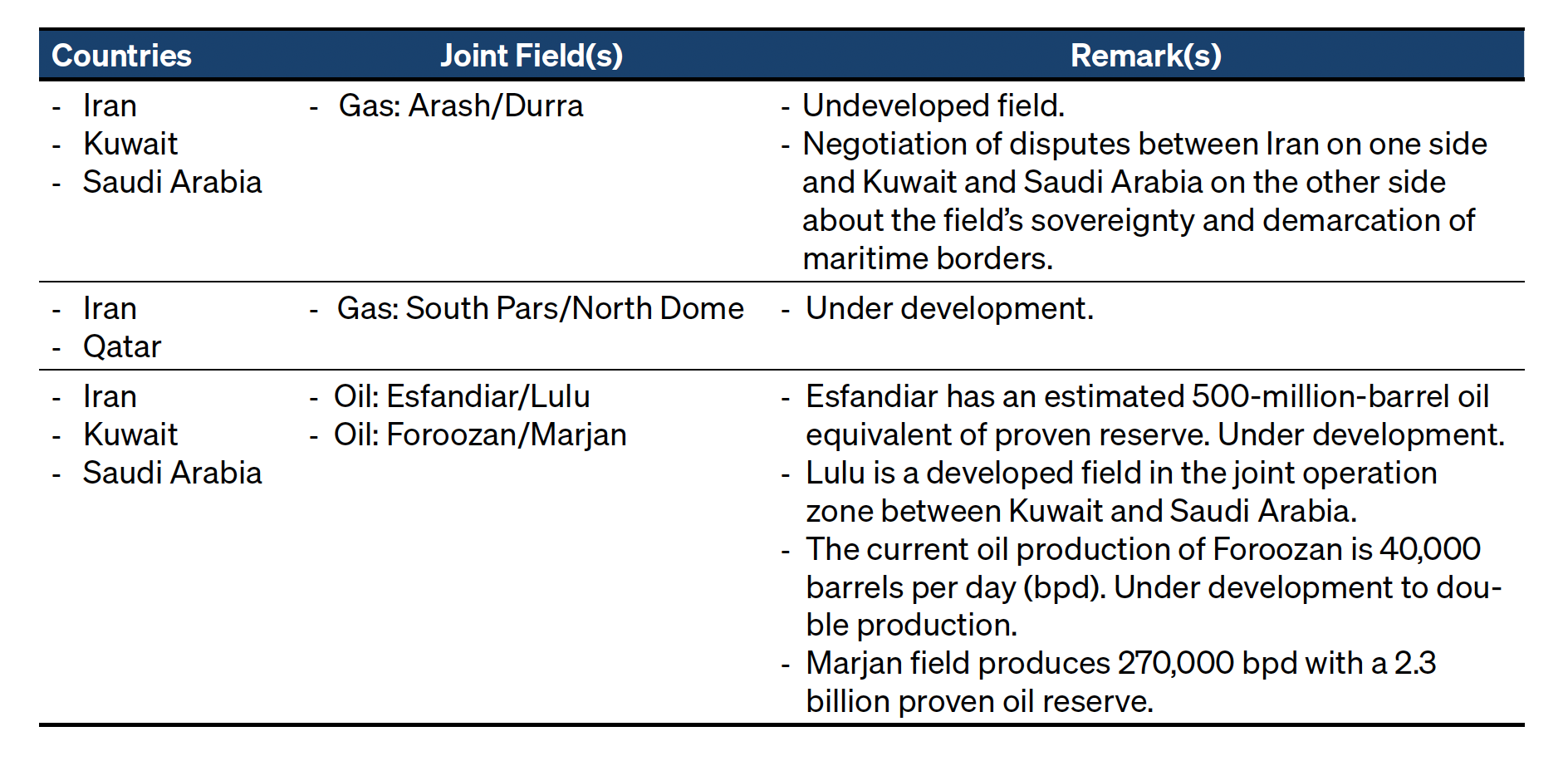
The Gulf countries — Bahrain, Iran, Iraq, Kuwait, Oman, Qatar, Saudi Arabia, and the United Arab Emirates (UAE) — held about 48% and 40% of the world’s proven oil and natural gas reserves, respectively, at the end of 2020.[2] They share several joint oil and gas fields that are expected to witness active joint development in the future (Table 1). Several Gulf countries have either not fully developed some of their energy production assets, or do not have sufficient resources to develop them, especially in the natural gas sector.
Iraq, Kuwait, and the UAE are net gas importers and their imports in 2022 constituted 50%, 40%, and 20%, respectively, of their gas consumption.[3] Iraq imports gas from Iran, and the UAE sources gas from Qatar through the Dolphin pipeline. Kuwait is the only country where about 46% of its total imported gas comes from external regions, i.e., Africa, Europe, and North and South America.[4] In early 2022, Kuwait signed a memorandum of understanding with Saudi Arabia to develop the joint offshore Arash/Durra gas field in the partitioned neutral zone. However, Iran has objected to such an agreement and demanded its share in the Arash/Durra gas field. Most likely the exploitation of the Arash/Durra field will not materialize in the short-term future until an agreement on the demarcation of maritime borders among the three nations is reached. Driven by their economic development and energy resource needs, these countries will eventually end up in joint rather than competitive exploitation of resources in this region.
Table 1 — Joint Gas and Oil Fields of Gulf Countries
Additional regional cooperation is expected to be developed through power grid interconnection. Currently, part of the Gulf region is interconnected through a power grid — operated by the Gulf Cooperation Council Interconnection Authority (GCCIA) — connecting Oman through the UAE to Saudi Arabia, Qatar, Bahrain, and Kuwait. Expansion plans for the GCCIA are ambitious. Iraq recently signed an agreement with the GCCIA to become part of the grid, and there are aims to extend to Eurasia and East Africa.[5]
GCCIA expansion that includes countries such as Iran and Turkey would provide reliability and stability to domestic power grids by facilitating greater arbitrage across regions. It could also serve as an additional pillar for the Gulf region to become a hub in producing and exporting clean energy to the world. The region’s geographic location makes it among the highest annual solar energy recipient of more than 2100 kilowatt hours (kWh) and its location is also blessed with wind speeds that can reach about 10 meters per second (m/s).[6] These clean energy resources can be exploited regionally and exported to other regions. Direct economic and spillover benefits would be realized across several economic sectors that are vital for regional vitality, including energy, manufacturing, information technology and communication services, etc.[7]
In 2021, natural gas and oil products dominated the energy mix for power generation in the Gulf region with shares of 74% and 23%, respectively; hydro and other renewables shares were 2% and 1%.[8] Given the partial present and full future power interconnection grid, the region’s exploitation of renewable energy in power generation and water desalination will greatly benefit mitigating emissions. Locally, steps toward expanding renewable deployment have been witnessed in the region’s largest and major player countries — Iran, Saudi Arabia, and the UAE. Common goals to reduce emissions can be another driver of regional cooperation in the long term.
Regional Water Network
All Gulf countries — except Iran — have under 1000 cubic meters per capita per year of natural renewable freshwater. This makes these countries’ water poor. Therefore, they are compelled to depend on energy-intensive seawater desalination to meet their potable water demand. Despite Iran’s abundance of natural freshwater, there are currently 95 water desalination plants with a total capacity of 638,000 cubic meters per day, operational or being constructed across the country to address the challenges of unprecedented levels of drought.[9] In addition, Iran plans to build water corridors linking the shores of Iran’s southern gulf to those of its northern Caspian Sea. The plan will connect the Strait of Hormuz to the central-eastern province of Kerman, transfer water to Hormozgan province on Iran’s gulf shores as well as eastern provinces and cities, bring water from the Gulf of Oman to the central province of Isfahan, and transfer water to Zahedan and Zabul in the southeastern Sistan and Baluchestan province.[10]
In Iraq, despite the presence of the Tigris and Euphrates Rivers, the country faces rising freshwater shortages. To meet the water demand, Iraq built a reverse osmosis plant to desalinate brackish and saline river water 20 km north of Basra (not seawater from the Gulf). Iraq also has a plan to build a seawater desalination plant in the southern Basra province.[11]
In 2000, the Arab Gulf states of the Gulf Cooperation Council (GCC) leaders decided to carry out a water interconnection study. The water interconnection network would supply freshwater to all GCC states from desalination plants that would be built on the Gulf of Oman and Arabian or Persian Gulf. Three desalination plants were proposed to be in Sohar in the Gulf of Oman, Sela in the UAE, and Khafji in Saudi Arabia. No further actions were taken until 2012 when the 14th GCC Consulting Meeting was held in Riyadh, Saudi Arabia, when the GCC leaders decided to carry out an additional study taking into account the outcomes of previous studies. A consulting company was awarded and executed the study.[12] The project had been in stagnation without any tangible actions since 2013. It is worth noting that in the early 2000s, Iran proposed to supply Kuwait with 200 million gallons per day of fresh water from the Karun River through land and subwater 550-km pipeline. Deal negotiations between the Iranians and Kuwaitis have stopped since 2006 due to political disagreements and tensions between GCC states and Iran.[13]
Given the critical water poverty, and the Gulf states’ experience in operating and planning seawater desalination, water treatment, and water resources management and freshwater transmission across the Gulf region, the region, eventually, is expected to see bilateral talks for water supply deals within the short-term future. Within the long-term future, a freshwater transmission network across the western Gulf bank region is likely to be materialized.
What To Expect
There are substantial regional challenges faced with regard to natural resource development and use, electricity generation and transmission development, and water availability across the Gulf region. Challenges generally bring opportunities, and there are significant opportunities to leverage the combined interests of countries across the region to attain a platform for regional growth. It remains to be seen to what extent some of the issues outlined herein — joint oil and gas field development, regional expansion of electricity grid interconnection, and joint water development and distribution — are fully capitalized for a Pareto-improving outcome. All the ingredients are in place for such outcomes, and there is certainly interest in achieving them. So, expect steps to be taken that improve overall regional well-being, although not likely all at once, even if other geopolitical issues at the root of regional conflicts remain.
< Previous article | Next article >
Notes
[1] Nayera Abdallah, “Iraq Signs 5-Year Gas Supply Deal with Iran, Says State Media,” Reuters, last modified March 27, 2024, https://www.reuters.com/business/energy/iraq-signs-5-year-gas-supply-deal-with-iran-says-state-media-2024-03-27/.
[2] Energy Institute, Statistical Review of World Energy, 2024, https://www.energyinst.org/statistical-review.
[3] Osamah A. Alsayegh, “The Case of Cooperation on the Energy Transition in the Gulf,” Bourse & Bazaar Foundation, April 10, 2024, https://www.bourseandbazaar.com/articles/2024/4/10/the-case-for-cooperation-on-the-energy-transition-in-the-gulf.
[4] Kuwait Institute for Scientific Research, Kuwait Energy Outlook 2023, Kuwait Foundation for the Advancement of Sciences, https://www.kfas.org/Publications/KEO2023.
[5] Ahmed Al-Ebrahim, “The GCC Interconnection: Supporting Energy Efficiency in the GCC” (PowerPoint Presentation, 1st IEF-EU Energy Day, Riyadh, Saudi Arabia, February 14, 2017, https://www.ief.org/_resources/files/events/1st-ief-eu-energy-day/1st-ief-eu-energy-day---gccia-perspective.pdf).
[6] “Global Solar Atlas,” Energydata.info, https://globalsolaratlas.info/map; “Global Wind Atlas,” Energydata.info, https://globalwindatlas.info/en/.
[7] Alsayegh, Kristian Coates Ulrichsen, Jim Krane, and Ana Martín Gil, “Exploring the Energy Transition and Net-Zero Strategies of Gulf Oil Producers” (Houston: Rice University’s Baker Institute for Public Policy, May 11, 2023), https://doi.org/10.25613/1XGY-DF16.
[8] International Energy Agency (IEA), “Data and Statistics,” https://www.iea.org/data-and-statistics.
[9] Gabriel Collins, “Iran’s Looming Water Bankruptcy” (Houston: Rice University’s Baker Institute for Public Policy, April 4, 2017), https://www.bakerinstitute.org/research/irans-looming-water-bankruptcy.
[10] Banafsheh Keynoush, “With the Hope Line, Iran Aims to Boost Seawater Transfer to Fight Growing Drought,” Middle East Institute, June 9, 2021, https://www.mei.edu/publications/hope-line-iran-aims-boost-seawater-transfer-fight-growing-drought; “Desalination Plants Capacity to Be Raised by 400,000 Cubic Meters,” Tehran Times, January 8, 2023, https://www.tehrantimes.com/news/480587/Desalination-plants-capacity-to-be-raised-by-400-000-cubic-meters.
[11] Robert Tollast, “Iraq and The Desalination Revolution: First Steps, Future Trends,” Iraq Energy Institute, May 1, 2020, https://iraqenergy.org/2020/05/01/iraq-and-the-desalination-revolution-first-steps-future-trends/; “Iraq Initiates Enormous Desalination Project,” Smart Water Magazine, August 31, 2023, https://smartwatermagazine.com/news/smart-water-magazine/iraq-initiates-enormous-desalination-project.
[12] “Water Interconnection Project,” Secretariate General of the Gulf Cooperation Council, Riyadh, Kingdom of Saudi Arabia, 2013, accessed December 28, 2022, bit.ly/46ZJiYQ.
[13] M. Eid, “Water and Security in the Arabian Gulf — A Challenging Strategic Relation,” Strategic Report 16, Center for Gulf and Arabian Peninsula Studies, Kuwait, 2021 (in Arabic).
This material may be quoted or reproduced without prior permission, provided appropriate credit is given to the author and Rice University’s Baker Institute for Public Policy. The views expressed herein are those of the individual author(s), and do not necessarily represent the views of Rice University’s Baker Institute for Public Policy.


