


Rice University’s Baker Institute for Public Policy welcomed dignitaries from the United States, Cyprus, Greece, and Israel on June 11 to mark the launch of the Eastern Mediterranean Energy Center (EMEC), a new initiative focused on advancing energy security, regional stability, and international collaboration.
U.S. Secretary of Energy Chris Wright, with the Minister of Energy, Commerce and Industry of the Republic of Cyprus Michael Damianos, Minister of Environment and Energy for Greece Stavros Papastavrou, Israeli Ambassador to the United States Yechiel Leiter, and Rice University President Reginald DesRoches signed a declaration of intent (DOI) to establish the EMEC. The agreement establishes a framework for cooperation among the four nations and advances a key initiative envisioned in the Eastern Mediterranean Security and Energy Partnership Act of 2019.
As the Eastern Mediterranean has become increasingly important to the future of the global energy markets and energy security, basing EMEC in Houston connects regional expertise with a global ecosystem to create new opportunities for research, dialogue, and collaboration that extend far beyond national borders.
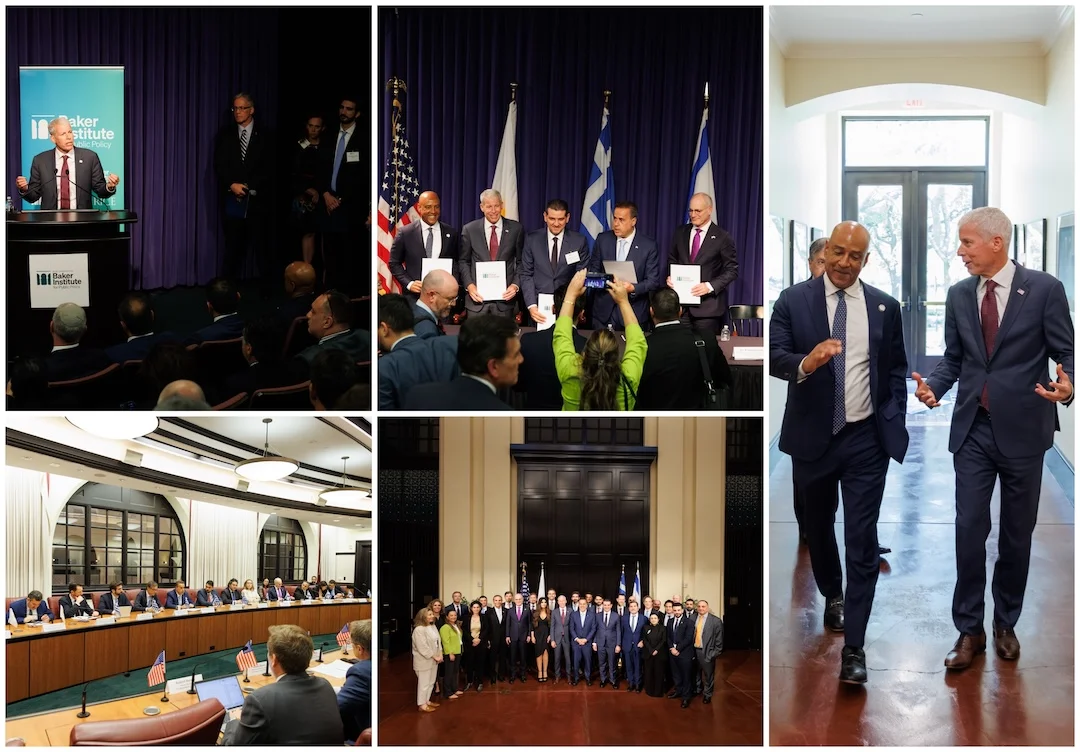
As one of the nation’s leading research universities, Rice is uniquely positioned at the intersection of academic excellence and energy leadership. Located in Houston, the energy capital of the world, the university has long approached complex global challenges through a combination of interdisciplinary research, international partnerships, and practical solutions that inform policy and action, said Rice President Reginald DesRoches.
“That philosophy was reflected in our strategic plan, Momentous, which prioritizes cutting-edge research and partnerships across academia, industry, and government to create resilient, efficient, and secure energy systems,” DesRoches said. “Today’s launch is a powerful example of that commitment, drawing on the Baker Institute’s internationally recognized expertise in energy markets and policy, and its ability to convene leaders to address complex global challenges.
“For decades, the Baker Institute’s Center for Energy Studies has earned international recognition for bringing together rigorous scholarship, thoughtful policy analysis, and leaders from across the energy sector to tackle some of the world’s most consequential energy challenges. Its reputation for objective, data-driven research and convening diverse perspectives makes it an ideal place for this new center to flourish.
Through the partnership, the center will play an important role in advancing energy security, regional stability, and technological cooperation among the United States, Greece, Cyprus, and Israel. EMEC aims to foster innovation, research, and policy analysis to enhance energy infrastructure and connectivity, which can provide not only the potential for new energy projects, but stabilization of an important region.
“This is a dynamic field,” said David Satterfield, director of the Baker Institute and former U.S. ambassador to Turkey and Lebanon. “The East Med has enormous further potential, not just for development, for coordination of development. It is a positive thing for energy, it’s a positive thing for industry, for all of the three states represented here today. It’s good for the region in a geopolitical sense as well. It provides a stabilization based upon the pragmatic and integrated development and distribution of energy resources, and that is a very good thing indeed. The Center for Energy Studies (CES), which Ken Medlock heads here, has long been a leader not just in the United States but globally in discussion of policy issues, including the East Med. We are delighted to be able to deepen our engagement on all of this.”
The partnership will support collaboration on shared priorities, including natural gas development, U.S. LNG infrastructure, energy transportation networks, grid reliability, critical infrastructure resilience, and emerging technologies. It will also facilitate scientific and technical exchanges, research partnerships, workforce development initiatives, and engagement with industry stakeholders.
“We need to use commerce to suppress and surpass conflict — that is the way to bring nations together in geopolitical tensions between countries,” Wright said. “You think of it as zero sum, there’s a winner and a loser, and both sides want to be the winner. Ultimately, one side will be the winner, one side will be the loser. Maybe more objectively, both sides lose, but one loses more than the other. In commerce, it’s entirely different, and commerce is voluntary exchange. It only happens when there’s winners on both sides. So, when you build, you develop energy, and you build energy distribution infrastructure, you bring countries, you bring people together. The three founding nations here and their leadership are all friends of mine and passionate in this mission. They not only want to develop energy to bring better opportunities to their people, but they wanted to bring those three nations together, and all of their neighbors as well, and use commerce to suppress and surpass conflict. These are generational investments.”
CES provides data-driven and politically neutral insights on the role of economics, policy, and regulation in the performance and evolution of energy markets across the globe. As the No. 1 university-affiliated think tank in the world, the Baker Institute conducts rigorous, data-driven research on critical foreign and domestic issues in order to offer essential data and nonpartisan analysis to inform policymaking and private sector efforts. Learn more here.


