


When wars disrupt a globally priced oil market, those least able to absorb higher costs bear the largest proportional costs.
Rising Oil Prices Impact Philippines
When oil prices rise over 40% in a matter of days, the effects spread far and wide. In higher-income countries, impacts range from minor inconveniences to more consequential “heat-or-eat” dilemmas, in which households face trade-off between energy spending and basic needs.
In an emerging market like the Philippines, where most people live with little economic cushion, a sharp increase in energy prices can have serious effects. On March 24, 2026, Philippine President Ferdinand Marcos Jr. issued an executive order, declaring a national energy emergency and highlighting the speed and scale of the oil price increase in the country.
Philippines Faces Dual Oil Risks
Serving as a proxy for oil-dependent developing economies, the Philippines illustrates how the ongoing Iran war can translate into social, fiscal, and political pressures.
The conflict is proving particularly consequential for the county because it is doubly leveraged to oil. About 30% of primary energy supply comes from oil, virtually all of it imported. The country’s transportation system is almost entirely oil-based. In addition, approximately 2.5 million Filipinos work in the Gulf region, earning around $15 billion per year and sending a significant portion home as remittances that support families and local economies.
Supply Shortages Push Asian Oil Prices
Asian buyers are now the largest customers for crude oil grades shipped from the Gulf via the Strait of Hormuz. Physical shortages precipitated by the loss of over 10% of global crude oil supply, combined with reduced volumes of refined products from the Gulf, are driving significant price increases. Multiple Asian refiners have cut runs, and refined product prices have spiked, especially middle distillates such as diesel and jet fuel. Jet fuel spot prices in Singapore have exceeded $200 a barrel as of mid-March.
In this environment of shortages and high demand, the Philippines is exceptionally exposed. Incomes are generally low, the petroleum intensity of moving goods across a large archipelago is significant, and domestic oil refining capacity is limited. Data from the Joint Organizations Data Initiative indicate that local refineries can cover only about one third of demand. As a result, the islands rely heavily on imports of refined oil products from regional suppliers, including South Korea, China, and Singapore.
China has restricted oil product exports to protect domestic consumers from rising international prices, which in turn reduces tradable supplies in Asia and further increases costs for countries such as the Philippines. At the same time, the Philippines lacks sufficient fuel storage capacity to absorb supply disruptions, which amplifies pressure when shortages occur.
Fuel Price Surges Strain Economy
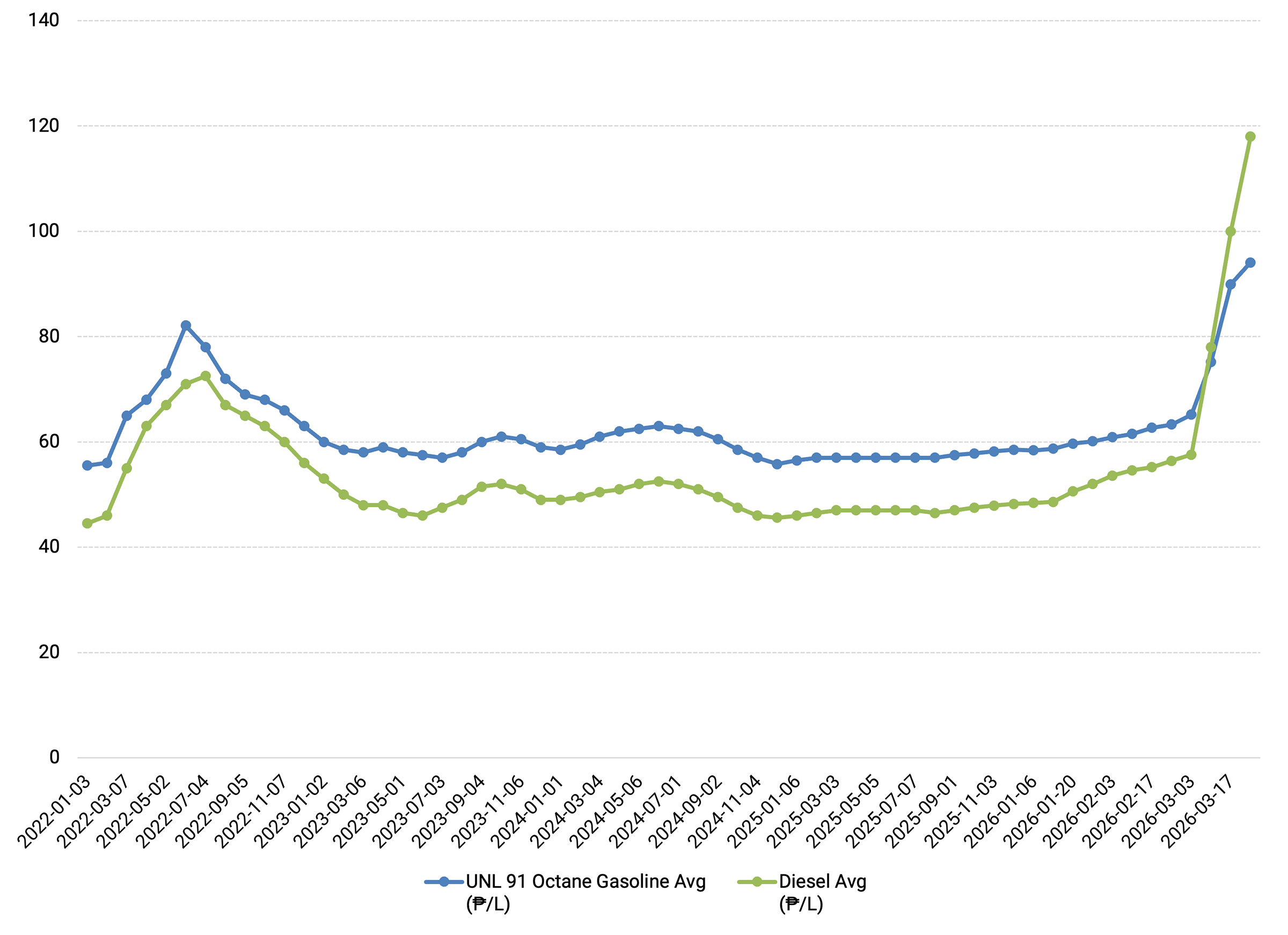
Fuel prices in the Philippines have surged over the past two weeks, and the effects are already spreading throughout the system. Diesel prices have effectively doubled during this period, and for the first time, fuel costs have reached triple-digit pesos per liter, equating to over $6.50 U.S. dollars per gallon.
Figure 1 — Manila Area Diesel and Gasoline Weekly Average Prices, Pesos/Liter
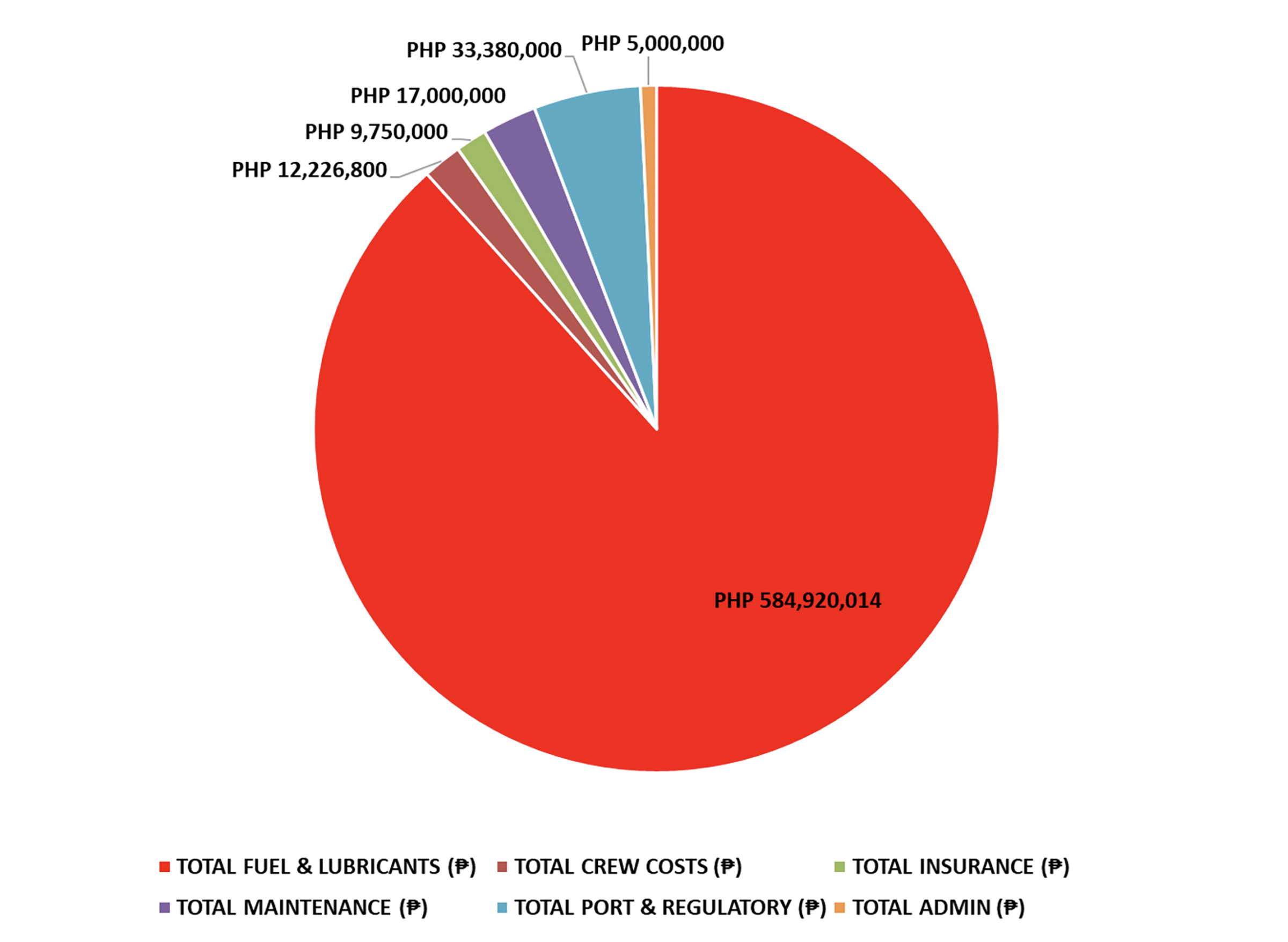
Moving people and goods by ship is especially important in the archipelagic Philippines. For illustration, Anthropic’s Claude was used to model a mid-size, 10,000 gross register tonnage (GRT) roll-on roll-off (RoRo) vessel operating on the busy Manila-Cebu shipping route. The trip covers about 475 miles — roughly the distance between Houston and Oklahoma City — and takes between 22 and 26 hours of sailing to complete.1
Even at prewar fuel prices, fuel accounted for about 85% of the vessel’s annual operating expenses, roughly $13 million U.S. dollars. If fuel prices were to double, the share would rise to more than 92%, or about $26 million. Steamship companies would then need to either pass these costs on to customers — who may already operate on thin margins — or seek government assistance, which, if extended at scale, could strain Manila’s fiscal position.
Figure 2 — Annual Operating Costs for a 10,000 GRT RoRo With 50 Peso Fuel
Note: Actual costs may vary based on vessel condition, operator efficiency, and market conditions. Not financial advice.
Philippines Responds to Rising Fuel Costs
In a March 22 video address, Marcos said, “It is clear that this war in the Middle East has had a huge impact on the entire world and here in the Philippines. Of course, we cannot let this burden fall on the commuters.”
The government has responded by shifting to four-day workweeks to conserve fuel, signaling how quickly the situation is evolving. It is also preparing cash subsidies for public transportation providers and relaxing fuel quality standards in an effort to increase supply and limit further price spikes.
Fuel Costs Weigh on Daily Life
Fuel price pressure is visible across daily life. In a country composed of islands, fuel underpins movement both between and within the archipelago. Logistics-related expenses account for more than a quarter of the cost of goods sold by businesses, with a substantial portion of those expenses coming from fuel.
When fuel costs rise quickly, the effects are felt everywhere. In a discussion with one of the authors, Florence Principe Gamboa, managing editor and coordinator of FACTS Asia and lecturer at Far Eastern University in Manila, put it simply: “Everyone is feeling it.”
The impact is also evident in the higher education sector. In another discussion with one of the authors, Deryk Matthew Baladjay, lecturer in international studies at De La Salle University and research manager at Amador Research Services, noted that universities are beginning to move back toward hybrid models, similar to those used during the COVID-19 pandemic, to reduce transportation and operating costs tied to the fuel price increase. While practical, this adjustment makes it harder to maintain consistent in-person engagement.
Oil Price Shock Could Boost Electrification
Will this oil price increase encourage Filipino consumers to pursue greater transport electrification? Electrification may become more attractive, not solely for climate reasons, but for resilience. The Filipino electricity system runs primarily on coal, so it is largely insulated from the most direct impacts of crude oil and natural gas price spikes.
Chinese firms could supply electric vehicles (EVs) and other electrification hardware, a strategic vulnerability the U.S. should monitor. This is also an area where the U.S. could encourage the Philippines and others nearby countries to source from a more diverse set of suppliers than the People’s Republic of China (PRC).
Electrification is likely to face practical limits in the Philippines, given a combination of cost — replacing expensive trucks is financially comparable to buying a home — and the physics of moving freight by sea on routes that can exceed 500 miles. Substantial investments in charging infrastructure would also be required.
Rising Oil Prices Highlight Resilience Needs
When wars disrupt a globally priced oil market, those least able to absorb higher costs bear the largest proportional costs. This has occurred twice in four years in the Philippines, and the current price increase is likely to accelerate domestic discussions about boosting electrification, expanding fuel storage, and pursuing other strategic resilience measures.
Note
1 The model is available upon request.
This publication was produced by Rice University’s Baker Institute for Public Policy. Wherever feasible, the material was reviewed by outside experts prior to release. Any errors or omissions are solely the responsibility of the author(s).
This material may be quoted or reproduced without prior permission, provided appropriate credit is given to the author(s) and Rice University’s Baker Institute for Public Policy. The views expressed herein are those of the individual author(s) and do not necessarily represent the views of Rice University’s Baker Institute for Public Policy.


