


Introduction
In November 2024, voters declined to approve two propositions that would have authorized Houston Independent School District (HISD) to issue $4.4 billion in bonds to reconstruct around 10% of its campuses and perform major maintenance on many others. In the wake of the election outcome, questions have arisen about the current utilization of the district’s campuses, especially in the context of its persistent decline in enrollment over the last decade.
This brief explores key aspects of HISD campus utilization, providing a data-driven analysis of current challenges and future considerations. It examines:
- The current utilization of campuses.
- A geographical analysis of utilization rates.
- National trends in public schools.
- The district’s demographic future.
- Research on school underutilization and closure.
Current Utilization
Each year, the district publishes a Campus Demographic Report (CDR). The CDR shows the enrollment at each campus and its capacity, both with and without temporary buildings (“overall building capacity” and “permanent building capacity”). The most recent report from the district, at the time of writing, was for the 2023–24 school year. However, the district provided our team with the enrollment data by campus for the 2024–25 school year and informed us that there had been no changes in the capacities at any campus.
Enrollment
The total enrollment for the 2024–25 school year is 176,731. However, 13,077 students were enrolled in programs not based on a district campus. Most of these students participate in the district’s online Texas Connection Academy and approximately a third are participating in programs housed at a local community college. Therefore, 163,654 students attend classes at a district campus. Enrollment is spread across 255 campuses, excluding two small pilot programs — Las Americas Newcomer Middle School (111 students) and Liberty High School (352 students) — which are located in temporary facilities and not included in this analysis.
Capacity
The total permanent building capacity for all HISD campuses is 212,493, resulting in a district-wide campus utilization rate of 77%. An additional 16,150 seats are available in temporary buildings spread over 89 campuses. The total utilization rate, including temporary buildings, is 72%.
Paradox in Enrollment Statistics
Under Capacity
The report shows a wide disparity in the utilization rate across HISD’s campuses, with low enrollment a significant issue in many schools.
- Fifty-one campuses (20%) were enrolled at less than 50% of their permanent building capacity.
- Eighty-one campuses (32%) had enrollment of more than 50%, but less than 75% of their permanent building capacity.
Just over half of the district’s campuses currently operate at less than 75% of their permanent building capacity. Additionally, the district has 7,605 unused seats in existing temporary buildings, primarily located at some of the least utilized campuses. This highlights the rapid fluctuation in enrollment at these campuses.
Over Capacity
At the same time, enrollments in 60 of HISD’s campuses exceed 100% of the permanent building capacity, with 22 above 120%. Even after taking temporary buildings into account, over half of these 60 campuses are overenrolled. To relieve the overcrowding, the district would have to add 8,383 new seats in permanent building capacity. If the district were to rely solely on adding more temporary buildings, it would need to add 4,323 seats in temporary buildings.
Geographic Analysis of Utilization Rates
Figure 1 presents a map of the district, illustrating school locations by percentage occupancy. A distinct pattern emerges from the distribution. Geographically, the enrollment pattern is generally divided along a line following state Highway 288 to downtown and then north along state Highway 59. Most of the underenrollment is located east of this line with most of the overenrollment located west of it. Unsurprisingly, this pattern coincides with the population growth and declines in the neighborhoods in which these campuses are located.
Figure 1 — Houston Independent School District: Map of Overall Enrollment
National Trends
Houston is not alone in facing declining enrollment and classroom underutilization. As discussed in a Brookings Institution study, many school districts, especially large urban districts, have been facing declining enrollments for some time. For example, Chicago’s public school system has lost 100,000 students since 2000 — approximately 25% of its enrollment — resulting in a third of its campuses operating at less than 50% capacity.
This trend has accelerated since the pandemic. According to the National Center for Education Statistics (NCES), public school enrollment fell by 1.2 million students, from 50.8 million students in fall 2019 to 49.4 million in fall 2020 and 2021. The NCES projects a further enrollment decline of 2.7 million students by 2031–32.
HISD stands out as one of the few large, urban districts with a significant number of overenrolled campuses. The reasons behind the district’s unusually large imbalances in campus utilization warrant additional research. It is possible that the district’s robust magnet school program — one of the largest in the country — is a factor.
The District’s Enrollment Future
In the last decade, HISD enrollment has declined by about 40,000. This has been driven by two principal factors.
First, HISD is primarily situated in the city’s urban core, where population growth has stagnated in recent decades. In recent years, Houston’s population growth has been driven by international immigration, largely consisting of primarily young, working-age adults seeking employment opportunities. Figure 2 shows a population pyramid for the district as of 2023.
Figure 2 — Population Pyramid for Houston Independent School District: 2023, Actual Numbers
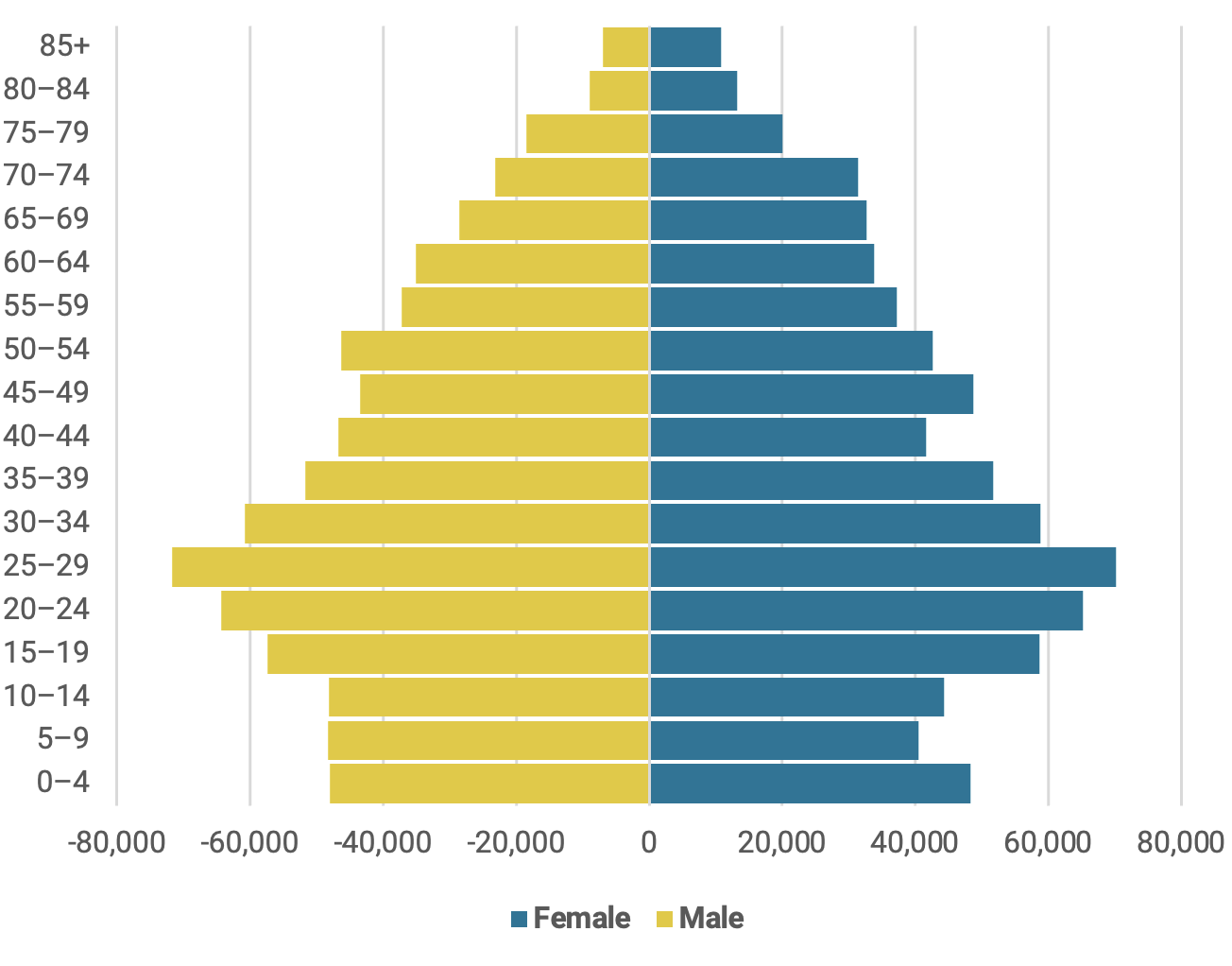
The noticeable expansion in the pyramid in the 20–34 cohorts is consistent with a large influx of young adults. Without that influx, the district’s pyramid would be nearly vertical through the 40–45 age cohort — in other words, the population would be much more evenly distributed across the age groups.
Another major factor in enrollment decline has been the advent of charter schools. This analysis by Houston Landing, using data from the Texas Education Agency, suggests that about 60% of the decline is from students leaving HISD for a charter school.
Given the challenging demographics in HISD, increased competition from charter schools, homeschooling, the likely adoption of a school choice or voucher program by the state of Texas, and a more restrictive national immigration policy, the likelihood of the district’s enrollment recovering in the future is very low. Indeed, it is more likely that the district will continue to see long-term decline.
Studies on School Underutilization and Closure
Much of the academic literature in recent decades has centered on overcrowded schools and the effects of classroom crowding. Researchers have now started to examine the impacts of declining enrollments and underutilized campuses.
- A considerable body of research, including this study of school closures in Philadelphia, supports the thesis that displacing students adversely affects educational outcomes.
- More recent research finds a correlation between schools with low enrollment and chronic low performance. While the potential causation for low enrollment and poor school performance has not been well studied, likely causes include fewer resources, poor faculty and student morale, and lack of scale to provide specialized programs.
- Underenrollment also creates logistical challenges for districts and families, including longer commuting times that could strain student and parent schedules and prevent participation in extracurricular activities.
For a commercial enterprise, the obvious solution would be to consolidate operations by closing underutilized facilities. However, such pragmatic calculations are much more difficult in the public school setting. Often a school — particularly in a declining neighborhood — is one of the community’s most important economic engines. Potential economic hardship for such communities, along with historical pride in their schools, generally leads to considerable community opposition to school closings.
Another factor to consider is how economic strains on a school district are associated with the underenrollment of campuses. As enrollment declines, a school district can relatively easily adjust staffing levels, but reducing the fixed costs associated with maintaining a campus is much more challenging. This, in turn, limits the resources available to expand capacity at other campuses. The wide disparity in HISD campus utilization suggests this issue may be affecting its ability to manage overenrollment at its 60 overcrowded campuses.
Looking Ahead to the Future
Across the country, many school districts are beginning to have difficult conversations about campus utilization.
- In Chicago, one study highlights how the city’s public school system is struggling with underenrolled schools after years of significant decline in student enrollment, suggesting that proactive measures may prevent chaotic closures in the midst of a budget crisis.
- In the Houston area, Aldine Independent School District (AISD), which adjoins HISD, recently announced the closure of six campuses.
- In Boston, there is a plan to close some public schools and merge others.
Only recently has the HISD leadership begun to publicly discuss the challenges it faces with underenrollment and the potential need to close some campuses. Some hope has been expressed that improved academic performance could increase enrollment by gaining parental confidence. While that may be a factor, the fundamental demographic realities of the neighborhoods these schools serve suggest it is unlikely to be a significant one.
Moving forward, priority should be given to reviewing campus utilization and resource allocation, addressing the dual challenges of under- and overenrollment, to ensure HISD is well-equipped to meet the community’s current and future educational needs.
This publication was produced on behalf of Rice University’s Baker Institute for Public Policy. Wherever feasible, the material was reviewed by external experts prior to its release. Any errors are the responsibility of the author(s) alone.
This material may be quoted or reproduced without prior permission, provided appropriate credit is given to the author(s) and Rice University’s Baker Institute for Public Policy. The views expressed herein are those of the individual author(s) and do not necessarily represent the views of Rice University’s Baker Institute for Public Policy.


