


Overview
In many states, adolescents under 18 can consent to their own contraceptive care, but Texas is not one of them. Professional medical associations recommend that minors have access to confidential sexual and reproductive health services. This brief reviews the evidence on minors’ access to such care and examines how Texas policies impact this access.
The Case for Confidential Contraceptive Access
In 23 states, minor adolescents can consent to their own contraceptive care. An additional five additional states allow minors to provide consent if they meet specific age eligibility criteria, typically between 12 and 16 years old.
By contrast, in Texas, unemancipated minors — those under 18 years old who are not legally independent from their parent(s) or guardian(s) — cannot consent to their own contraceptive care. Parental consent is required to obtain clinician-provided contraception. However, all Texas minors can consent to pregnancy testing as well as testing and treatment for sexually transmitted infection (STI) without parental involvement.
Parental Consent Requirements Create Barriers
When minor adolescents can consent to their own sexual and reproductive health care, they are more likely to seek these services. In contrast, sexually active minors who express concerns about accessing confidential reproductive health care are less likely to use contraception. Minors who face barriers to confidential contraception are also more likely to experience higher pregnancy and birth rates.
One in five (20%) Texas high school students are sexually active. Among sexually active minors in Texas, just 27% used a highly effective contraceptive method at their last sexual encounter, such as oral contraceptives, contraceptive injections, or an intrauterine device; 16% did not use any contraceptive method. Texas has the nation’s eighth-highest teen birth rate and third-highest rate of repeat teen births.
A 2022 study of sexually active Texas minors seeking contraception found that many wanted to use a highly effective method to prevent pregnancy but were unable to involve a parent to obtain care. When they attempted to talk with parents about contraception, they reported that their parents were uncomfortable discussing the topic, lacked knowledge about methods, did not view contraception as important, or reproached them for raising the issue. Even when minors have parental support, confidential access remains crucial to empower them to choose their contraceptive method and take the initiative in making their own appointments.
Parents also acknowledge the difficulty of discussing contraception with their teens. Many express interest in having health care providers address contraception with their children, seeing providers as a bridge to facilitate conversations about sexual and reproductive health.
Importance for Minors’ Health
Although parents have legal responsibility for their children’s medical care, their authority is not absolute. Federal and state laws, along with numerous court decisions, recognize minors’ right to privacy and confidentiality regarding their health care, including access to contraception without parental consent. Disclosure of minors’ reproductive health decisions could put them in dangerous situations.
Professional medical associations, including the American Academy of Pediatrics and the Society of Adolescent Health and Medicine, recommend that all minors receive confidential care. This promotes open communication about health concerns and connects minors with resources that can affect their long-term health. Confidential care can help reduce the risk of unwanted pregnancies and STIs, as well as support minors’ overall development as they take responsibility for their reproductive healthcare. If health care providers suspect abuse or neglect, they are legally obligated to protect the minor, regardless of parental involvement.
These professional associations also recommend that confidential care be low or no cost, to reduce barriers for high-risk groups, including low-income youth and young Black and Latina individuals.
Limited Options for Confidential Contraceptive Care in Texas
There are approximately 7.5 million Texans under the age of 18.
- Most have health insurance through private plans (50%) or Medicaid (36%), based on rounded figures.
- About 1% (approximately 72,000) are enrolled in the Children’s Health Insurance Program (CHIP), down from 5% in 2018; CHIP does not cover contraception in most cases.
- Nearly 12% of minors (approximately 940,000) in Texas are uninsured — the highest rate nationwide.
- Minors who are uninsured and living on low incomes may be able to obtain reproductive health care through the Healthy Texas Women (HTW) program or at heath centers supported by the state-funded Family Planning Program (FPP). According to recent reports, only 1,956 minors received services through FPP in fiscal year 2023, and just over 100 obtained care through HTW.
Figure 1 provides a breakdown of health insurance coverage types among Texas minors.
Figure 1 — Texas Minors’ Insurance Status
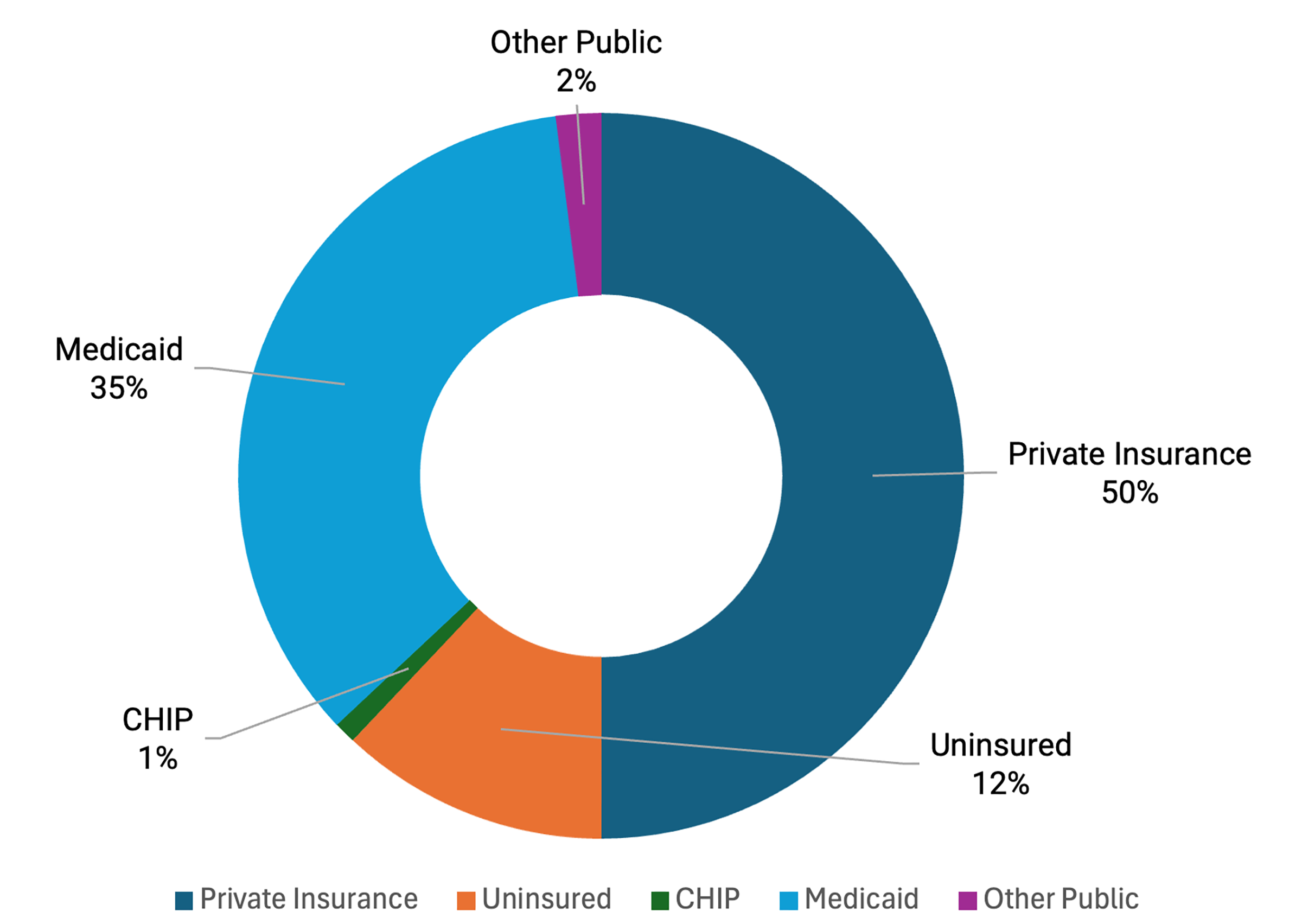
Note: Minors with low incomes can use FPP and HTW with parental consent. Minors can also access contraception through Title X with parental consent.
While many Texas minors have insurance or access to state programs that cover contraceptive services, these options do not guarantee confidentiality. As a result, even insured teens — or those enrolled in public programs — remain subject to Texas’s parental consent laws, limiting their ability to receive confidential contraceptive care.
Title X and Confidential Care for Minors — Texas Exception
Title X of the Public Health Service Act 1970 established the Family Planning Program, which guarantees confidential services to all clients, including minors, and prioritizes individuals and families living on low incomes. While health centers receiving Title X funding encourage family participation in reproductive health decision-making, they cannot require parental consent or notify parents that a minor has requested or received services.
However, in 2022, a federal district court in Texas ruled in Deanda v. Becerra that Title X violates parents’ rights as well as state and federal law. As a result, minors in Texas can no longer obtain contraception through Title X-funded clinics without parental consent. This ruling only applies in Texas; minors in other states can still receive confidential contraceptive care at Title X health centers.
Table 1 outlines the primary insurance and publicly funded programs through which minors in Texas may access contraceptive care.
Table 1 — Minors’ Contraceptive Coverage in Texas, 2024

Note: FPL refers to the federal poverty level.
Policy Possibilities
Removing parental consent requirements for contraception from state programs would expand access for Texas minors, helping reduce adverse reproductive health outcomes and support a healthy transition to adulthood.
Senate Bill 348, filed during the 2025 Texas legislative session, proposes allowing minor parents to consent to their own contraceptive care. While this change would represent a step forward — particularly in preventing repeat pregnancies among teen parents — its impact would be limited. The bill does not extend confidential access to contraception for all minors, leaving many without a pathway to care without parental involvement.
Broader reform would be needed to fully support reproductive autonomy and access for all minors in Texas.
Conclusion
In Texas, unemancipated minors must obtain parental consent to access clinician-provided contraception, even though they can consent to other sexual and reproductive health services. This requirement runs counter to guidance from professional medical associations and creates unnecessary barriers to care. As a result, minors — particularly those already facing challenges — may be unable to obtain the most effective methods of contraception to prevent unwanted pregnancies.
Acknowledgment
This publication was produced in collaboration with Resound Research for Reproductive Health.
This publication was produced on behalf of Rice University’s Baker Institute for Public Policy. Wherever feasible, the material was reviewed by external experts prior to its release. Any errors are the responsibility of the author(s) alone.
This material may be quoted or reproduced without prior permission, provided appropriate credit is given to the author(s) and Rice University’s Baker Institute for Public Policy. The views expressed herein are those of the individual author(s) and do not necessarily represent the views of Rice University’s Baker Institute for Public Policy.


