


Introduction: Why the Distinction Matters
As the world transitions toward cleaner energy sources, the terms renewable diesel and biodiesel are often used interchangeably. However, these fuels differ significantly in their chemical composition, production processes, performance characteristics, and environmental impacts. Understanding these differences is essential for policymakers, fleet operators, and consumers aiming to make informed decisions about sustainable fuel alternatives.
Figure 1 — Structural Comparison of Biodiesel and Petrodiesel Molecules

Chemistry and Process
Biodiesel — FAME
Biodiesel, also known as FAME (Fatty Acid Methyl Ester), is an oxygenated fuel, meaning it contains oxygen in its molecular structure (Figure 2). This is a key difference from renewable diesel or petroleum diesel. A small change at the molecular level has a big impact on its properties, which is discussed later. For now, it is important to note that pure biodiesel cannot be used in a diesel engine without modifications. Biodiesel is produced through a process called transesterification, which is relatively simple and requires methanol and a catalyst. This process can even be done in a garage or small facility. The result is FAME or biodiesel, along with a byproduct called glycerin.
Figure 2 — FAME Biodiesel Production Process

Renewable Diesel — HVO
Renewable diesel, also known as HVO (hydrotreated vegetable oil), is fundamentally different from FAME biodiesel because it contains only hydrogen and carbon, making it a hydrocarbon fuel similar to petroleum diesel (Figure 3). While it is not identical to petroleum diesel due to its lower content of aromatics, branched hydrocarbons, metals, and other impurities, renewable diesel is so similar that it is considered a drop-in replacement. This means it can be used in modern diesel engines without needing to be blended with petroleum diesel. This drop-in characteristic is a significant advantage over FAME biodiesel. However, renewable diesel has a slightly lower energy content compared to petroleum diesel — about 4% less by volume — but this can be compensated for by other desirable properties.
Figure 3 — Renewable Diesel Production Process

The exact process for producing HVO is not widely disclosed due to proprietary reasons. However, it is known that hydrotreating (also called hydrodeoxygenation) is carried out using catalysts and requires high temperatures, high pressure, and the presence of hydrogen. This process converts feedstock that contains double bonds and oxygen into hydrocarbons by saturating the double bonds and removing the oxygen. The production process is more complex compared to transesterification and requires a dedicated facility. HVO is often produced in petroleum refineries with only minor adjustments needed to accommodate the process.
Feedstock
Both renewable diesel and biodiesel can use the same feedstock, such as vegetable oils, fats, and waste oils. Over the past decade, feedstocks used for biodiesel and renewable diesel production in the U.S. have become more diverse. In addition to soybean oil and animal fats, low-value feedstocks like used cooking oil (UCO) and distillers corn oil (DCO) are becoming more common. Depending on the specific oil used, the resulting fuel can have slightly different properties. For example, biodiesel derived from jatropha has poorer cold flow properties than biodiesel made from soybean or canola oil.
The difference between the production processes is that transesterification, which is used to produce biodiesel, is less flexible when it comes to using low-quality feedstocks, such as used cooking oil, which has a high concentration of free fatty acids. To use this type of feedstock for biodiesel, a different catalyst, such as enzymatic catalysis, is needed. However, this is more expensive and has slower reaction rates. Another option is to add an acid pre-treatment process before the standard transesterification process. Hydrotreating, which is used to produce renewable diesel, does not need to adapt as much to treat low-quality feedstock.
Another important point is the co-reagent used in these processes. For biodiesel, the co-reagent is an alcohol (most commonly methanol), while for renewable diesel, hydrogen is used. This difference is significant because methanol is usually derived from nonrenewable natural gas, meaning that biodiesel produced with methanol is only about 95% derived from biological, renewable resources (bio). In contrast, if ethanol — derived from renewable sources like corn or sugarcane — is used instead of methanol, biodiesel can be considered fully bio. Similarly, the hydrogen used in renewable diesel production can come from either renewable or nonrenewable sources, which affects its sustainability.
Biofuel Nomenclature by Feedstock Origin
A different way of naming biofuels according to their feedstock input involves classifying them as first, second, or third-generation, and as conventional or advanced biofuels.
- First-Generation Fuels — These are made from food or animal feed crops and use established methods such as fermentation and distillation. They are also referred to as conventional biofuels.
- Second-Generation Fuels — These are produced from nonfood sources, including dedicated energy crops, agricultural and forest waste, and other materials like used cooking oil and municipal solid waste.
- Third-Generation Fuels — Biodiesel produced from microalgae through conventional transesterification or hydro-treatment of algal oil is commonly known as a third-generation biofuel.
Second- and third-generation biofuels, often called advanced biofuels, are characterized by their production techniques or pathways still being in the research and development, pilot, or demonstration phases.
Fuel Properties
As mentioned, biodiesel (FAME) contains oxygen while renewable diesel does not. This difference leads to significant variations in their properties, affecting both engine performance and supply chain logistics.
Both renewable diesel and biodiesel can replace fossil fuels and help reduce climate emissions, but only renewable diesel can be used as a standalone fuel in all diesel engines. Due to its physical properties, pure biodiesel has limited direct-use applications and logistical challenges:
- Solvent Properties — Biodiesel is a powerful solvent, so it can degrade rubber in fuel lines and loosen sediments in fuel tanks and pipelines, leading to clogged engine fuel filters.
- Cloud Point and Gelling — Pure biodiesel has a relatively high cloud point, which means that it turns into a gel at warmer temperatures than petroleum diesel, making its use problematic in cold climates. As a result, biodiesel cannot be stored or transported in regular petroleum liquid tanks and pipelines. Instead, it must be transported by rail, vessel, barge, or truck, often in specialized heated equipment to ensure it remains liquid.
- Water Absorption and Microbial Growth — Traditional biodiesel can also absorb water, which may lead to microbial growth in storage tanks, causing subsequent corrosion or clogging problems.
Because of these limitations, the use of traditional biodiesel is still limited to a maximum concentration of 7% in Europe (based on the EN 590 diesel standard) and up to 20% in other parts of the world. However, one positive aspect is that blending biodiesel with petroleum diesel increases the lubricity of the fuel. Due to its oxygen content, biodiesel has approximately 7% less energy by volume than petroleum diesel.
Tailpipe Emissions
Both renewable diesel and biodiesel are better for the environment than petroleum diesel in terms of tailpipe emissions, as they produce less particulate matter, due to the absence of sulfur and aromatics. In terms of CO2 emissions, there are no significant differences between the two. However, some authors suggest that renewable diesel may be slightly better than biodiesel in terms of overall tailpipe emissions.
The presence of oxygen in biodiesel influences its combustion, leading to both positive and negative effects.
- Positive Effects — The oxygen content causes the fuel to burn at a higher temperature, which improves combustion efficiency and reduces emissions of carbon monoxide (CO), hydrocarbons (HC), and particulate matter (PM).
- Negative Effects — The higher combustion temperature also increases nitrogen oxide (NOx) emissions, which can contribute to air pollution and acid rain. Estimates suggest that biodiesel increases NOx emissions by about 10% compared to petroleum diesel.
While not considered greenhouse gases (GHGs) and therefore not included in CO2e (carbon dioxide equivalent) calculations, emissions such as CO, HC, PM, and NOx can significantly impact health and the environment. These pollutants contribute to localized air pollution, affecting respiratory health and overall environmental quality.
Renewable diesel may have an advantage in terms of emissions, but new exhaust emission control technologies — such as catalysts or selective catalytic reduction (SCR) systems — can help reduce NOx and PM emissions for both biofuels and petroleum diesel. As these technologies improve, the differences in emissions between these fuels may become less significant.
Life-Cycle Analysis
Life-cycle analysis (LCA) is a technique used to assess the environmental impacts of all stages of a product’s life, including raw material extraction, processing, manufacturing, distribution, use, and disposal or recycling. When comparing fuels, LCA may focus on specific parts of the fuel’s life cycle, or the entire well-to-wheel (WTW) cycle, to evaluate the environmental merits and challenges of each fuel.
One important tool for conducting LCA is the GREET model (greenhouse gases, regulated emissions, and energy use in technologies), developed by Argonne National Laboratory. This free software enables users to evaluate the life-cycle impacts of various fuels, including biodiesel and renewable diesel.
LCA studies are highly situational and dependent on many factors, as explored in the following sections.
Greenhouse Gas Reductions in Biofuel Production
The environmental benefits of biofuels are evident in their potential to significantly reduce GHG emissions across their life cycle, varying by feedstock (Figures 4 and 5):
- First Generation — Producing first generation biofuels such as biodiesel and renewable diesel from vegetable oils results in life-cycle GHG emission reductions ranging from 40% to 69% compared to petroleum diesel.
- Second Generation — Higher GHG reductions can be achieved with second generation or advanced biofuels. Converting waste grease and byproducts, such as tallow, used cooking oil, and distillers corn oil, into biodiesel or renewable diesel can yield reductions of 79% to 86%.
The higher greenhouse gas reductions for second-generation biofuels largely stem from their avoidance or significant reduction of land-use change (LUC) related emissions. Unlike many first-generation feedstocks, these advanced biofuels minimize or eliminate emissions from land conversion, farming energy, fertilizer production, and commodity transportation.
Figure 4 — Life-Cycle Greenhouse Gas Emissions of Bio-, Renewable, and Petroleum Diesel

Note: Life-cycleGHG emissions of petroleum diesel versus (a) biodiesel (BD) and (b) renewable diesel (RD) pathways. Marker symbols represent life-cycle GHG emissions, including land-use change (LUC) emissions. UCO refers to used cooking oil. The rendering bar for UCO also includes UCO collection emissions. The corn oil pathway is based on distillers corn oil (DCO), not edible corn oil.
Well-to-wheel GHG emissions are typically expressed as grams of carbon dioxide equivalent per megajoule (g CO2e/MJ) of fuel consumed in a vehicle, accounting for all energy and emissions associated with biofuel production and vehicle operation.
Combustion emissions during vehicle operation are considered carbon neutral, as atmospheric carbon dioxide uptake by plants offsets emissions from biomass-derived diesel. However, the CO2 emissions from the fossil carbon used in methanol production for biodiesel are included.
Figure 5 — Life-Cycle GHG Emissions from Oilseed and Biofuel Production
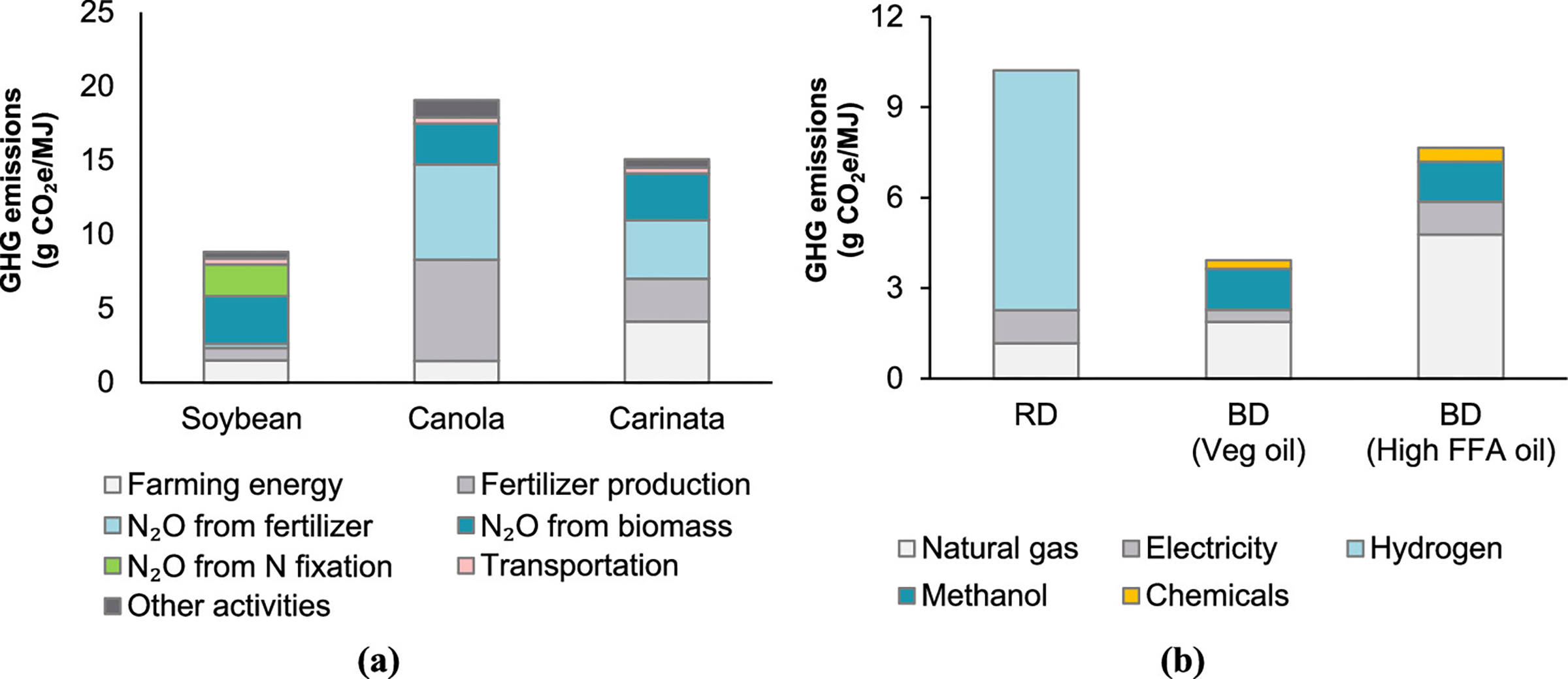
Note: Breakdown of life-cycle GHG emissions of (a) oil seed production and (b) biofuel conversion processes. FFA refers to free fatty acid. Other activities refer to GHG emissions associated with other farming activities, such as insecticides and CO2 from urea application.
Renewable Diesel Versus Biodiesel
The difference in life-cycle analysis (LCA) emissions when comparing the same feedstock between renewable diesel and biodiesel is subtle, and biodiesel is often referred to as being “cleaner” than renewable diesel. While this is generally true, there are some variations that could result in slightly higher emissions for biodiesel production, especially when low-value feedstocks (second-generation or advanced biofuels) are used.
Transesterification — the process used to produce biodiesel — is less energy-intensive than hydro-processing, which requires very high temperatures and pressure. As a result, biodiesel tends to have, on average, lower GHG emissions. However, if the feedstock is used cooking oil or other low-quality feedstock (second-generation biofuel), an additional step is needed in the biodiesel process, which results in slightly higher GHG emissions than the renewable diesel route.
Conclusion: Key Takeaways and Future Considerations
Renewable diesel and biodiesel both offer promising alternatives to petroleum diesel, but they are not created equal. Biodiesel (FAME) is easier to produce and widely available, yet it requires blending and engine modifications. Renewable diesel (HVO), while more complex and costly to produce, offers superior compatibility with existing diesel engines and infrastructure.
When evaluating these fuels, it is important to consider not only their chemical and performance differences but also their broader implications — including feedstock sustainability, life-cycle emissions, and market dynamics. As the biofuels landscape evolves, further exploration into areas such as fuel degradability, pricing trends, production forecasts, trade-offs, and the role of sustainable aviation fuel (SAF) will be critical to shaping a resilient and low-carbon energy future.
This publication was produced on behalf of Rice University’s Baker Institute for Public Policy. Wherever feasible, the material was reviewed by external experts prior to its release. Any errors are the responsibility of the author(s) alone.
This material may be quoted or reproduced without prior permission, provided appropriate credit is given to the author(s) and Rice University’s Baker Institute for Public Policy. The views expressed herein are those of the individual author(s) and do not necessarily represent the views of Rice University’s Baker Institute for Public Policy.


