


Author(s)

This brief is part of “Election 2024: Policy Playbook,” a series by the Baker Institute and Rice University that offers nonpartisan, expert analysis and recommendations to equip policy leaders governing the United States and Texas in 2025.
The Big Picture
- The asylum system, along with the situation at the U.S.-Mexico border, is one of the most contentious issues in the federal 2024 election — as well as one of the most important to voters.
- Restricting access and increasing enforcement at the border does not stop migration; rather, it forces individuals onto more dangerous routes and into the hands of human smuggling operations.
- Instead, the new administration and Congress should focus on expanding legal pathways to migration and updating the asylum system.
Summarizing the Issue
Asylum is a mainstay of our federal immigration system. Under international and domestic law, an individual who faces persecution in their home country can cross into the territory of the United States and ask for protection. If they meet stringent criteria and are not found to pose any threat to national security, they are legally allowed to stay in the country. But the mass underfunding of the asylum system — in addition to unprecedented global displacement — has led to an immense backlog of applicants, with an average wait time of 4.3 years.
In tandem with this, the political stalemate in Congress over immigration reform has left individuals with few options for entering the U.S. legally. As a result, individuals have turned to crossing the border irregularly and claiming asylum as one of the only means to enter the U.S. — whether or not they will eventually be granted asylum and allowed to stay — further contributing to a backlog.
Both Republican and Democratic presidential administrations have sought ways to reduce the number of individuals seeking asylum in order to mitigate public concerns about security at the southern border, usually invoking executive authority to do so. These include:
- Migration Protection Protocols, informally “Remain in Mexico,” and the imposition of Title 42 under former President Donald Trump.
- Introduction of the CBP One app and more restrictive requirements for asylum under current President Joe Biden.
But as Figure 1 shows, these restrictions have not reduced irregular entries over the medium-to-long term.
Figure 1 — Number of CBP Migrant Encounters at U.S. Southwestern Border, 2000–24
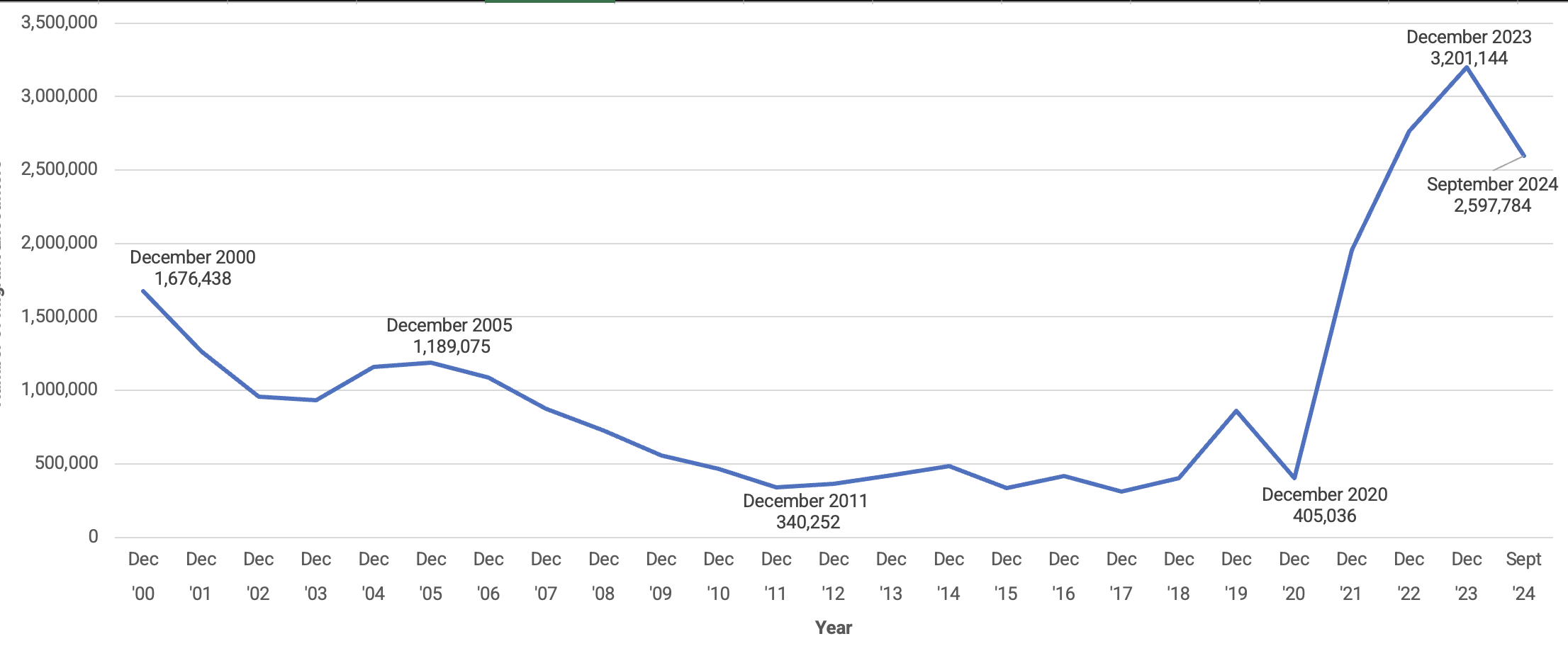
Note: Beginning in 2020, CBP changed the way it measured the number of individuals crossing the U.S. Southwestern border irregularly from “apprehensions” to “encounters.” The category of “encounters” broadly includes the number of individuals crossing between ports of entry, requesting asylum at ports of entry, and attempting multiple irregular entries who are expelled to Mexico who try to cross again; thus, the number of “encounters” is higher than the previous measurement of “apprehensions.”
Policies that undermine asylum may suppress arrivals temporarily or force individuals to take more dangerous or deadly routes, but those seeking safety or a better life are unlikely to be deterred. Thus, the issue of how to effectively manage migration at the southern border remains prescient.
Expert Analysis
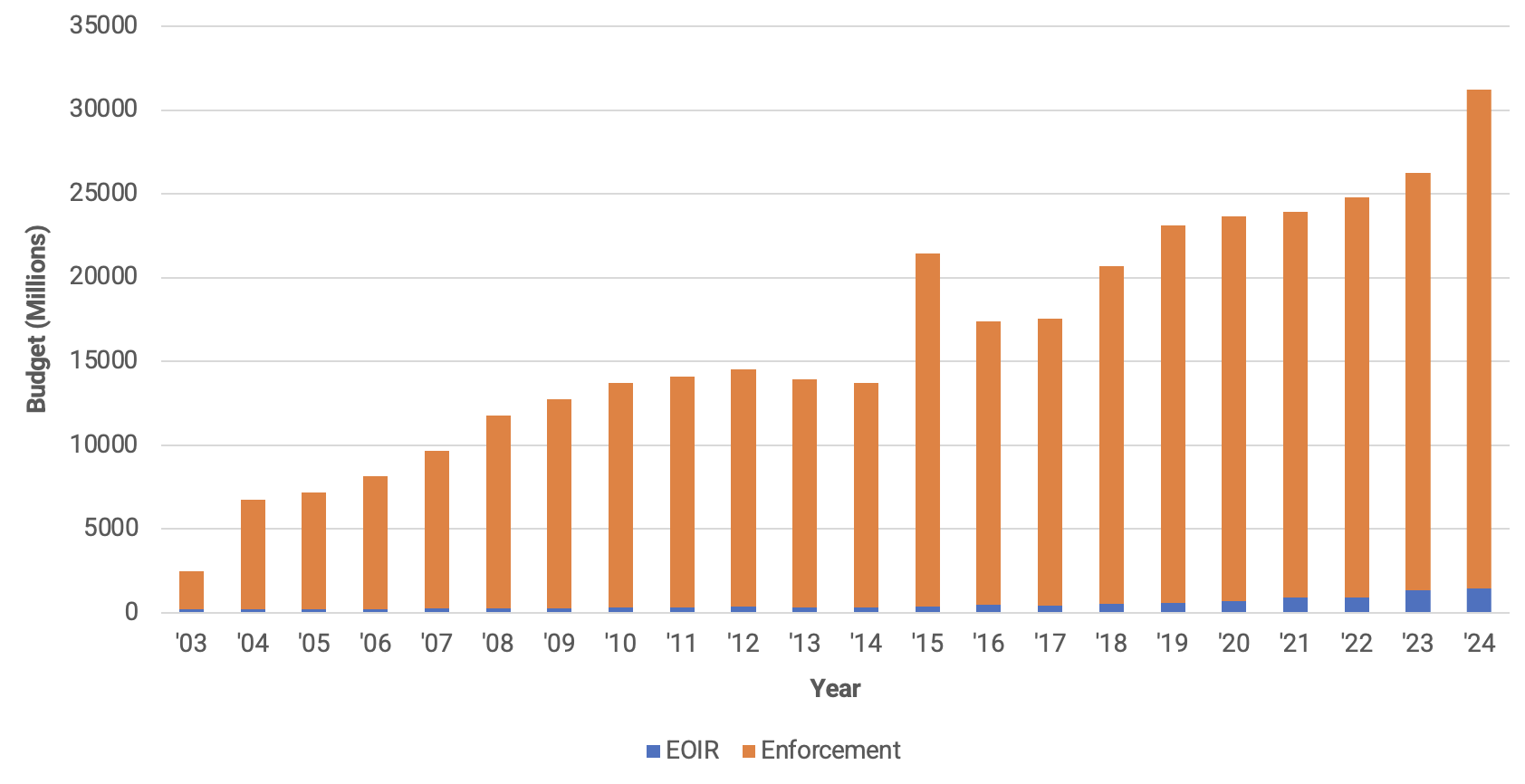
Rather than shutting down the border entirely or ending access to asylum, the border can be both securely and humanely managed. This could be partly addressed through a realignment of resource allocation. Funding used toward immigration enforcement — including technology, physical infrastructure, and personnel — has drastically outpaced asylum system funding. Between fiscal year 2003 through 2024, Congress has spent $24 on Immigration and Customs Enforcement (ICE) and Customs and Border Patrol (CBP) for every $1 spent on the immigration court system, as shown in Figure 2.
Figure 2 — Executive Office for Immigration Review Budget (EOIR) Versus Enforcement Budget, 2003–24
Additionally, research on the U.S.-Mexico border shows that enforcement has historically been successful when also coupled with expanded options for regular migration. The Biden administration has used executive authority to open new pathways — namely, humanitarian parole for Cubans, Haitians, Nicaraguans, Venezuelans, Afghans, and Ukrainians — allowing approximately 600,000 more individuals to enter the U.S. over the last three years. But this move has drawn criticism from Republicans who want to see the use of parole — and, more broadly, executive authority — minimized or eliminated, even as Congress has failed to pass immigration reform since 1990.
Policy Actions
To address asylum and the situation at the U.S.-Mexico border, the incoming administration and Congress should:
- Create stronger incentives to use legal immigration pathways over irregular ones. To prevent individuals from turning to the asylum system as a means of entry to the U.S. when they are unlikely to have a successful claim, Congress can create additional regular opportunities, such as family reunification or education and work visas. Doing so would address acute labor shortages and also prevent individuals from turning to human smuggling operations in order to gain irregular entry to the U.S.
- Invest and restructure the asylum court system. The Department of Justice’s Executive Office of Immigration Review (EOIR), referred to as the “immigration courts,” needs additional judges and further financial resources. Even reallocating a small fraction of the budget currently dedicated toward immigration enforcement would make a difference. Congress could also make the immigration court system independent by moving it out of the executive branch of government, thereby helping to insulate it from political headwinds.
- Affirm the right to seek asylum. Our asylum system exists because of historical precedent. When Jewish individuals in Europe sought refuge to escape the rising Nazi regime in the 1930s, they were denied access on economic grounds — which in some cases was also a smokescreen for antisemitism — contributing to the death of 6 million Jewish victims during the Holocaust. After World War II, the world vowed not to let such a horror occur again, subsequently developing grounds for admission based on persecution. Asylum remains a critical human right and lawmakers can turn to this history to emphasize that we must uphold and modernize the system.
The Bottom Line
To address concerns over asylum and security at the U.S.-Mexico border, the new administration and Congress should create legal pathways for immigration, take steps to better fund and update the asylum system, and focus political messaging on the historic and current importance of providing refuge to those seeking safety.
This material may be quoted or reproduced without prior permission, provided appropriate credit is given to the author and Rice University’s Baker Institute for Public Policy. The views expressed herein are those of the individual author(s), and do not necessarily represent the views of Rice University’s Baker Institute for Public Policy.


