


Author(s)

Overview
Achieving sustainability requires a systems-level approach that weighs a broad array of factors across three impact areas: environment, economy, and society. The explicit recognition of these three dimensions has been widely accepted for over three decades, while the foundational ideas behind the concept of sustainability have been in development for nearly 50 years. Over the five decades since, sustainability has evolved, and so too have the methods used to measure it — yet many existing frameworks fail to fully capture its complexities, trade-offs, and opportunities. While Occam’s razor suggests that the simplest explanation is often the best, applying this principle to sustainability is misleading: Reducing complex environmental, economic, and social trade-offs to a single metric or narrow assessment can lead to misguided decisions and unintended consequences. It may be time to rethink how sustainability is assessed to ensure it aligns with today’s challenges and emerging innovations.
The Evolution of Sustainability
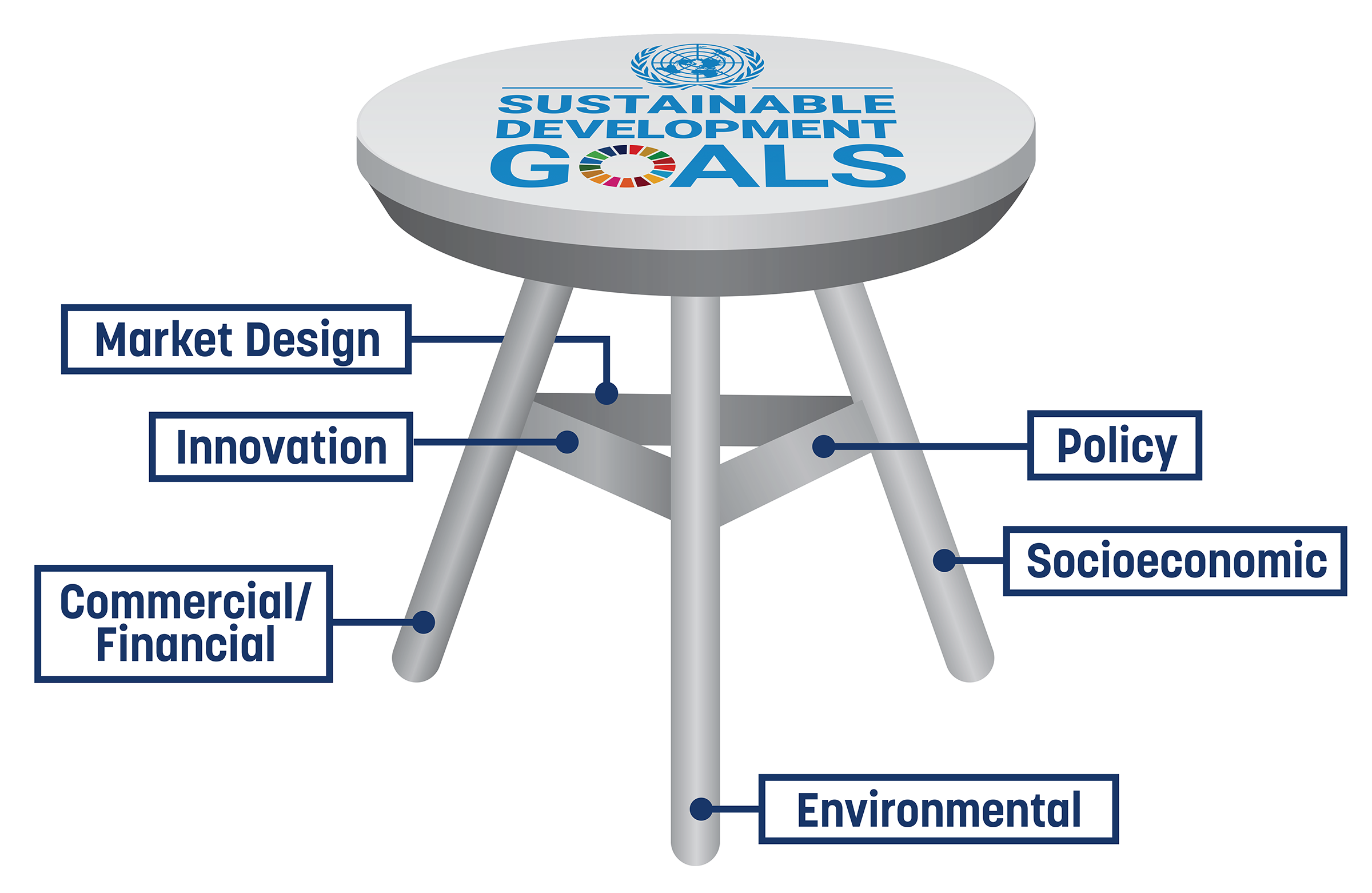
When originally introduced, it was reasoned that achieving a more sustainable future would require consideration of environmental, economic, and social impacts across the full life cycle of a product — from raw materials extraction and production to use and eventual disposal. In other words, systems thinking must be employed. At the time, adopting this approach also meant acknowledging that the three pillars of sustainability are interconnected and trade-offs among them are inevitable. Like a three-legged stool, overemphasis on one pillar can destabilize the entire structure, highlighting the importance of balance to ensure long-term sustainability and functionality. Each pillar must support and reinforce the others through innovative solutions, thoughtful market design, and effective policy measures to achieve a truly sustainable system (Figure 1).
Figure 1 — Balancing Sustainability
Fast forward to 2025, and sustainability remains widely misunderstood, misrepresented, and inconsistently applied by governments, industries, investors, and the public. Conversations and policies about sustainability tend to prioritize the environmental aspect, focusing heavily on climate change and emissions. Sustainability is far more involved than focusing on singular impacts, predetermining presumed eco-friendly options, or transitioning to alternative energies — especially when purported “clean” alternatives can have significant environmental and social impacts along their global supply chains. As a result, comprehensive insight on the impact of the overall system, including trade-offs among the three pillars, and any potential risk-shifting, is needed before an action, policy, product, or technology is deemed sustainable.
Understanding Life Cycle Assessment
Life Cycle Assessment (LCA) is the methodology most often used for assessing the environmental impacts of a commercial product, process, or service. The majority of LCAs are narrowly focused, concentrating almost exclusively on climate and emissions in only a portion of the life cycle— meaning they fail to represent all three legs of the stool. For example, many LCAs capture the emissions or climate impacts of only the production and use phases while disregarding the impacts of upstream or downstream activities that could significantly alter the results. An understanding of how LCAs evolved helps explain this disconnect.
From Coca-Cola to Critical Policies
In the late 1960s, Coca-Cola commissioned one of the earliest known LCAs to evaluate the environmental footprint of its packaging options, leading to the formalization of methodologies in the 1970s and 1980s — and eventually evolving into internationally standardized frameworks to guide how LCAs are conducted, including ISO 14040 and ISO 14044.
Since then, LCAs — and their intentions — have morphed over the years. They are now gaining prominence as a tool to validate product and technology sustainability claims, support major policy initiatives, substantiate environmental, social, and governance (ESG) pronouncements, and play a central role in business strategy and financing decisions. For instance:
- LCAs will be required for the U.S. Treasury Department’s eligibility for hydrogen tax credits under the Inflation Reduction Act of 2022.
- LCAs are increasingly relevant in meeting current and anticipated climate disclosure requirements under the U.S. Securities Exchange Commission rules.
- The EU requires LCAs for product declarations under the Critical Raw Materials Act.
- The United Nations Global Plastics Treaty may require LCAs for recyclers.
- ESG investments are often supported by LCA outcomes, which can sometimes be flawed and misleading.
Why Narrow Approaches Cannot Define a Broad Challenge
As LCAs are increasingly viewed as a core element in policymaking and investment decisions, it is more important than ever to understand and address the challenges and uncertainties they present. The lack of proper contextualization, accurate scoping, and transparency about a study’s limitations and assumptions may distort the life cycle benefits as well as the risks. This has led to significant misinterpretation by decision-makers, investors, and the public — often resulting in policies and financial decisions that have disproportionately shifted risks to vulnerable communities and created rebound effects across global supply chains.
Given the inconsistency in definitions, frameworks, and methodologies — as well as the reliance on databases with baselines and averages that may not align geographically or temporally with the study in question — using only a select few impact categories raises serious questions about whether LCAs are suitable as a foundation for sustainability policymaking and investing. These discrepancies complicate efforts to draw meaningful comparisons, standardize sustainability benchmarks, or implement uniform policies. They also underscore the need for greater transparency and consistency in LCA practices.
The Impact of LCA Limitations
The outcome and interpretation of LCAs are incontrovertibly dependent on the assessment’s scope and boundaries, which are unclear in many studies. Given the multifaceted nature of sustainability, practitioners using LCAs should expand impact categories beyond emissions to encompass a broader range of environmental metrics, such as water quality and sourcing, land use, biodiversity, waste management, etc.
Additionally, social and economic dimensions — currently absent from traditional LCA frameworks, including the International Organization for Standardization (ISO) — must be integrated into decision-making to provide a holistic understanding of sustainability. Without these considerations, the suitability of conventional and narrowly applied LCAs as a standalone tool for assessing sustainability is highly questionable.
Systemic Challenges
The evolution of the LCA reflects the growing complexity and breadth of sustainability analysis over the past several decades. Whereas LCA developed from energy analysis alone to a semi-comprehensive environmental burden analysis in the 1970s, full-fledged life cycle impact assessments and life cycle costing models were introduced in the 1980s and 1990s, while social-LCA and particularly consequential LCAs — a more thorough form of assessment used in decision-making when substantial environmental impacts are expected — gained ground in the first decade of the 21st century.
This evolution has resulted in a wide variety of LCA approaches, each tailored to specific objectives, metrics, and methodologies and often using different databases. This diversity, coupled with the subjective choices made by practitioners, can result in vastly different outcomes even when assessing the same product or technology within the same industry or sector, located in the same region.
Because ISO never intended to standardize LCA methods in detail and a lack of consensus on ISO requirements exists, a range of divergent approaches and types has emerged. Additionally, life cycle costing — initially introduced in the 1960s by the U.S. Department of Defense for procuring expensive military equipment — and social life cycle assessment approaches have since been proposed and developed. However, these methods often face consistency challenges when it comes to evaluating environmental factors, particularly regarding system boundaries, time perspectives, calculation procedures, and other methodological aspects.
Reconciling LCA with Sustainability: Bridging the LCA Gap With Externalities
Addressing the shortcomings of existing LCA studies as a means to understand sustainability requires accounting for additional externalities, such as economic and social impacts, rebound effects, behavioral responses, price impacts, and dynamic factors. But this broadening of life cycle sustainability assessment to include economic and social impacts is at odds with ISO’s explicit focus on environmental issues — further complicating efforts to achieve consistency and standardization. The primary challenge in this arena lies in organizing, selecting, and effectively utilizing the vast array of disciplinary models to address various types of life cycle sustainability questions.
The Hidden Trade-Offs of Sustainability
When LCAs Challenge Conventional Wisdom
When conducted from a cradle-to-grave perspective, LCAs often reveal counterintuitive insights at odds with commonly held beliefs and preferences about sustainability. For instance, the results can sometimes challenge conventional notions like the waste hierarchy, which prioritizes reduction, reuse, and recycling over landfill or incineration. Perspective matters in sustainability. In regions facing severe energy poverty, where financial resources and infrastructure are limited — and where the capacity to build and maintain recycling facilities is lacking — incineration that allows for energy recovery might be the most sustainable option, at least in the interim. It not only reduces littering and landfill dependency but also transforms waste into a valuable economic resource by generating energy to support local communities.
This approach creates demand for previously undervalued waste materials, incentivizing their collection and management, which can drive job creation and economic activity in waste handling and energy production. Access to energy serves as a foundation for economic development, improved health and education, and better overall living conditions. Additionally, it provides an immediate, practical solution to addressing a community’s energy needs and waste management challenges while offering a stepping stone toward more comprehensive long-term sustainability strategies.
The Need for Tailored Sustainability Strategies
This example demonstrates the importance of tailoring sustainability strategies to specific regional circumstances rather than relying solely on dated waste hierarchy models or overly simplistic portrayals of sustainability. When sustainability is viewed as a complex system that inherently involves trade-offs, findings often challenge societal perceptions and preferences, such as the widespread belief that a circular economy or recycling automatically equates to sustainability. The example above also underscores the intricate balance required to achieve sustainable outcomes and highlights the need to critically assess practices within their broader environmental, economic, and social contexts.
Beyond the Metrics: Why LCAs Fall Short As Definitive Tools for Sustainability
The reliance on LCAs as definitive tools for sustainability decision-making is fundamentally flawed due to the inherent vastness and subjectivity of sustainability itself. While LCAs offer a structured approach to measuring environmental impacts, they are often treated as final arbiters of sustainability, a role they are ill-equipped to fulfill. Sustainability is an enormous, multi-faceted concept that varies depending on cultural, geographical, and economic perspectives. What is deemed sustainable in one scenario may have detrimental implications in another, yet LCAs often fail to capture this nuance, reducing complicated trade-offs to simplified metrics and leaving critical value judgments unresolved. This oversimplification is particularly problematic as LCAs are increasingly leveraged to bind policies despite their methodological and philosophical constraints as well as the diversity of global perspectives and realities of sustainability.
While sustainability should embrace a systems approach — that is, recognizing the three pillars of sustainability — the deeper concern lies with the commodification and political construct of sustainability. The growing use of LCAs as tools for market competition and ESG reporting has amplified their influence, oftentimes beyond their original intent. Companies and investors now rely heavily on LCAs to substantiate sustainability claims, creating incentives for selective or biased interpretations of results. This trend risks relegating sustainability to a mere checklist, stripping it of its potential to drive genuine transformation and fostering only superficial awareness. LCAs can promote improved product and process design, uncover operational efficiencies, and help companies decide on material selection that is best suited to their goals. However, they were never designed to be the cornerstone of policy, underpin ESG investments, or become a static requirement written into regulations. The current bias and narrow understanding of sustainability, combined with the variability and sheer expansiveness of “sustainability as a system” undermines the ability of LCAs to serve as objective, universally applicable tools capable of tackling global social and environmental challenges. While LCAs are valuable tools for climate and emissions disclosures, the fact of the matter is that using LCAs in this context is simply an exercise of climate and emissions reporting, not a measure of sustainability.
The Illusion of Sustainability
Unpacking the ‘System’ Beyond the Boundaries of LCAs
The fundamental issues with LCAs extend beyond their methodological and contextual limitations — they arise from the inherent ambiguity of what it means to “take impacts into account” within an undefined and expansive “system.” The concept of “system” extends far beyond the LCA-defined framework of processes, inputs, and outputs included in an analysis. It encompasses the broader, interconnected web of existence through which the world operates and spans all three domains of sustainability: environmental, social, and economic. Defining the boundaries of this system is fraught with uncertainty. We often cannot clearly define where the system begins or ends — should the boundaries include upstream resource extraction in sensitive habitats or regions of the world operating under corrupt regimes, overseas processing, international trade, downstream disposal, or the myriad societal and economic impacts across such activities? Even if boundaries are established, determining what constitutes a “good” or “bad” score remains highly interpretive. Among the countless impacts across systems, which ones should be prioritized, how, and by whom — and for whose benefit? Sustainability metrics, from a systems perspective, lack universal benchmarks, and the absence of consensus on what is “acceptable” means LCA results will invariably be arbitrary or misleading.
The Inherent Dilemmas in Value Judgments
A systems approach to sustainability would entail an infinite amount of environmental, social, and economic impact categories, but LCAs often fail to address how trade-offs between these dimensions should be weighed, introducing the dilemmas of making value judgments. If one impact is deemed “bad” while others are “acceptable,” how do we reconcile those differences? Who decides? For instance, should an affordable product with a high carbon footprint but strong social benefits be labeled unsustainable? These value judgments are subjective and situation-dependent, making it nearly impossible to arrive at a universal standard for sustainability. Ultimately, every human activity — whether producing a product, developing an innovative technology, or simply existing — impacts natural cycles, contributes greenhouse gases, and consumes resources. Without a clear understanding of what an acceptable systems outcome would look like, LCAs risk becoming exercises in futility. Rather than guiding meaningful action, they may create a false sense of achievement while perpetuating the illusion that sustainability is something we can definitively quantify and achieve.
Guiding Smarter Sustainability Decisions
LCAs Can Inform Decisions but Do Not Define Sustainability
While LCAs have value as tools for informing decisions, they should be viewed as one piece of the sustainability puzzle, not a conclusive justification for sustainability. The gaps and limitations must be acknowledged, and their application must be carefully considered to avoid misrepresenting or oversimplifying the difficult realities of sustainability.
These limitations do not undermine their value as a rigorous scientific tool to systematically validate assumptions, spotlight challenges, clarify decision-making options, prioritize resource allocation, identify operational inefficiencies and manufacturing bottlenecks, and target interventions.
The strength of LCAs also makes them an instrumental mechanism to guide policies and regulatory frameworks while also enhancing capital planning and operational strategies by pinpointing opportunities for efficiency gains and smarter resource allocation.
In short, LCAs are not a precise or comprehensive accounting of the actual impacts that have occurred or will occur throughout a product, process, or technology’s life cycle, nor should they be used as a standalone tool to justify financial or policy decisions. But when applied consistently and scoped appropriately within the proper framework and interpreted and communicated with transparency, LCAs can provide practical insights to inform decisions by broadening the understanding of the interplay between the economic, social, and environmental dimensions of sustainability. True sustainability resists oversimplification. While Occam’s razor warns against unnecessary complexity, it does not guarantee that the simplest solution is the correct one — especially in a world where trade-offs, unintended consequences, and systemic challenges define the reality of sustainable decision-making.
Acknowledgment
The author would like to thank Dr. Michelle Michot Foss for her insights and thoughtful discussions — which significantly contributed to the depth and scope of this brief — as well as the Center for Energy Studies ongoing research on LCAs.
This publication was produced on behalf of Rice University’s Baker Institute for Public Policy. Wherever feasible, the material was reviewed by external experts prior to its release. Any errors are the responsibility of the author(s) alone.
This material may be quoted or reproduced without prior permission, provided appropriate credit is given to the author(s) and Rice University’s Baker Institute for Public Policy. The views expressed herein are those of the individual author(s) and do not necessarily represent the views of Rice University’s Baker Institute for Public Policy.


