


Author(s)

Even if the narrower definition of hemp is implemented in November 2026, alignment between federal and state policies will still determine regulatory effectiveness.
Federal and State Hemp Regulation
The U.S. market for consumable hemp products has grown into a multibillion-dollar industry. Laws governing this industry vary considerably across states, and highly potent, sometimes harmful products are widely available in retail stores and online. While a federal provision narrowing the definition of hemp — and, by extension, the scope of legal consumable hemp products — is on the horizon, federal action largely remains uncertain.
This policy brief reviews differing state approaches to regulating consumable hemp products and the challenges accompanying them. It also offers recommendations for state and federal policies that balance consumer demand with the need to protect the public from potentially unsafe products.
Hemp Policy Landscape
US Hemp Market
Through the passing of the 2018 Farm Bill, Congress removed hemp from Schedule I of the Controlled Substances Act (CSA). Legally defined as cannabis sativa L. with <0.3% delta-9 tetrahydrocannabinol (THC) by dry weight, hemp has many agricultural, industrial, and textile uses. Legalizing it removed the complicated restrictions governing its cultivation. At the same time, it also unleashed a sprawling market for consumable hemp products that has outpaced other uses of the plant.
In 2024, U.S. retail sales of hemp-derived cannabinoid products — including both THC and non-impairing cannabidiol products — totaled roughly $6.9 billion, while the total value of U.S. industrial hemp production was about $445 million. Because the federal definition of hemp only limits delta-9 THC content, manufacturers can use the plant to make products with high concentrations of other THC isomers, such as delta-8 THC. These compounds produce effects similar to delta-9 THC, the primary psychoactive component in marijuana. As a result, many of the most popular hemp-derived products cause impairment.
Public Health Concerns
The ubiquity, potency, and chemical complexity of intoxicating hemp products have raised concerns among public health experts and spurred calls for more consistent and robust regulation. Regulatory efforts have occurred almost entirely at the state level, with considerable variation across jurisdictions. This uneven landscape largely diminishes policy effectiveness, and public health and state officials have asked for federal action to strengthen safety and accountability measures within the consumable hemp industry.
Pending Federal Regulation
In November 2025, Congress listened to these requests for increased regulation. A new, narrower definition of hemp was included in the bill that ended the longest government shutdown in history and excludes the following:
- Cannabis seeds and “intermediate” hemp products with more than 0.3% total THC.
- Final hemp-derived products with more than .4 milligrams (mg) of total THC per container.
- Any cannabinoids that do not naturally occur in the cannabis plant.
The Food and Drug Administration (FDA) is tasked with defining “container” and providing a list of naturally occurring cannabinoids.
This federal policy change does not take effect until Nov. 13, 2026, giving Congress time to reconsider the amendment. Lawmakers have introduced bills both to further delay implementation and create a more comprehensive regulatory framework.
State Regulatory Approaches and Challenges
For any path Congress chooses, enforcement will be challenging and expensive. If primary responsibility falls to states, some may maintain their current hemp regulatory frameworks, which could create a conflict between federal and state law similar to that of the marijuana legal landscape.
As states play a central role in setting and enforcing hemp policy, it is critical to understand the regulation of consumable hemp products at the state level. While some continue to take a minimal interventionist approach, many have adopted targeted measures that provide a blueprint for a national regulatory framework.
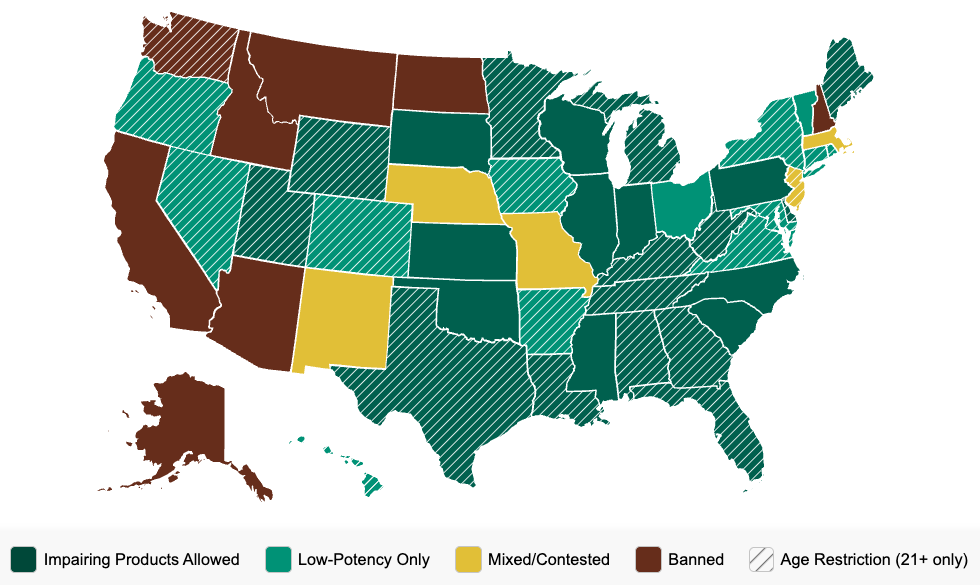
This brief draws from a Baker Institute database that provides a comprehensive overview of hemp policies across all 50 states as of April 2026 (Figure 1). Built using publicly available state legislative and legal documents, this database details key components of state hemp policy, such as age restrictions and potency limits. This brief discusses common state-level approaches to regulating consumable hemp products and offers recommendations for how hemp policy can effectively balance public health protections with consumer demand.
Figure 1 — Map of State Hemp Laws, April 2026
Product Bans
At least eight states and Washington, D.C. prohibit the sale of consumable hemp products with any detectable amount of THC. Raw hemp flower is still permitted in these states, but its total THC content must not exceed 0.3% and it is unlikely to cause impairment.
Notably, five states with consumable hemp product bans — Alaska, Arizona, California, Montana, and Washington — legalized marijuana for recreational use, and two of them — New Hampshire and North Dakota — legalized it for medical use. State marijuana markets typically operate within stricter regulatory systems than consumable hemp markets, reflecting a more deliberate rollout of marijuana legalization.
For states where recreational or medical marijuana use is legal, hemp product bans are likely driven less by concerns about impairment than by efforts to confine THC sales to more tightly regulated markets.
Age Restrictions
Public health officials and industry leaders alike agree on the importance of preventing youth access to impairing hemp products. Twenty-six states that allow sales of hemp products with THC prohibit their sale to individuals under 21. Age restrictions usually face little legislative opposition, yet some state efforts to enact these provisions have not passed. This typically has occurred when such measures are part of larger bills with contentious regulatory components. In North Carolina, for example, efforts to enact age restrictions have been paired with broader provisions to regulate or restrict certain hemp-derived products, drawing opposition from some lawmakers and industry stakeholders.
While age restrictions and verification requirements can effectively limit youth access at brick-and-mortar stores, they are far less effective at addressing youth access to online markets. A 2023 analysis published in the Journal of Cannabis Research found that approximately 85% of companies selling consumable hemp products online did not require age verification at the time of purchase.
Potency Thresholds
There are several approaches to regulating product potency. About half of all states permit products with enough THC to cause impairment. In the most permissive states, consumable hemp products are allowed as long as they contain no more than 0.3% delta-9 THC. This limit does not account for other forms of THC or tetrahydrocannabinolic acid (THCA).
THCA is a chemical precursor to delta-9 THC that converts into delta-9 when heated, at which point it can cause impairment. The omission of THCA from hemp THC measurement standards is widely viewed as a major loophole because it allows products, especially hemp flower and vape cartridges, to have technically legal levels of delta-9 THC but high levels of THCA. Roughly eight states still use a delta-9-only standard.
Other states account for THCA by requiring products to remain below 0.3% total delta-9 THC, or delta-9 THC plus THCA. However, approximately eight of these states rely solely on a weight-based potency standard and do not impose milligram caps for edibles or beverages. Because THC is measured in milligrams, a weight-only standard allows highly potent products to enter the market. For example, a 50-gram candy bar can satisfy the 0.3% threshold and contain up to 150 mg THC, far exceeding the limits permitted in most states with legal marijuana markets.
Several other states impose both weight-based limits and milligram caps while still allowing impairing products. Common THC caps are 5 mg, which may cause impairment in new or occasional users, and 10 mg, which is the standard threshold in state recreational marijuana markets. These serving limits suggest an effort to balance consumer demand for impairing products with the public health goal of reducing the risk of accidental overconsumption.
Approximately 13 states that permit consumable hemp products set potency caps low enough to effectively prohibit products that may cause impairment. For example, Arkansas, New York, and Rhode Island limit products to 1 mg total THC per serving, a non-impairing dose for most adults.
While serving caps are important, they do not sufficiently address total package potency. States that limit servings to less than 5 mg THC typically limit containers to 10 mg THC. However, exceptions exist; for example, Oregon limits servings to 2 mg THC and containers to 20 mg THC. States that allow impairing products often establish higher package limits. Alabama, Louisiana, and Minnesota permit 40–50 mg THC per container; Utah allows 150 mg THC per container; and Georgia permits up to 300 mg THC per container.
Packaging limits are crucial for reducing potential harms caused by pediatric exposures, as young children may consume an entire package that resembles a regular snack. From 2021 to 2022, not long after Congress legalized hemp, National Poison System data show increases in child exposures to delta-8, delta-10, and THC-0-acetate. Effects of cannabis exposure in children can range from lethargy and vomiting, to respiratory depression, seizure, or unresponsiveness. These harmful side effects also appear in child exposure cases in state with legal marijuana markets, where the industry has generally accepted the 10 mg THC per serving limit but has often opposed comparable container restrictions.
Chemical Conversion Bans
Chemical conversion refers to a process through which hemp-derived compounds — typically cannabidiol (CBD) molecules — are modified with solvents, acids, or other chemical catalysts to create THC isomers or analogs. Delta-9 and delta-8 THC, for example, are naturally present in hemp but in low concentrations. Manufacturers therefore often convert CBD into these compounds to produce them in commercially viable amounts.
At least 34 states now prohibit the sale of chemically converted cannabinoids, a policy that can limit product potency by restricting high concentrations of THC isomers. Roughly two-thirds of states with conversion bans also impose low-potency caps.
Beyond potency concerns, two additional issues are likely driving restrictions on converted cannabinoids. First, scientific evidence regarding their effects is limited. Delta-8 THC, for instance, is considered less potent than delta-9 THC, but the evidence is primarily anecdotal or relies on animal models. Other popular converted cannabinoids, such as THC-acetate ester (THC-O), do not occur naturally, while cannabinoids such as hexahydrocannabinol (HHC) and tetrahydrocannabiphorol (THCP) appear naturally only sporadically and in trace amounts. These compounds are considered more potent than delta-9 THC, but their short- and long-term effects on humans remain largely unknown.
Second, the conversion process itself raises safety concerns. Producing delta-8 THC typically involves combining CBD with chemical catalysts such as solvents and acids that restructure the molecule. Residual solvents, such as sulfuric acid, may remain in the final product and can cause harm when consumed. The process for making HHC, a hydrogenated form of THC, can involve heavy metal catalysts such as platinum and palladium, which are not included in standard hemp testing panels. Conversion can also create unintended by-products. Olivetol, for example, is a known by-product of cannabinoid conversion that can irritate the respiratory tract and is not screened for in standard hemp product analyses.
Hemp-derived delta-9 THC products are also not immune to these concerns. As delta-9 THC exists in hemp in low concentrations, manufacturers may rely on CBD conversion to produce it in greater quantities. According to a 2023 Journal of Cannabis Research analysis, 49% of 53 popular delta-9 hemp products sold online and in several states were likely produced through chemical conversion rather than natural extraction.
Although cannabinoid compounds can be synthesized safely, no uniform manufacturing standards or consistent testing requirements have been established to govern these processes. As a result, product composition and quality vary widely, increasing the risk of consumer exposure to unknown chemicals or harmful contaminants.
Advertising Restrictions
Unlike tobacco, which is subject to consistent federal marketing standards, hemp-derived THC products are regulated through a fragmented set of state policies. Federal prohibitions on false and misleading health claims apply to hemp product advertisements, but enforcement has been limited and episodic, relying largely on warning letters and targeted actions rather than systematic industry oversight.
At least 23 states that permit the sale of hemp-derived cannabis products impose some advertising restrictions, with most aimed at limiting unverified health claims and youth-appealing packaging and imagery. State advertising rules generally do not apply to web-based marketing, and analyses suggest that online venues may minimize the potential harms of consumable hemp products.
Another significant regulatory gap is the absence of limits on price promotions, such as buy-one-get-one sales and bulk discounts, that incentivize higher volume purchases. For comparison, some states with legal marijuana programs have restricted promotional practices, though these limits vary and change over time. Notably, New York repealed its marijuana promotion bans in 2025.
Enforcement Challenges
State efforts to more tightly regulate the consumable hemp industry face numerous challenges. In several states, illegal or improperly tested products can still be found in retail stores. Oversight resources are often limited and outmatched by the size of the hemp industry and the chemical complexity of its products. For example, as Texas was debating a ban on impairing hemp products during its 2025 legislative session, the Department of State Health Services reported having enough capacity to inspect stores only once every five years.
The lack of federal regulation increases state enforcement difficulties. This is especially the case for online sales, where enforcement against out-of-state retailers can raise concerns about improperly interfering with interstate commerce. Challenges related to testing, labeling, and age restrictions are amplified in the online marketplace, where oversight is minimal.
Some states have responded to enforcement challenges by limiting the types of businesses that can sell hemp products, thereby reducing the number of entities that require monitoring and inspection. Louisiana, for instance, does not permit the sale of consumable hemp products at gas stations. Others have reassigned enforcement authority to alcohol control boards or cannabis regulatory agencies in states that have legalized marijuana. A number of states have also pursued civil actions against noncompliant businesses, using litigation as a deterrence tool.
Policy Recommendations for Hemp Regulation
Implementing a full prohibition on consumable hemp products is not a practical policy solution due to their popularity and the market’s size. A minimalist regulatory approach is not sufficient, either. Rather, legislative guardrails are necessary to protect consumers from harmful products.
These measures should be implemented through federal channels and reinforced with complementary state policies. However, national action remains uncertain. Even if the narrower definition of hemp is implemented in November 2026, alignment between federal and state policies will still determine regulatory effectiveness.
The recommendations below follow an approach long used for alcohol and tobacco: allowing adults access to products that carry some risk, while limiting access to those who are underage and to products that pose the greatest risks.
1. Establish a National Age Limit and Product Safety Standards
State hemp regulations remain limited in effectiveness due to the absence of national standards governing consumable hemp products. The revised federal definition of hemp, if it goes into effect, could help address online sales to minors by making impairing products illegal at the federal level, thereby giving regulators clearer authority to take legal action against online retailers. However, the federal amendment does not include age limits or establish youth prevention measures. Thus, if states do not uniformly adopt the new federal definition, the current patchwork policy approach will likely remain.
The Cannabinoid Safety and Regulation Act, introduced in the Senate in December 2025, provides a comprehensive regulatory framework. It would prevent youth exposure through the following:
- Establishing a national age limit of 21 and older for sales.
- Requiring age verification with ID for online sales.
- Prohibiting products from using imagery that appeals to youth.
- Directing the FDA to establish child-proof, tamper-evident packaging standards.
It also sets serving and container caps for THC and mandates testing for pesticides, residual solvents, heavy metals, and compounds, such as sulfuric acid, that are used to synthesize cannabinoids.
This legislation would be a substantial step toward establishing consistent standards for consumable hemp products. However, significant obstacles to national regulation remain, including industry opposition, reluctance among federal regulatory agencies to oversee consumable hemp products, and disagreement on whether to regulate the products or ban them entirely.
2. Prevent Youth Exposure to Consumable Hemp Products
Limiting accidental and intentional cannabis consumption among young children and adolescents is an important public health goal. A collective set of policy tools can help reduce product attractiveness and limit accidental exposures by:
- Restricting sales to individuals 21 and older and requiring age verification at all points of sale.
- Limiting sales near schools.
- Requiring plain, child-resistant, and tamper-evident packaging.
- Placing serving and container limits on THC quantity.
- Prohibiting marketing that uses young models and imagery that appeals to youth.
Many states have already enacted some of these measures, though marketing restrictions remain largely inadequate.
States that have not yet enacted youth prevention measures should separate those provisions from more contentious regulatory concerns to improve the chances of achieving consensus.
3. Establish Product Potency Limits To Protect Children and Adults
Potency limits for cannabis products can reduce harms from both accidental ingestion by children and unintentional overconsumption by adults. The American College of Medical Toxicology recommends limiting THC content in cannabis products to 5 mg per serving and 50 mg per container to mitigate the severity of effects when young children accidentally consume these products. A 2023 study published in Pediatrics analyzing emergency department data within an urban hospital network indicates that ingestion of more than 60 mg of THC is associated with severe toxicity in small children.
These limits are lower than the 10 mg per serving standard in the legal marijuana industry and considerably lower than many states’ current container limits. Reducing the THC cap may affect convenience for some consumers and could face resistance from segments of the industry. However, these limits do not prevent adults from consuming more THC if they choose to do so. Given the documented risks of pediatric cannabis poisoning and the potential for high-potency products to encourage overconsumption, the public health rationale for lower potency limits outweighs concerns about consumer convenience.
Relatedly, cannabis products should not contain other psychoactive substances, including alcohol, caffeine, and tobacco. Such combinations increase the risk of adverse events and may encourage harmful patterns of use. While many states prohibit these combinations, existing restrictions are often only partial or not uniformly enforced. Greater alignment across state and federal policies would improve the effectiveness of potency regulations as guardrails against the highest-risk product types.
4. Restrict Chemically Converted Cannabinoids and Require Disclosure
Converted cannabinoids raise significant safety concerns because of the chemicals involved in the process and the lack of manufacturing and quality control standards governing their production. Reducing the number of potentially harmful products sold through legal challenges requires clear and enforceable standards for testing methods, product composition, and ingredient disclosure. Many states have banned chemically converted cannabinoids, and others should consider implementing similar policies. At minimum, product packaging should be required to clearly disclose when cannabinoids are produced through chemical conversion to allow consumers to make more informed decisions.
The revised federal definition of hemp set to take effect in November 2026 excludes chemically converted cannabinoids, thus making these compounds federally illegal. However, the proposed Cannabinoid Safety and Regulation Act takes a more nuanced approach by prohibiting “artificially derived” cannabinoids while still allowing “semi-synthetic cannabinoids” produced through a “single chemical reaction,” similar to delta-8 THC or a non-impairing cannabinol. This framework appears to recognize a distinction between cannabinoids produced through relatively modest chemical conversion and those created through more extensive chemical syntheses.
Delta-8 THC products are popular and abundant in the hemp market. If delta-8 THC is in fact a less potent isomer of delta-9 THC, its availability could provide an alternative to higher potency detla-9 products. Yet, more research is needed to fully understand delta-8 THC’s effects. Even if delta-8 THC is determined to be a relatively safe substance on its own, the safety of any chemically converted cannabinoid product ultimately depends on robust manufacturing and testing standards alongside consistent oversight.
Federal regulators and industry experts should collaborate to establish national standards that ensure product safety through label disclosures and testing regulations.
5. Align Hemp Marketing Restrictions With the Regulatory Approach Used for Tobacco
Tobacco marketing is constrained by the U.S. Tobacco Control Act and complementary state measures. Core features of these policies include restrictions on product giveaways, limits on certain promotional and sponsorship practices, and mandatory warning statements on packaging and in advertisements. While these controls are not without limitations — youth vaping rose significantly amid a period of heavy marketing toward this population — tobacco marketing limits have nevertheless contributed to reductions in smoking initiation and uptake.
Consistent state and federal rules are needed to curb marketing tactics that encourage heavier consumption of THC products. These measures should include limits on price promotions, restrictions on outdoor advertising and advertising in places with youth-dominant audiences, and enforceable truth-in-advertising requirements regarding health claims and product potency.
6. Remove Criminal Penalties for Cannabis Possession
Cannabis is a multibillion-dollar industry, yet individuals across the U.S. still face the risk of arrest and other legal consequences for possessing cannabis.
In states that prohibit marijuana but permit hemp, individuals may be arrested for possessing products purchased at state-licensed stores because law enforcement cannot reliably distinguish between legal hemp and illegal marijuana. Individuals who use cannabis may still face repercussions in states that allow some forms of cannabis possession, which could affect their access to employment and federally assisted housing as well as their immigration and firearm ownership statuses. Additionally, if the federal revision to the definition of hemp takes effect as written, it could recriminalize behavior that is currently lawful in several states, exposing individuals to arrest or other legal consequences.
Laws prohibiting behaviors that pose risks to the public, such as impaired driving, remain necessary. Public consumption can instead be discouraged with civil penalties rather than criminal sanctions. A similar approach should be taken for cases involving youth possession. While it should not be permitted, states should develop alternative responses to adolescent experimentation that avoid the long-term collateral consequences associated with legal system involvement.
7. Strengthen Efforts To Raise Awareness About the Risks of Cannabis Use
Marijuana legalization has coincided with a long-term decline in Americans’ perceptions of cannabis use as a risky behavior. This trend follows decades of federal messaging that often overstated cannabis’s harms, tying its use to impulsive and criminal behavior and invoking racist stereotypes of Mexican immigrants, Black Americans, and other minorities. While correcting this narrative was necessary, the shift toward greater acceptance of cannabis use many now be contributing to an underestimation of its health risks.
For example, high doses of THC have been linked to anxiety, acute psychosis, and cannabis dependence, and cannabis use can negatively affect brain development. It may also increase the risk of psychotic episodes among individuals vulnerable to or with a history of psychosis.
Chemically converted cannabinoids derived from hemp are less understood and less researched than delta-9 THC. While some consumers adopt personal strategies to reduce potential harms, others may not be aware of the specific risks associated with newer and increasingly complex products. Both the marijuana and hemp industries have likely benefited from limited consumer knowledge about the risk profile of modern cannabis products, as well as from lingering public skepticism of government messaging about cannabis use.
To date, public health messaging regarding hemp-derived cannabinoids remains minimal. By contrast, several states with legal marijuana markets have launched public education campaigns, and Massachusetts, for example, has demonstrated success in improving public understanding of cannabis risks.
However, state-level efforts tend to have limited reach. Nonprofit organizations, such as the Partnership to End Addiction, provide quality educational materials for families and schools, but achieving population-wide awareness remains difficult. The limitations of these partial approaches underscore the need for federal leadership. A national education effort modeled on effective tobacco prevention campaigns could help counter potentially misleading industry marketing and improve public understanding of cannabis-related risks.
Conclusion
Balancing individual freedom with protection from harm is a central task of public health policy. In the area of substance use, the United States has long struggled to find a middle ground between punitive prohibition and commercialized markets. This tension is now unfolding in hemp policy, where policymakers have both an obligation and an opportunity to develop robust and health-focused regulatory frameworks.
At the same time, the broader drug landscape is rapidly evolving. Both licit and illicit markets are being reshaped by the emergence of new synthetic substances and chemically modified drugs. This moment may represent an inflection point in how federal and state governments respond to modern substance use. Consistent and effective hemp policies can help establish a framework for regulating not only today’s cannabis market, but also the emerging drug trends that will likely shape future regulation and public health responses.
This publication was produced by Rice University’s Baker Institute for Public Policy. Wherever feasible, the material was reviewed by outside experts prior to release. Any errors or omissions are solely the responsibility of the author(s).
This material may be quoted or reproduced without prior permission, provided appropriate credit is given to the author(s) and Rice University’s Baker Institute for Public Policy. The views expressed herein are those of the individual author(s) and do not necessarily represent the views of Rice University’s Baker Institute for Public Policy.


