


Overview
- Texas Medicaid managed care organizations (MCOs) already offer a wide range of food-related value-added services (VAS), though access varies substantially by plan, program, and region.
- These services include meal delivery, nutrition counseling, transportation to food resources, grocery incentives, and limited emergency food supports.
- While there are pockets of innovation, such as grocery delivery memberships, flexible benefit choices, and transportation incentives, they are currently limited to select plans.
- Persistent gaps include low member awareness, variation in eligibility and benefit design, and limited public evaluation of impact.
- Recent policy changes, including HB 26 and authorization of In Lieu of Services (ILOS), create an opportunity to build on existing VAS infrastructure and lessons learned.
Context and Rationale
Value-added services have long been a tool used by Texas Medicaid MCOs to promote healthy behaviors, address non-medical drivers of health, and improve quality and member experience. Food-related VAS — ranging from meal delivery to grocery incentives — have emerged as a key strategy for addressing food insecurity among Medicaid members. However, information about these benefits is fragmented across individual plan websites and outreach materials, obscuring a clear statewide view of available services.
In 2025, Texas enacted HB 26, signaling increased policy attention to nutrition and other non-medical drivers of health within Medicaid. While HB 26 authorizes ILOS for certain nontraditional health supports, the existing valued-added services offer important insights into how MCOs are already addressing food and nutrition needs — and provide a roadmap for future implementation.
Policy Framework for Medicaid Food-Related Services
Under HB 26, Texas Medicaid may use ILOS to allow health plans to cover select nontraditional services when they are clinically appropriate and cost‑effective. VAS — plan-funded, optional benefits that supplement standard Medicaid coverage — offer a practical foundation for this policy shift. Historically, utilization of VAS has been limited by factors such as member awareness, navigation challenges, and variation in benefit design. As Texas moves toward ILOS implementation, existing food-related VAS function as real-world examples of how nutrition supports are delivered within managed care.
Texas Food-Related Medicaid Services Landscape
Categories of Support
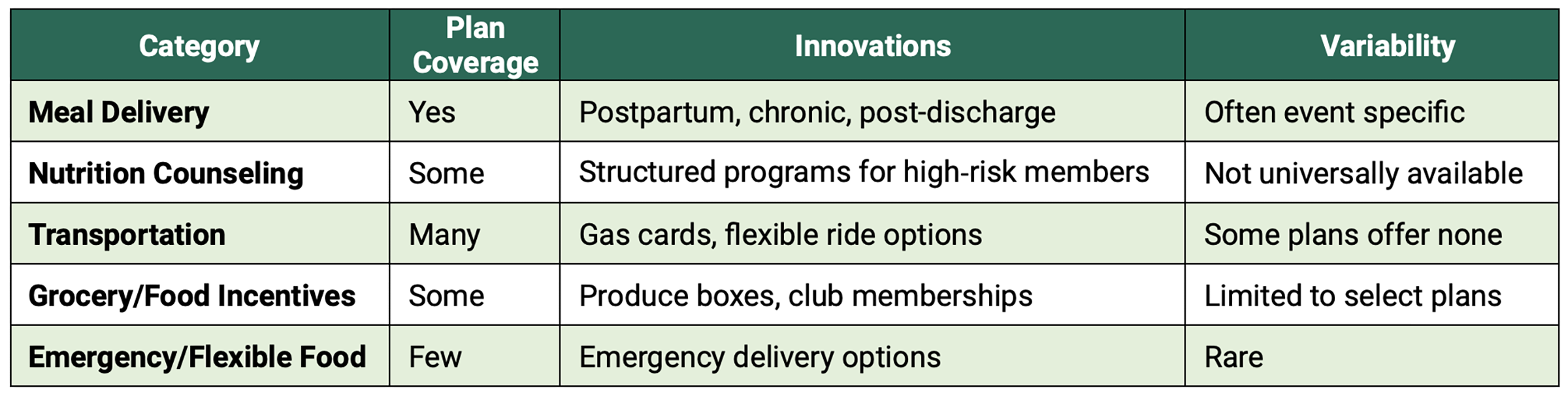
- Meal delivery: Often provided after hospitalization, postpartum, or for members with chronic conditions.
- Nutrition counseling: Access to dietitians or structured education and coaching programs.
- Transportation to food resources: Rides to WIC offices, food banks, grocery stores, and community events.
- Grocery and food incentives: Healthy food gift cards, produce boxes, or grocery delivery memberships.
- Emergency or flexible food support: Limited offerings to address acute or time-limited needs.
Breadth and Depth
Some MCOs — such as Community Health Choice, Wellpoint, and Driscoll Health Plan — offer multiple types of food-related VAS, creating more comprehensive approaches to food security. Other plans concentrate benefits on specific populations, including pregnant members, individuals with chronic conditions, or children with disabilities.
Variation Across Programs and Geography
Food-related VAS vary by Medicaid program — including STAR, STAR+PLUS, STAR Kids — and by service area. In some cases, an MCO offers substantially different benefits across programs within the same geographic region, contributing to uneven access for members.
Innovations and Pilot Programs
- Grocery delivery memberships, such as one‑year SHIPT subscriptions for high-risk pregnant members.
- Member choice models that allow selection among produce boxes, warehouse club memberships, or grocery gift cards.
- Transportation incentives, including gas cards designed to reduce barriers to accessing food resources.
While these approaches demonstrate innovation, they remain available in only a subset of plans and regions.
Key Gaps and Policy Recommendations
Key Gaps
- Low awareness and navigation complexity limit utilization of available benefits.
- Uneven availability and eligibility criteria contribute to variation in access across plans and regions.
- Limited public evaluation and shared learning make it difficult to assess impact or scale promising practices.
Policy Recommendations
- Leverage existing VAS infrastructure to inform design and rollout of ILOS nutrition supports.
- Strengthen communication processes to improve access.
- Strengthen data practices, including food insecurity screening, referral tracking, and outcome monitoring.
- Support partnerships with food banks, WIC providers, and community‑based organizations.
- Build capacity among service coordinators and provider partners to connect members to available supports.
Table — Food-Related Value-Added Services at a Glance
Conclusion and Path Forward
Food-related value-added services are an established but inconsistent component of Texas Medicaid managed care. While many MCOs offer meaningful supports to address food insecurity, variation in availability, awareness, and design limits their impact. As Texas seeks to expand and better align nutrition supports through tools such as ILOS, existing value-added services offer valuable insights into what works, where gaps remain, and how to integrate food-related services statewide.
Appendix — Food‑Related Value-Added Services by Program and Plan
Addressing food insecurity: Texas MCOs have developed a variety of food-related VAS to help address food insecurity and support healthy eating. A summary by program and plan follows:
STAR/CHIP/CHIP Perinatal
- Aetna: Weight loss programs, $25 quarterly allowance for health/grocery products, bus passes for WIC visits.
- Blue Cross Blue Shield Texas: Up to 14 home-delivered meals after hospital discharge, rides to non-Medicaid services.
- Community First Health Plan: Home-delivered meals for postpartum members, bus passes to grocery stores and community resources.
- Community Health Choice: Rides to WIC/food banks, $100 Baker Ripley membership for nutrition and wellness activities.
- Cook Children’s Health Plan: Monthly round trip for non-medical needs, $50 food benefit for pregnant/high-risk members.
- Dell Children’s Health Plan: Rides to food resources, fresh food delivery after childbirth, emergency food delivery.
- Driscoll Health Plan: Rides to food pantries, one-year SHIPT grocery delivery for high-risk pregnant members, nutritional counseling.
- El Paso Health: $25 food gift cards for new members, extra nutrition counseling for youth, gift cards for pregnant members.
- FirstCare/BSW: Monthly ride for groceries, WIC, fitness, or classes.
- Molina: Up to 10 home-delivered meals for members with behavioral health conditions (including depression), $30 gas reward for food resource visits.
- Parkland: Monthly ride to grocery/food bank/WIC, meal service for postpartum members.
- United: Four round-trip rides for uncovered health needs, including groceries.
- Wellpoint: Up to 12 round trips to WIC/food pantries, community events.
STAR+PLUS (For Adults With Disabilities and Older Adults)
- Community First Health Plan: Bus passes to grocery stores and community offices.
- Community Health Choice: Rides to food banks, access to a nutritionist, home-delivered meals post-hospitalization.
- El Paso Health: Ride service for non-medical needs, $50 Healthy Eats gift card for diabetic members, up to 14 home-delivered meals post-discharge.
- Molina: $15 gas reward for food resource visits, up to 10 home-delivered meals post-discharge, dietitian visits for diabetic members.
- Superior: Transportation for nutritional counseling, rides to benefit offices.
- United: Four round-trip rides for uncovered health needs, $60 flexible healthy food benefit post-hospitalization.
- Wellpoint: Up to 12 round trips to WIC/food pantries, one month of home-delivered meals post-discharge, choice of produce boxes, Sam’s/Costco membership, or $100 grocery gift card.
STAR Kids (For Children With Disabilities)
- Aetna: Bus passes for members and families to WIC and community events.
- BCBSTX: Rides to non-Medicaid services, up to 14 home-delivered meals post-discharge.
- Community First Health Plan: Bus passes to grocery stores and community offices, home-delivered meals post-hospitalization.
- Cook Children’s Health Plan: Monthly round-trip for social needs, $50 food gift card during hospitalization.
- Driscoll Health Plan: Rides to food pantries, one-year SHIPT grocery delivery for high-risk pregnant members, nutritional counseling.
- Superior: Up to 15 home-delivered meals per year post-hospitalization, rides to Social Security or food pantry.
- United: Four round-trip rides for uncovered health needs.
- Wellpoint: Up to 12 round trips to WIC/food pantries.
This publication was produced by Rice University’s Baker Institute for Public Policy. Wherever feasible, the material was reviewed by outside experts prior to release. Any errors or omissions are solely the responsibility of the author(s).
This material may be quoted or reproduced without prior permission, provided appropriate credit is given to the author(s) and Rice University’s Baker Institute for Public Policy. The views expressed herein are those of the individual author(s) and do not necessarily represent the views of Rice University’s Baker Institute for Public Policy.


