


Overview
Increasingly, services that address patients’ non-medical needs are being integrated into health care delivery to improve health outcomes. In Texas, we identified nearly 150 programs addressing patients’ non-medical needs, such as food insecurity, housing instability, and transportation access. In this emerging field of practice, it is critical to evaluate these programs to understand who they help, under what conditions, and at what cost. An initial review shows that only about half of these programs are being evaluated. This raises essential questions about current practices and how program evaluation can be advanced going forward.
Non-Medical Health Care Services in Texas
Health care providers, systems, and payers are expanding approaches to address patients’ non-medical needs. When incentives focus on improving health rather than performing more clinical procedures, non-medical services can have a big impact on program performance. This is because clinical care alone accounts for only a small portion — about 20% — of health outcomes. The other 80% is influenced by the conditions where people live, learn, work, and play. Addressing patients’ non-medical needs can improve health and avoid future higher-cost treatment by improving disease self-management, reducing vulnerability to future health issues, and increasing outpatient care.
The Texas Consortium for the Non-Medical Drivers of Health at Rice University’s Baker Institute for Public Policy partnered with the Kinder Institute for Urban Research to develop an online, searchable database to catalog programs across Texas that integrate non-medical services into health care delivery. Established in August 2023, the Non-Medical Drivers of Health Program Index is a searchable repository of non-medical project data.
As of November 2024, it contains abstracts of 148 programs across 36 distinct health care organizations. The program index offers valuable information about:
- Non-medical drivers.
- Health conditions.
- Sources of funding.
Importantly, the index also indicates whether the program has been evaluated. Evaluation is a systematic process of gathering and analyzing data to understand what a program is doing, as well as its accomplishments, benefits, value, or significance.
Link Between Funding and Evaluation
The sustainability of such programs always depends on funding. Funding decisions typically consider the effectiveness of programs in improving health and the costs associated with delivery. Therefore, evaluation of program outcomes is an essential component of program delivery and sustainability. This brief provides an initial review of the evaluation status of programs in the index and outlines plans for further investigation.
Evaluation Status of Non-Medical Programs
Evaluation: Yes or No?
Evaluation status was determined by asking the yes-or-no question: “Has the program been evaluated?” Additional instructions for determination outlined: “Evaluation may include internal or external evaluation, capturing some detail on whether the program is working, for what population, under what circumstances.”
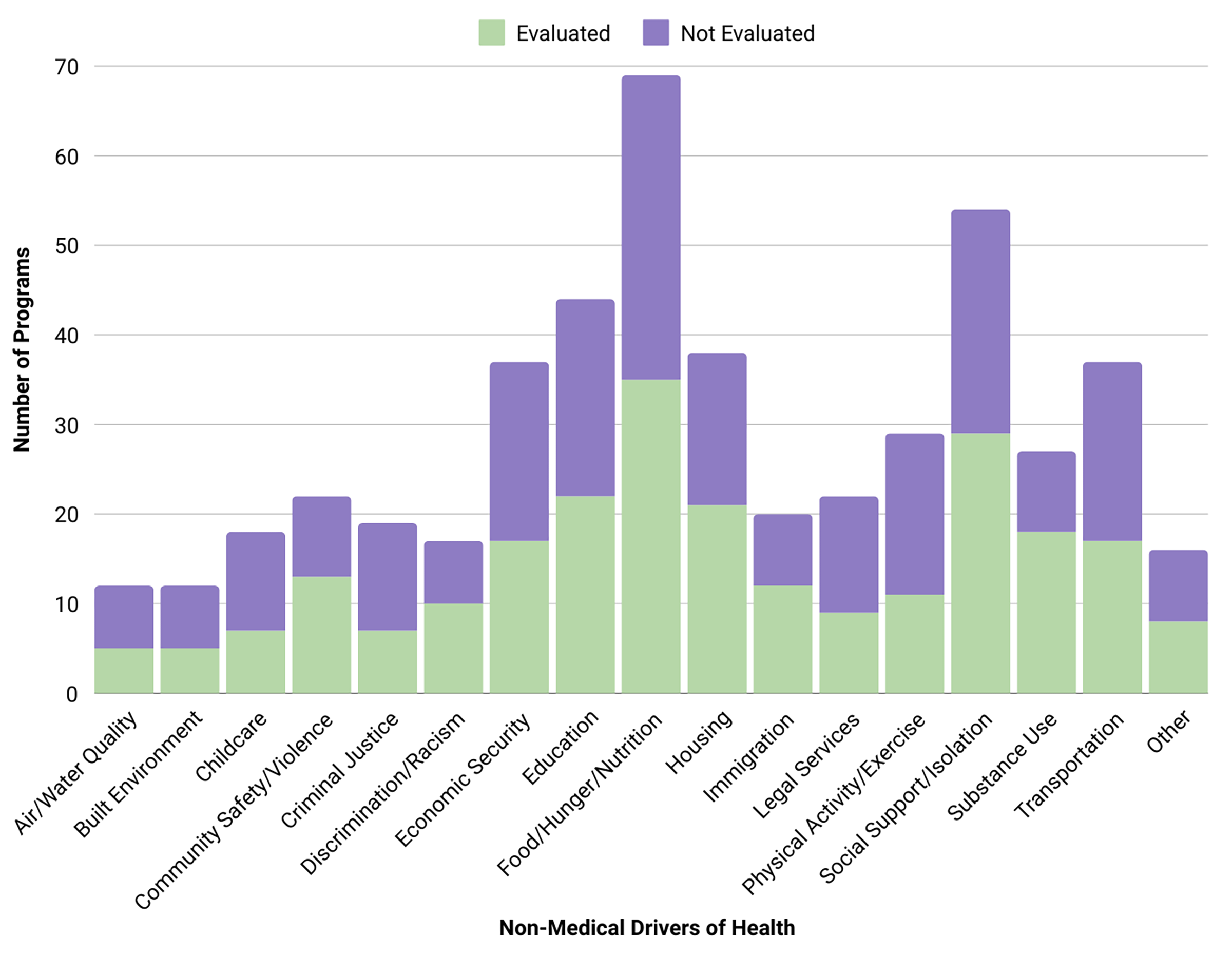
Of the 148 programs in the program index, 70 (47%) had been evaluated. This nearly equal split between evaluated and non-evaluated programs raises important questions about the health care sector’s approach to interventions that address non-medical drivers of health.
- For programs conducting evaluations, What evaluation methods are being used, and how do they measure impact?
- For those not conducting evaluations, What are the potential barriers being faced?
Types of Programs
Responses to evaluation questions were further examined to understand the relationship to program characteristics. There was a small positive correlation, which suggests that externally funded programs — such as those supported by grants — are slightly more likely to be evaluated than programs funded internally through operating budgets. In some cases, funding comes with expectations about measuring program impact. There was no significant relationship between evaluation status and the non-medical drivers or health conditions the program addressed (Figure 1).
Figure 1 — Evaluation Status by Non-Medical Drivers of Health
Next Steps for Increasing Evaluation Capacity
This initial review drives the need to learn more about how health care organizations evaluate programs addressing non-medical needs. Evaluation is crucial to justify program implementation, document effectiveness, and foster continuous quality improvement. To advance this field of practice in Texas, consistent and uniform evidence must be established.
The challenge of gathering evidence is not limited to non-medical services. In fact, only 10% of medical treatments have high-quality evidence demonstrating their effectiveness, highlighting the need for ongoing evaluation in health care delivery. To support the evaluation of non-medical services, the Texas NMDOH Consortium has hosted training through its webinar series and connected members with experienced program evaluators for consultations and evaluation guidance.
A Way Forward
Evaluations are not uniformly conducted in this new area of practice. However, building strong evidence through evaluation validates progress and provides insights for designing and sustaining future programs that address non-medical needs in health care. To grow this approach, it is critical to assess the content of evaluations and determine the methods and practices used. For those programs that have not been evaluated, it is important to identify barriers and find solutions for future assessments of program performance. Answers to these questions will be pursued in the consortium’s ongoing review and interpretation of evaluations in the program index.
This material may be quoted or reproduced without prior permission, provided appropriate credit is given to the author and Rice University’s Baker Institute for Public Policy. The views expressed herein are those of the individual author(s), and do not necessarily represent the views of Rice University’s Baker Institute for Public Policy.


