Home
Home

  • People
  • Events
    USMCA Flags
    Claudio X. González Center for the US and Mexico
    Thu, July 09, 2026 | 10 am - 11 am
    The State of Negotiations of the USMCA See Details
    AIHC New
    Science and Technology Policy
    Tue, Sep. 15 - Thu, Sep. 17, 2026 | 8 am - 6 pm
    AI in Health Conference See Details
    SynBio-Crop
    Science and Technology Policy
    Fri, Sep. 18, 2026 | 9 am - 5 pm
    Synthetic Biology at the Intersection of Science, Ethics, and Policy See Details
  • Podcasts
  • Research Programs
  • Research & Commentary
  • Press
  • Support
  • About
  • Newsletter
  • Search
  • Research
  • Twitter
  • Facebook
  • instagram
  • Linkedin
  • Youtube
  • Newsletter
  • Economics & Finance
  • Energy
  • Foreign Policy
  • Domestic Policy
  • Health & Science
  • All Publications
Center for Energy Studies | Commentary

Can DUCs Continue to “Goose” U.S. Oil Production?

March 17, 2022 | Mark Finley

Table of Contents

Author(s)

Headshot of Mark Finley

Mark Finley

Nonresident Fellow | CES Director's Council
Read More

Share this Publication

  • Facebook
  • Twitter
  • Email
  • Linkedin
  • Print This Publication
  • Cite This Publication

    Mark Finley, “Can DUC’s Continue To 'Goose' U.S. Oil Production?” (Houston: Rice University’s Baker Institute for Public Policy, March 17, 2022).

    Copy Citation

Over the past year, shale oil producers have increased production by drawing down their large inventory of drilled-but-uncompleted wells, known by industry short-hand as DUCs. I’ve written several times on this dynamic — see here, and here — and this short note provides an update.

But have most of the DUCs flown away by now?

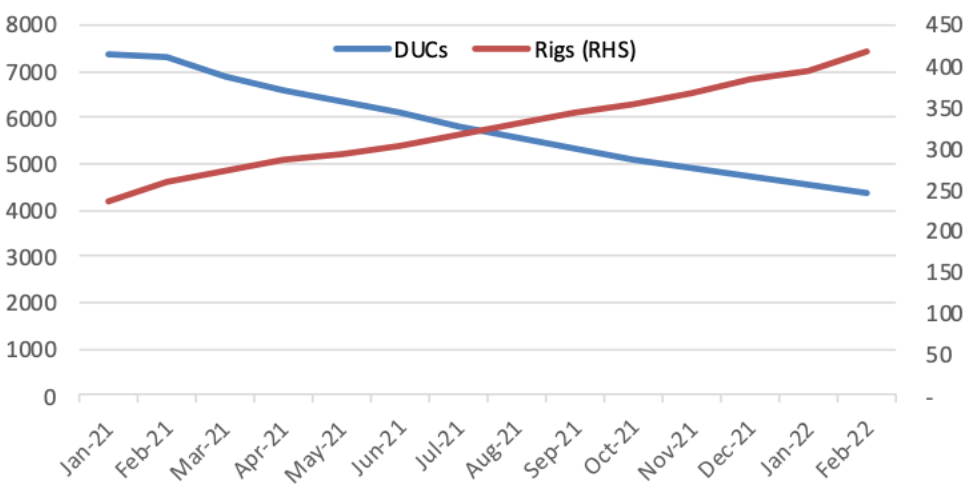
This week’s EIA Drilling Productivity Report — an excellent piece of work — shows the continued recovery rig activity in oil-focused plays (Permian, Eagle Ford, Bakken and Niobrara) as well as continued DUCs withdrawals. The pace of withdrawals has slowed — less than half the peak rate but still substantial (-132 in February).

Figure 1 — U.S. Shale: Rigs & DUCs
US shale: rigs & DUCs
Source  EIA DPR and author calculations (oil-focused plays only).


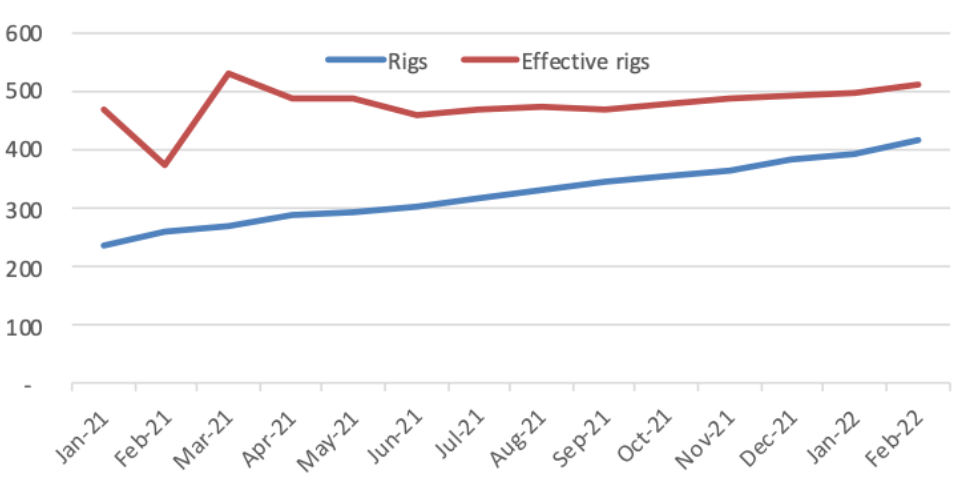
Assuming constant productivity (for both rigs and wells), we can roughly calculate the impact of DUCs withdrawals.  In other words, how many more rigs would have been needed to get the same production impact without DUCs?  In February, we’d have needed nearly 100 more rigs.

Figure 2 — U.S. Shale: Impact of DUC Withdrawals
US shale: impact of DUC withdrawals
Source  EIA DPR and author calculations (oil-focused plays only).


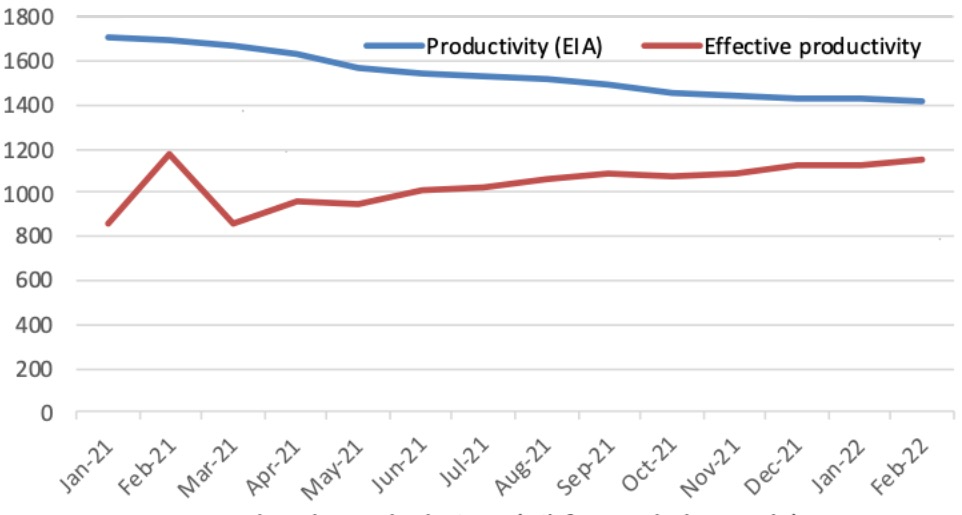
We can also see the impact of DUCs on EIA’s productivity measure, “new-well oil production per rig.”  On EIA’s data productivity has been declining; correcting for DUCs withdrawals shows that effective productivity is significantly lower … but improving.  Continued improvements in productivity would at least partly reduce the need for continued rig additions to offset DUCs slowing DUCs withdrawals.

Figure 3 — U.S. Shale: DUCs Impact on Productivity
US shale: DUC's impact on productivity
Source  EIA DPR and author calculations (oil-focused plays only).


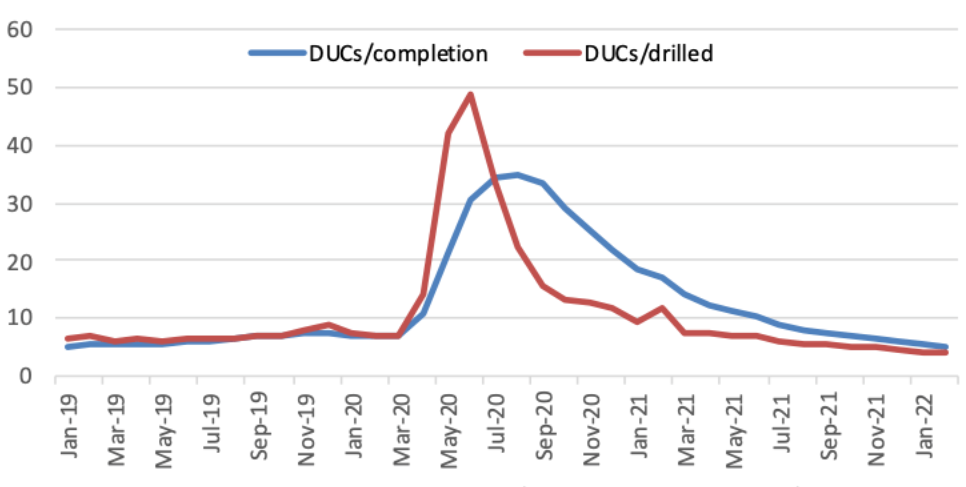
For how long can DUCs withdrawals continue to support U.S. oil production? Ratios of DUCs to underlying activity (either per completion or per well drilled) are now BELOW the pre-COVID levels.  This suggests we are nearing an end of the DUCs’ contribution.

Figure 4 — U.S. Shale: DUCs Ratios
US shale: DUCs ratios
Source  EIA DPR and author calculations (oil-focused plays only).


And we may already be seeing an impact for U.S. production as DUCs withdrawals slow:  EIA had to revise down its expectations for U.S. shale growth in the latest DPR.

With a growing focus on U.S. domestic production in the aftermath of Russia’s invasion of Ukraine, the depletion of the DUCs inventory represents an additional challenge for domestic producers.


This post originally appeared in the Forbes blog on March 17, 2022.  

  • Print This Publication
  • Share
    • Facebook
    • Twitter
    • Email
    • Linkedin

Related Research

3d wireframe model of a broken chain with random numbers.
Center for Energy Studies | Issue Brief

Sustainability in a Fragmented Global Economy: Managing Trade-Offs Across Interconnected Systems

Read More
EMEC1
Center for Energy Studies | Press Release

Rice’s Baker Institute launches Eastern Mediterranean Energy Center with US Department of Energy

Read More
Oil Field. Winter industrial landscape with an oil pump and torch in the background.
Center for Energy Studies | Issue Brief

How Declining Oil Production Could Weaken Russia’s Geopolitical Power

Read More
  • Contact Us
  • Donate Now
  • Press
  • Membership
  • Careers
  • Student Opportunities
  • About the Institute
  • Rice.edu

6100 Main Street
Baker Hall MS-40, Suite 120
Houston, TX 77005

Email: [email protected]
Phone: 713-348-4683
Fax: 713-348-5993

  • Twitter
  • Facebook
  • instagram
  • Linkedin
  • Youtube
  • Newsletter
  • © Rice University's Baker Institute for Public Policy
  • Web Accessibility
  • Privacy Policy