


Author(s)

This testimony was delivered by Jim Blackburn before the Subcommittee on the Environment of the House Committee on Science, Space and Technology on July 22, 2019.
Access the full written testimony in the PDF on the left-hand sidebar, or watch video of the hearing. Blackburn's remarks begin at the 38:10 mark.
How We Can Build Resilience to Storm Impacts
Building resilience to adverse impacts from surge and rain events is a very difficult issue. First, one has to define resilience, which I consider to be the ability to withstand impacts, being not only to absorb but also recover, to “spring back into shape.” In SSPEED Center’s initial work after Hurricane Ike, we were all struck by the difference between the impact of Ike’s surge on human development near Galveston on the Bolivar Peninsula, which was devastated, as compared to the adjacent natural marsh and prairie ecosystems, which were inundated up to twenty miles inland and recovered relatively
quickly.
These natural systems are resilient because they have evolved to survive and rebound from inundation. We made an early decision that from a non-structural flood damage reduction standpoint, we needed to encourage economic solutions that recognized the value of our coastal marshes and prairies because on the Texas coast, regulation to protect these areas is not likely to happen. We believed that if we could create monetary benefits from maintaining, enhancing or creating such resilient land uses, then we would be heading in the right direction. These economic solutions will be discussed further in Sections 3 and 4.
Second, a point of resilience relating to “living with water” evolved from Hurricane Harvey as well as many earlier large rain events in the Houston region. I doubt that any city in the world can “control” the flooding generated by a Harvey-like storm that dumped 40 to 50 inches of rain in 4 days. We can, however, minimize the damage from such storms by making more room for water in our communities. In Houston, we have tried to limit the expanse of our channels and bayou flood plains to maximize development immediately adjacent to them. Over time, this has proven to be unwise; we will need to move back development from the water’s edge, providing more room for the water and letting the bayous flood along their physical floodplains. The Dutch, who many consider to be the best flood protection thinkers in the world, have made a similar decision to “make room for the river” in their more recent projects. Flood water must be treated differently than in the past. We cannot banish it. We simply must expand the area “dedicated to water.” That will generate land use consequences that are discussed in Section 4 below.
Third, for us here in Houston to become resilient, we must address coastal surge flooding in the Houston-Galveston area, which threatens the largest refining and chemical complex in the United States. The 2.2 million barrels of refining capacity and 200+ chemical plants on the west side of Galveston Bay are very much at risk from the large storms we are starting to see. This infrastructure represents 13% of U.S. refining capacity and almost 27% of the jet fuel capacity of the United States. This is a bona fide national security issue not adequately addressed by current methodologies (see Section 4), and this critical infrastructure is not going to be able to just move from harm’s way. The industrial complex along the Houston Ship Channel and Galveston Bay has to be protected with structural solutions if it is going to survive the next several decades. Just as important is the need to protect the approximate 800,000 people living adjacent to the western shoreline of Galveston Bay, many of whom work at these plants. The western bay area potentially inundated by storm surge from a weak Category 4 hurricane (also known as FEMA Storm 36) is shown in Figure 1.
Figure 1 — Projected inundated area (in purple) from a weak Cat 4 (FEMA Storm 36) coming ashore at the worst location for Houston
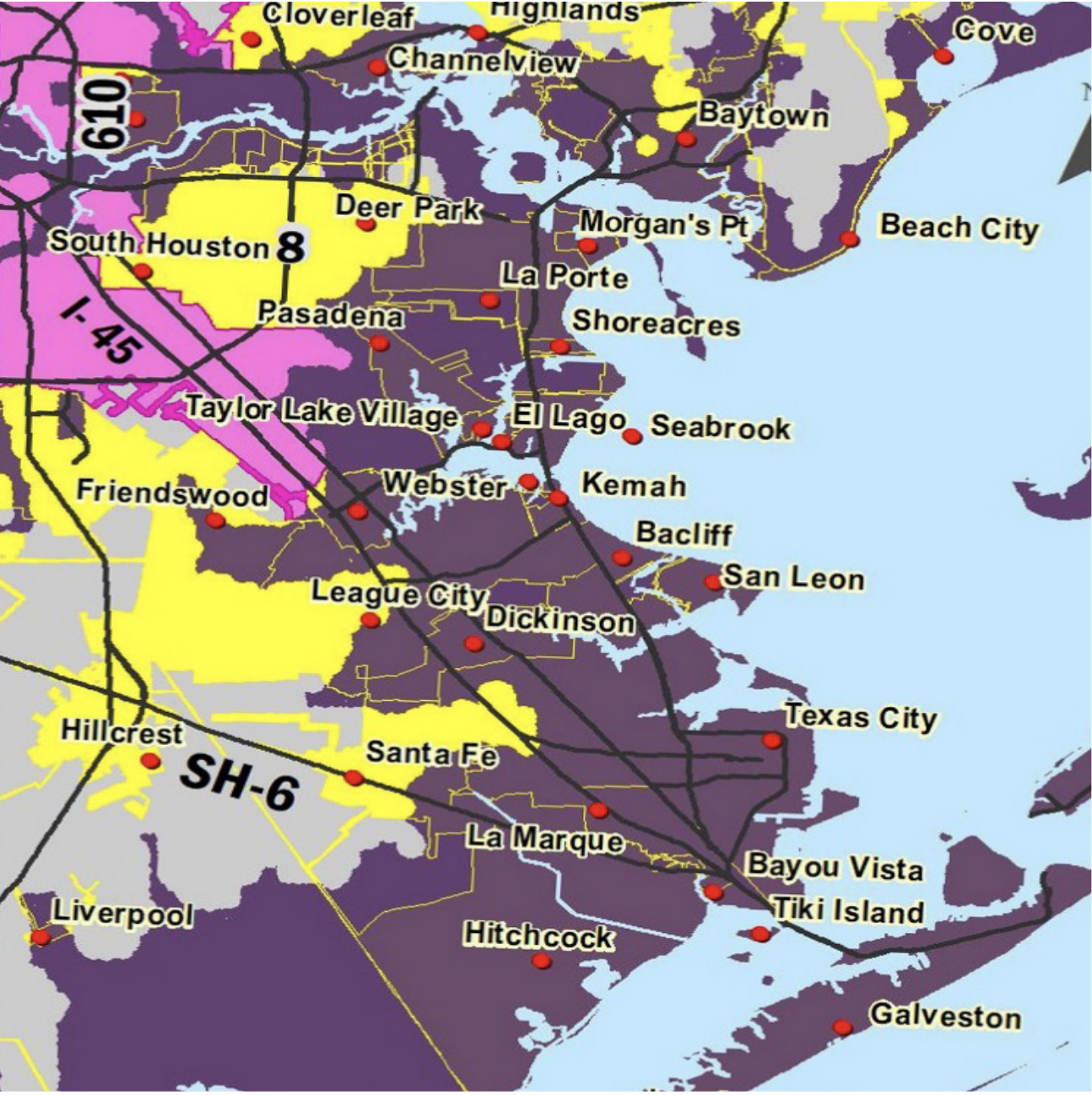
Such a hurricane’s storm surge would inundate the area shown in purple, including the western bay cities that are identified and the refining and chemical complexes up the Houston Ship Channel (top center), the Bayport complex (north of Taylor Lake Village and El Lago) and the Texas City industrial complex. Areas shown in yellow are the portions of incorporated cities not flooded by this surge, the pink area is that part of the City of Houston also not flooded by this surge and the light grey is unincorporated areas not flooded by this surge.
In the case of the Houston Ship Channel (a federal navigation project), non-federal action may generate surge protection to a greater level than federal action will provide, an important piece of the resilience puzzle that is related to both the characterization of the risk and the flexibility of our evaluation tools. To this end, the SSPEED Center has proposed the Galveston Bay Park Plan, an in-bay surge protection system that is compatible with and supplemental to the Coastal Spine barrier recently proposed by the U.S. Army Corps of Engineers. Further discussion of this issue is set out in Sections 3 and 4 of this presentation.
Fourth, for humans to be resilient, we need vision, information and action. Vision includes mimicking nature where possible, “living with water” and protecting critical infrastructure and people from the big storms of the future. Good information is imperative to making sound decisions, yet it is lacking, if not absent, at least in the Houston region regarding issues such as the size of rain events and hurricanes in the future, flood detection and warning and public awareness and education. We often seem to skip this step of good information and go directly to “action”, and that is a major resilience-related mistake from my perspective.


