Home
Home

  • People
  • Events
    Map of the Middle East
    Wed, June 10, 2026 | 5 pm - 6:45 pm
    The Middle East and US Foreign Policy: What Happens Next? See Details
    AI in Health Conference_Banner Image
    Science and Technology Policy
    Tue, Sep. 15 - Thu, Sep. 17, 2026 | 8 am - 6 pm
    AI in Health Conference See Details
    SynBio-Crop
    Science and Technology Policy
    Fri, Sep. 18, 2026 | 9 am - 5 pm
    Synthetic Biology at the Intersection of Science, Ethics, and Policy See Details
  • Podcasts
  • Research Programs
  • Research & Commentary
  • Press
  • Support
  • About
  • Newsletter
  • Search
  • Research
  • Twitter
  • Facebook
  • instagram
  • Linkedin
  • Youtube
  • Newsletter
  • Economics & Finance
  • Energy
  • Foreign Policy
  • Domestic Policy
  • Health & Science
  • All Publications
Center for Health Policy | Health Economics | Research Paper

Vaccine Legislation in Texas and the Rise of the State Anti-Vaccine Movement

November 30, 2020 | Sarah Lasater, Rekha Lakshmanan, Kirstin R.W. Matthews
Vaccine

Table of Contents

Author(s)

Sarah Lasater

Research Assistant, Center for Health and Biosciences, Baker Institute

Rekha Lakshmanan

Nonresident Fellow, Center for Health Policy

Kirstin R.W. Matthews

Fellow in Science and Technology Policy

Share this Publication

  • Facebook
  • Twitter
  • Email
  • Linkedin
  • Download PDF
  • Print This Publication
  • Cite This Publication

    Sarah E. Lasater Rekha Lakshmanan Kirstin R.W. Matthews, Ph.D. “Vaccine Legislation in Texas and the Rise of the State Anti-Vaccine Movement: A Survey of Vaccine-Related Bills Filed and Passed in the Texas State Legislature from 2009 to 2019”

    Copy Citation

Tags

VaccinesHealth careTexasVaccine legislation

Over the past decade, anti-vaccine rhetoric and activity have increased in the United States, resulting in decreased vaccination rates and more frequent outbreaks of vaccine-preventable diseases. In this study, researchers use Texas as a case study to determine if vaccine-related legislation became a partisan issue between 2009 and 2019. 

Read a summary of the study below, or download the full paper on the left-hand sidebar.

Purpose

  • The goal of this paper was to assess whether vaccine policies have moved from being a public health issue to a partisan issue in Texas over the last decade.
  • The authors reviewed and analyzed vaccine-related bills filed and passed in the 2009, 2011, 2013, 2015, 2017, and 2019 Texas legislative regular sessions.

Results

  • Between 2009 and 2014, 104 vaccine-related bills were filed; 31 received floor votes, and 21 passed (a 20% passing rate, similar to the overall passing rate in each legislative session).
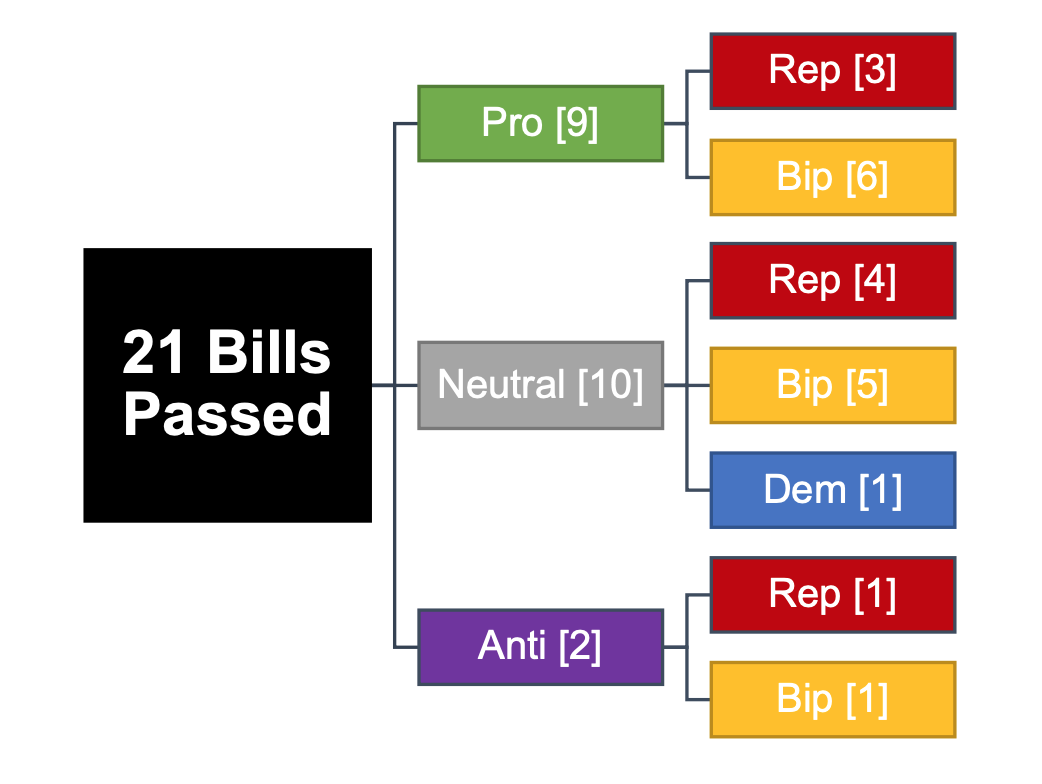
Chart that shows the number of vaccine-related bills passed in Texas and whether they were pro-vaccine, anti-vaccine, or neutral.
  • Most bills that passed had bipartisan support (13), followed by seven that were sponsored only by Republicans, and just one that was sponsored exclusively by Democrats.
  • Most bills that passed were neutral in content (10), followed by nine pro-vaccine bills, and only two anti-vaccine bills.
  • While more Republicans filed anti-vaccine bills (13) compared to Democrats, they also filed just as many pro-vaccine bills (13) and eight neutral bills.
  • Most bills that passed were related to vaccine information, the Texas Immunization Registry, or vaccine availability and access.
  • There were no strictly pro- or anti-vaccine hotspots in Texas.
  • Floor votes did not trend along party lines.

Conclusions

  • Vaccine policies do not seem to be a partisan issue in the Texas Legislature.
  • Bipartisan sponsorship helped improve the chances of bills being passed.
  • Neutral and pro-vaccine bills were passed, but bills on divisive issues, such as non-medical exemptions, were more challenging to pass.

For more information on vaccine policy and Baker Institute research, email [email protected].


This material may be quoted or reproduced without prior permission, provided appropriate credit is given to the author and Rice University’s Baker Institute for Public Policy. The views expressed herein are those of the individual author(s), and do not necessarily represent the views of Rice University’s Baker Institute for Public Policy.

© 2020 Rice University’s Baker Institute for Public Policy
https://doi.org/10.25613/316v-r631
  • Print This Publication
  • Share
    • Facebook
    • Twitter
    • Email
    • Linkedin

Related Research

Child at play on colorful playground equipment
Center for Health Policy | Podcast

How Public Policy Can Nurture Childhood Resilience

Read More
Family building atoms model
Center for Health Policy | Podcast

How Science Misinformation Affects Parenting and Child Health

Read More
Student walking toward school bus
Center for Health Policy | Podcast

How School Safety Policies Affect Student Well-Being

Read More
  • Contact Us
  • Donate Now
  • Press
  • Membership
  • Careers
  • Student Opportunities
  • About the Institute
  • Rice.edu

6100 Main Street
Baker Hall MS-40, Suite 120
Houston, TX 77005

Email: [email protected]
Phone: 713-348-4683
Fax: 713-348-5993

  • Twitter
  • Facebook
  • instagram
  • Linkedin
  • Youtube
  • Newsletter
  • © Rice University's Baker Institute for Public Policy
  • Web Accessibility
  • Privacy Policy