


Author(s)

To access the full paper, download the PDF on the left-hand sidebar.
An Introduction to Stem Cells
Stem cells are cells that have the potential to replicate themselves for indefinite periods and to divide, producing one copy of themselves and one cell of a different type (differentiation). In humans, stem cells have been located in the early stages of development after egg fertilization (around five to six days); the umbilical cord and placenta; and in several adult organs.
Regardless of their source all stem cells have two general properties:
- Stem cells are capable of dividing and renewing themselves for long periods. Unlike muscle cells, blood cells, or nerve cells — which do not replicate themselves — stem cells can divide continuously and keep their innate properties.
- Stem cells are undifferentiated and can give rise to multiple cell-types. Stem cells do not have any tissue-specific structures that allow them to perform specialized functions. They cannot carry molecules of oxygen through the bloodstream like red blood cells or release signals to other cells, such as permitting the body to move or speak, as nerve cells do. Although stem cells do not have any tissue-specific structures, they can give rise to differentiated cells, including red blood cells and nerve cells.
Stem cells have varying abilities to differentiate into different cell-types. One type of stem cell can give rise to any other cell-type of a given organism (for example, an embryonic stem cell). Other stem cells can only give rise to cells of a given tissue type (for example, bone marrow can produce blood stem cells) or only give rise to a few cell-types in a given tissue.
Figure 1 — The Potential Uses of Embryonic Stem Cells
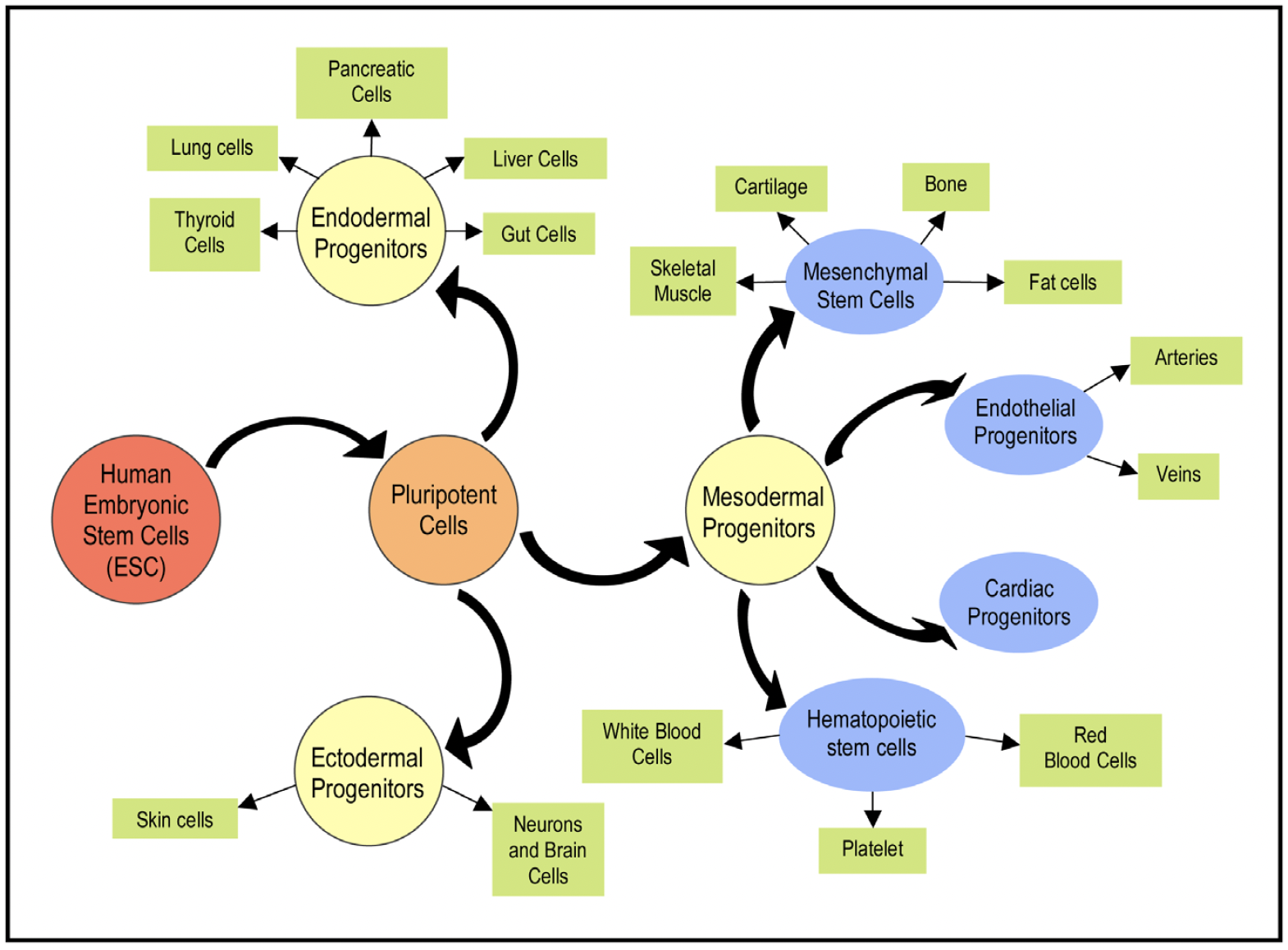
Scientists are just beginning to understand the signals in a body which can trigger cell differentiation. These signals can be created within a cell, triggered by a cell’s genes, or by a neighboring cell that releases chemicals to promote differentiation in other cells. Determining what these signals are and what stem cells require to differentiate into different cell-types is a crucial research area which must be explored in order to utilize stem cells for therapies.
When cells differentiate, their abilities become more restricted. They often follow only a few prescribed pathways and can lose the capacity to replicate themselves. The ability of stem cells to replicate and remain unspecialized until they are needed is an important area of research vital to understanding human development.
Stem cells offer a new look at old problems and diseases such as burns and diabetes. Although the field is relatively new, the impact of new discoveries could profoundly change medical research and therapy. Many of these new approaches involve the use of somatic cell nuclear transfer (sometimes known as therapeutic cloning) to produce recipient-specific tissue by creating embryonic stem cell lines.
This new area of research has great potential, but it is not without its controversies. Many ethical dilemmas are produced with the creation and destruction of human blastocysts as well as the potential to clone an entire human being (reproductive cloning). No matter where society designates the boundary to be for this research, or whether stem cells can live up to our high expectations, a great deal can be learned through careful and thoughtful studies.


