


Author(s)

Introduction
There are approximately 74 million children in the United States, and 21% of them live in families with incomes below the federal poverty threshold. Poverty puts children at risk for poorer health and reduced educational achievement. The vitality of a nation depends, in part, on the wellbeing of future generations. Yet unlike other developed countries, the U.S. has not prioritized the welfare of children; it ranks near the bottom on standard measures of child health and well-being among Organisation for Economic Co-operation and Development (OECD) nations. For instance, the overall health of American children ranks second to last, and educational achievement in math, reading, and science is ranked 21st out of 25, with 25 being the worst. Poor health and educational outcomes could be related to inadequate brain development during childhood.
Advances in neuroscience and developmental biology demonstrate that a child’s health and ability to learn is determined by how well the brain develops during the first few years of life. The brain controls the biological effects of all other organ systems and influences intelligence, learning, health, and behavior. Because the brain controls these different aspects of human life, impaired brain development as a child can lead to low educational outcomes and suboptimal physical, mental, and behavioral health, which together cause decreased functioning in society when these children reach adulthood. Therefore, investments in early childhood to support healthy brain development can improve children’s health and learning, thus reducing societal costs in remediation, health care, mental health services, and incarceration.
Causes of Poor Brain Development
Table 1 — Factors That Influence Early Childhood Brain Development
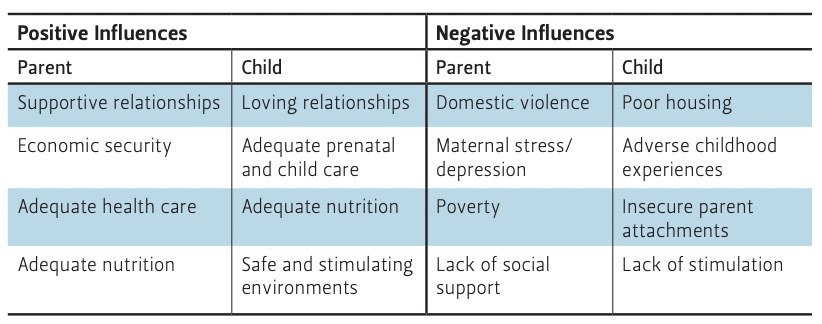
There is a critical window from birth to age 4 when the brain development of a child is most affected. During this period, new neuronal connections are formed at the rate of 700 new connections per second. Neurons that remain inactive or are rarely stimulated are eliminated, and those that are stimulated by experience are strengthened and maintained. The caregiver’s response to the child’s verbal or nonverbal communication, often called “serve and return,” shapes which neuronal connections remain and which are eliminated, making caregiver-child relationship the most significant influence on brain development. Negative caregiver-child interactions, such as insecure parental attachments, can create irreversible changes in the brain that impede the child’s intelligence, learning, behavior, and mental health. Many external factors influence the caregiver-child relationship (Table 1), and families living in poverty are most at-risk for experiencing negative influences.
Policy Recommendations
Current federal policies can have a greater positive impact on reducing deficits and strengthening the economy if there is a focus on supporting the optimal brain development of the next generation. There is strong evidence that investments in early childhood yield 7 to 10 percent per year return on investment, measured by increased school and career achievement and reduced expenditures for remedial education, health, and the criminal justice system. Therefore, we recommend revisions to the following current policies:
1. Expansion of the Early Head Start Program (EHS)
Head Start (HS) programs have demonstrated greater parental involvement and higher earnings for participating children when they reach their 20s. Several evaluations of the Early Head Start program have demonstrated improved parent-child relationships and higher cognitive, language, and social-emotional development in children who participated in EHS compared to those who did not. However, there often are not enough spots in HS and EHS to enroll all children from low-income working families that need child care. We recommend increasing funding for HS and EHS to increase access to these evidence-based programs for all children who need it.
2. Increase licensure requirements and wages for child care workers
Licensing requirements for child care workers vary by state and often do not require more than a high school diploma. Additionally, wages are very low and, therefore, retaining skilled providers is difficult. Because low-income children in working families spend a lot of time with child care providers, we recommend policies that support additional training and increased wages for child care workers.
3. Provide federal funding for mandatory parenting classes for those enrolled in Women, Infants, Children (WIC) and Supplemental Nutrition Assistance Program (SNAP)
Evidence-based parenting programs have been consistently identified as one of the most cost-effective evidence-based public policy solutions for child welfare. We recommend a requirement and additional funding for states that receive federal funds for WIC and SNAP to provide free parenting classes to families receiving benefits. Raising healthy children results in healthy adults. In order to increase the capacity of American children to become productive citizens and compete in a global economy, it is vital that future federal policies include a focus on improving children’s brain development.
References
Currie J., D. Thomas. June 1995. “Does Head Start make a difference?” American Economic Review 85, no. 3: 341–364
Eagleman, D. The Brain: The Story of You. 2015. New York: Pantheon Books.
Harvard University Center on the Developing Child. “The Science of Early Childhood Development.” bit.ly/2nAPEYz.
High/Scope Educational Research Foundation. November 2004. The High/Scope Perry Preschool Study Through Age 40. Accessed March 17, 2017. bit.ly/2mc4zvb.
Lee S. et al. April 2012. “Return on investment: evidence-based options to improve statewide outcomes.” Document No. 12-04-1201. Olympia: Washington State Institute for Public Policy.
Rolnick, Art and Rob Grunewald. March 2003. Early Childhood Development: Economic Development with a High Public Return. Accessed March 17, 2017. bit.ly/2mYkr3h.
Heckman, James J. and Dimitriy V. Masterov. October 2004. The Productivity Argument for Investing in Young Children. Accessed March 17, 2017, bit.ly/2mRTOvd.
UNICEF Innocenti Research Centre. 2007. “Child poverty in perspective: An overview of child well-being in rich countries. Report Card 7.” uni.cf/2niEyKl.
This material may be quoted or reproduced without prior permission, provided appropriate credit is given to the author and Rice University’s Baker Institute for Public Policy. The views expressed herein are those of the individual author(s), and do not necessarily represent the views of Rice University’s Baker Institute for Public Policy.


