


Overview
Social and environmental impacts have historically received limited consideration in the planning and execution of infrastructure projects. This lack of attention is often evident in the communities that experience disruptions to their social and physical landscapes as a result.[1] In response, governments and private entities are increasingly required (by the public and existing regulations) to identify and address potential consequences of large infrastructure projects on the physical and social environment through more comprehensive impact assessments and participatory processes.[2]
Although governments, corporations, civil society, and international organizations play central roles in shaping large-scale development and infrastructure, significant challenges remain in how they address potential physical and social harms associated with these projects.[3] However, this is slowly changing through businesses’ engagement with the emerging green economy, and many companies’ pursuit of accessing new markets, securing resilient supply chains, and reducing carbon emissions, sometimes by adopting so-called nearshoring strategies that relocate manufacturing closer to end markets.[4] While these supply chain shifts are positive in some respects, they often reproduce or exacerbate uneven social and environmental burdens in the communities where companies relocate.
This report, which is the result of a research project led by the Claudio X. González Center for the U.S. and Mexico and the Department of Science, Technology and Innovation Studies, part of the School of Social and Political Science at the University of Edinburgh, explores these tensions through a comparative analysis of infrastructure development impacts depicted in two case studies:
- Industrial development along the United States-Mexico border, specifically Ciudad Juárez, the largest city in the northern Mexican state of Chihuahua.
- Offshore wind infrastructure in the United Kingdom, focusing on the East Lothian coast in Scotland.
Through an environmental justice framework, the report examines these significantly different projects and their specific contexts. Ultimately, it aims to identify common challenges experienced across most infrastructure development projects and to propose pathways for more equitable and sustainable infrastructure transitions that reduce impacts on physical and social environments.
Environmental Justice: A Concept Across Borders
Environmental justice (EJ) is a powerful and adaptable framework that transcends political, geographic, and ecological boundaries. At its core, EJ encapsulates the effort to address environmental injustice: the disproportionate exposure of socially, politically, and economically marginalized populations to environmental harm. Although a universal definition remains elusive, EJ overall embraces the fair treatment of all people — regardless of race, color, national origin, or income — concerning the development, implementation, and enforcement of environmental laws, regulations, and policies.[5]
Rooted in a historical and broader philosophical debate over justice, EJ has evolved beyond traditional notions of distributive fairness to integrate recognition and procedural elements.[6] This approach allows those who employ an EJ framework to examine which and how environmental benefits and harms are distributed, who are recognized as potentially affected communities, and how infrastructural and social decisions are made.
EJ provides a comprehensive basis for examining equity of access across systems, such as energy, water, and food, as well as the right to a clean environment. Three key aspects are central to address in an EJ framework in this context:
- Inequitable exposure to harm.
- Unequal distribution of costs and benefits of environmental policies.
- Barriers to participation and legal recourse.[7]
Environmental injustices are not confined to a single region; they unfold in both the Global North and South, often involving transboundary ecosystems, global corporations, and international policy regimes. An EJ framework’s ability to link material, symbolic, and institutional dimensions of injustice makes the approach an indispensable tool for confronting environmental inequality and for highlighting the recurring character of these issues across disadvantaged groups.[8]
The following sections examine EJ dynamics in two distinct contexts: the U.S.-Mexico border and the Scottish coastal region.
Geographical and Political Border of the US and Mexico
For over three decades, the U.S.-Mexico border region has witnessed notably disproportionate impacts on low-income groups across its almost 2,000-mile length. The border dynamics have intensified traffic, pollution, industrial production of waste and population growth, exacerbating binational competition for resources.[9]
The anticipated arrival of a new wave of infrastructure development and the expansion of nearshoring efforts in the region is expected to place further burdens on border populations. These communities are particularly vulnerable due to the region’s demographic stress and persistent social inequalities, which is compounded by a changing climate and the cumulative impacts of 30 years of high industrial activity.[10]
Carolina Prado introduced the notion of borderland environmental justice (BEJ) as a unique perception distinct from mainstream U.S. and other placed-based EJ definitions.[11] Shaped by the complex sociopolitical dynamics of the U.S.-Mexico border, BEJ is defined by four key factors:
- Socio-ecological integration: Acknowledging that the border region is ecologically interconnected through shared natural systems, such as rivers and wildlife corridors.
- Core-periphery economic relationship: Highlighting the post-North American Free Trade Agreement (NAFTA) era, where northern Mexico has become a production hub for multinational companies, but local communities disproportionately experience the environmental and social consequences.
- Fragmented governance: Stressing how environmental management is divided among multiple government levels in both countries, creating overlapping jurisdictions and gaps in accountability.[12]
- Spatial and gendered injustice: Pointing out the gender gap in the border-area factory workforce, which increasingly faced intensified environmental risks due to systemic inequalities, such as low education, poverty, and exclusion.[13]
Ecosystemic Border of the Scottish Coast
The new offshore wind developments along the coast of Scotland form an ecosystemic border where the land and sea environments intersect. The distinction between onshore and offshore wind draws also a clear line between two types of large infrastructure projects:
- Onshore wind projects have well-known socio-environmental impacts on land to communities of humans, animals, and broader ecosystems.[14]
- Offshore wind projects are larger but newer infrastructure developments, and many of their potential socio-environmental impacts and benefits remain unknown or currently under study (Figure 1).[15]
The natural borders between sea, land, and air form a nexus for EJ issues, directly connecting and creating tensions between diverse communities of humans and living beings, such as local fishermen, energy companies, birds, and aquatic fauna.[16]
The scope of an EJ approach lies in its ability to connect material, symbolic, and institutional forms of injustice across scales and contexts. As Nancy Fraser and David Schlosberg argue, achieving justice in one dimension often depends on progress in the others, making EJ a truly borderless framework for understanding and addressing environmental inequalities.[17]
Figure 1 — Offshore Wind Turbines

Environmental Justice and Large Infrastructure Projects
Large infrastructure projects are at the center of EJ debates, even when they are meant to improve lives and sometimes help to protect the environment. This is particularly evident in regions undergoing rapid physical transitions, such as the U.S.-Mexico border, which is facing industrial infrastructure development, and the U.K., which is currently undergoing offshore wind expansion. While often deemed essential for advancing low-carbon goals and regional economic development, these projects are nonetheless entangled with complex social, political, and environmental dynamics that tend to challenge assumptions of fairness and justice.
Nearshoring Along the US-Mexico Border
The shift toward nearshoring in the U.S.-Mexico border to more efficiently access the U.S. and Canadian markets was expected to drive significant infrastructure investment in the region. While nearshoring is considered more of a business strategy aimed at reducing transportation-related carbon emissions and improving local environmental standards, it is not large-scale infrastructure development itself. Instead, it serves as the major catalyst and driver for that growth, putting intense pressure on the receiving regions to fund and build the necessary roads, power grids, industrial parks, and border facilities to accommodate new businesses and workers. Altogether, this places a considerable strain on local communities.
While the projected economic growth from nearshoring has not been clearly manifested or adequately documented in the past few years, current market dynamics are introducing significant new stressors. Specifically, the surging need for data centers is placing unprecedented pressure on the border region’s land supply and critical resources, particularly water and energy.
Additionally, the U.S.-Mexico border region is experiencing increasing climate vulnerability, largely intensify preexisting inequalities, particularly in areas with transboundary water conflicts, limited ecosystem services, resource competition, and weak environmental enforcement.[18]
Offshore Wind Across the UK
In the U.K., decarbonization initiatives focus on a just transition, which seeks to balance environmental objectives with social equity through more inclusive governance. Yet, as the country scales up offshore wind power — set to reach 50 gigawatts (GW) by 2030 — such projects’ material and social impacts are becoming more apparent.[19] While the energy transition is presented as an opportunity to hire potentially displaced oil and gas workers, it also raises questions about who benefits from these projects, where they are located, and how surrounding communities participate in planning and benefit-sharing processes or are affected by the projects’ negative externalities.
Environmental Justice Framework’s Key Aspects
In both contexts, EJ offers a critical lens to interrogate the promises and pitfalls of infrastructure-led development, even when projects are intended to mitigate broader negative impacts on the planet or the region. It requires focus on three key facets:
- Distributive outcomes: Who gains and who bears the burdens?
- Recognition: Whose voices are heard and whose are sidelined?
- Procedural fairness: How are decisions made?
Through a comparative lens, this report aims to explore these entanglements and seeks to inform academic literature and policies that embed EJ principles into large infrastructure projects. In doing so, it contributes to policy debates and projects that support more inclusive, equitable, and sustainable infrastructure futures on both sides of the Atlantic.
The US-Mexico Border: Industrial Dynamics and Impacts
Environmental and Social Impacts of Trade and the Promise of Nearshoring
Rapid population growth and urbanization along the U.S.-Mexico border, as well as infrastructure development, have outpaced environmental regulation, leading to a range of compounding social and physical landscape challenges.[20] Industrial cities such as Tijuana and Ciudad Juárez face persistent air and water quality issues, exacerbated by the lack of adequate hazardous waste disposal facilities.[21] Maquiladoras and other small and medium industries are central to regional economic development. However, despite being regulated through international norms, third-party certifications, and core corporate mandates, they remain major emitters of greenhouse gases and industrial pollutants.[22]
Reforms stemming from North American free trade agreements — NAFTA and the United States-Mexico-Canada Agreement (USMCA) — led to a decline in worker protections and increased job precariousness across Mexico.[23] As employment opportunities expanded, labor conditions deteriorated, particularly in border industries reliant on low-wage, non-unionized labor. The weakening of social safety nets and environmental safeguards left workers with limited recourse, reinforcing cycles of vulnerability and environmental injustice.
The nearshoring phenomenon follows the same pattern. Despite promises of environmental advantages — such as reduced transportation waste and emissions — the social cost of developing further infrastructure for expanded industrial activity in the region has been overlooked.[24] Nearshoring goals largely do not include ways to mitigate or compensate the most vulnerable communities for the negative externalities arising from larger flows of trade or large infrastructure settlement.[25]
The Case of Ciudad Juárez
Ciudad Juárez has long been a hub for multinational corporations focused on industrial production sectors such as transportation equipment, electronics, medical devices, plastics, and textiles. Pollutant releases are substantially concentrated in northern border cities, such as Ciudad Juárez, Tijuana, and Reynosa, reflecting an entrenched pattern of “environmental sacrifice zones” shaped by international trade and deregulation.[26] This trend is fueled by global trade patterns. Although the concept of comparative advantage aims for economic efficiency, it often results in the relocation of “dirty” industries to regions where environmental oversight is weak, allowing companies to minimize costs at the expense of local ecosystems and communities. As recently as 2022, Ciudad Juárez accounted for just over 47% of total releases and transfers of waste nationwide, making it the most burdened city in Mexico.[27]
In Ciudad Juárez, toxic substances often land in illegal dumps or sewers due to the lack of secure disposal infrastructure.[28] This has led to harmful leaching of heavy metals, acids, adhesives, and solvents into soils and waterways — hazards magnified when waste is dumped near populated areas, nature reserves, or flood-prone zones.
Ciudad Juárez is an example of how local governments on both sides of the border face conflicting priorities, often choosing to prioritize cross-border trade that drives their economies instead of programs that address expected environmental harms to ecosystems and communities. The limited urban planning done during the decades of great industrial growth (1990–2010) created a series of segregated communities on both sides of the border. These separated communities were formed by institutionalized residential practices akin to redlining, which resulted in an uneven distribution of ecosystem services to low-income groups. Consequently, these residents were more likely to face negative environmental impacts including pollution, poor sanitation, lack of clean water, and exposure to toxic waste.[29]
A perception study involving diverse stakeholders — including industry representatives, government officials, academics, civil society organizations, and residents of peripheral neighborhoods — revealed a shared awareness of the significant EJ impacts on Ciudad Juárez’s community, particularly those caused by the maquiladora industry. This study was conducted as part of the baseline research for the development of the Dashboard for Environmental and Social Indicators created to help address the disproportionate environmental burdens experienced by vulnerable populations in Ciudad Juárez, Mexico.[30] The study also showed each sector had a very specific perception of what EJ should entail and how the government should address the challenges posed by implementing EJ policies (Figure 2).
Figure 2 — Overall Perception of Socio-Environmental Impacts Identified by Stakeholders
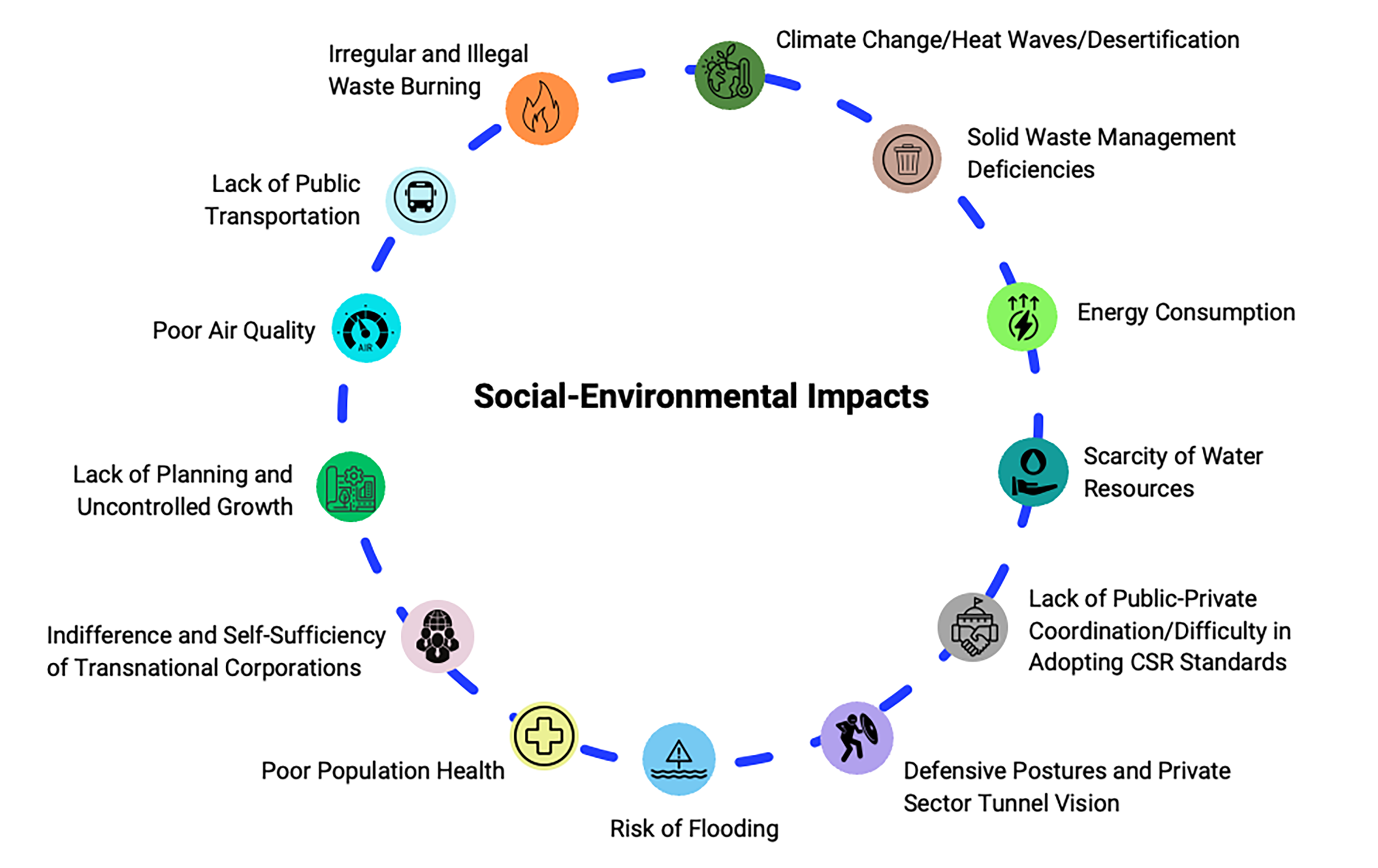
Note: Stakeholders included those in government, academia, civil society, industry, and local community sectors. CSR refers to corporate social responsibility.
Government: The government recognized that EJ is the fair distribution of benefits and environmental impacts and pointed out that environmental injustices happened because of procedural ineffectiveness or weak regulatory processes. Study participants suggested a restorative justice scheme to propose public policies aimed at repairing existing socio-environmental impacts in Ciudad Juárez.
Academia and Civil Society: Representatives from academia and civil society groups emphasized the importance of distributive justice, framing EJ in Ciudad Juárez as a pathway to resolving the structural inequalities that shape access to resources and decision-making power. They highlighted the city’s physical and spatial disparities and identified the lack of civic participation as a key dimension of distributive injustice. Without investment in education and participatory structures, they noted that EJ in Ciudad Juárez will remain out of reach for the communities most affected by ecological degradation and inefficient urban planning.
Industrial Sector: Those in the industrial sector were less keen to talk about EJ; instead their perspective centered on corporate social responsibility (CSR) and the need to comply with international certifications and standards. This recognition was often accompanied by a degree of defensiveness, criticizing the business ecosystem’s inward-looking tendencies. This group acknowledged a lack of coordination with the public sector and civil society as well as the reluctance of many transnational corporations to engage beyond their immediate operational interests. However, participants emphasized that meaningful change would require stronger public-private cooperation, greater openness among corporate actors, and a shift from fragmented, self-sufficient approaches toward a shared responsibility for Ciudad Juárez’s environmental and social challenges.
Local Communities: Residents from affected neighborhoods described living with multiple overlapping socio-environmental impacts, including chronic water shortages, poor solid waste management, degraded air quality, and worsening public health conditions due to noise and urban waste. They suggested that the rapid, unregulated expansion of the city and the inadequate provision of basic services in marginalized areas have compounded these problems. Participants identified the broader structural issues behind these environmental injustices: ineffective government regulation, the absence of transparent communication with public services, and a general lack of institutional accountability.
UK Coastal Regions: Offshore Wind Development Across Natural Borders
Related Environmental and Social Impacts
Surveys consistently show strong public support for offshore wind development in the U.K., with many respondents highlighting its potential social and economic benefits.[31] The sector is forecast to generate more than 30,000 new jobs in the coming years, while the onshore construction and maintenance phases are expected to deliver significant local economic gains.[32] In some coastal regions, offshore wind may contribute to population growth, diversification of local economies, and the diffusion of technological expertise.[33] Yet questions remain about how fairly these benefits are distributed. Critics argue that revenues often flow disproportionately to large corporations and the central government rather than to host communities, raising concerns about social equity and long-term local development.[34]
Alongside these socioeconomic dimensions, offshore wind brings important environmental trade-offs. The construction and operation of wind farms can disturb seabed habitats, alter fish behavior, reduce seabird foraging success, and generate underwater noise pollution.[35] There are also risks of collisions for birds and marine mammals, changes in benthic ecosystems, and potential contamination from vessel traffic or disturbed sediments.[36] However, research suggests that ecological benefits are also possible. Turbine foundations can function as artificial reefs, enhancing fish and shellfish populations, while exclusion zones around wind farms may provide safe havens for prey species and top predators. Offshore wind development may additionally promote carbon storage in seabed sediments, contributing to climate mitigation goals.[37]
As the U.K. accelerates its offshore wind program to meet net-zero targets, balancing these competing outcomes is crucial. Careful planning, inclusive governance, and robust environmental monitoring will be essential to ensure that the expansion of offshore wind delivers not only clean energy, but also fair and sustainable benefits for both people and ecosystems.
The Case of Cockenzie and Prestonpans
The suburban villages of Cockenzie and Prestonpans sit on the coastal shores of the North Sea in East Lothian, on the eastern edge of Scotland, an ideal location for offshore wind. Two developments — Seagreen 1A, which an estimated 500 megawatts (MW) of power generation and Inch Cape with an estimated 1.1 GW — utilise the site of the former Cockenzie Power Station, a coal-burning facility that supplied over 10,000 jobs during its lifespan (1967 to 2015), to landfall the offshore developments.[38] Nestled between Cockenzie and Prestonpans, the site spans 0.8 km connecting the two villages.
Geographically similar, the two villages share a 3.2 km stretch of coastline, yet their distinct experiences of poverty, employment opportunities, and economic development separate them culturally. In 2020, 23.1% of Prestonpans’ 9,880 residents lived in areas classified among the 20% most deprived in Scotland.[39] Sharply contrasting with Prestonpans, Cockenzie had no recorded areas of high deprivation and had relatively high affluence, with 43% of its 5,217 residents in the least deprived category.[40] Although both villages are equally connected to the new offshore wind grounding site, the benefits are not equally distributed. Seagreen 1A established a £1.8 million community benefit fund across six East Lothian Community Councils.[41] However, it allocated the money in equal shares rather than according to population or need — an approach that risks deepening existing inequalities.[42]
Beyond social justice considerations, the offshore wind developments require significant onshore infrastructure, including high-voltage substations, underground cabling, and a potential 342 MW battery energy storage system (BESS). The onshore elements sparked local opposition — particularly regarding the BESS site — due to concerns about noise, decommissioning, animal protection, and fire risks. As a result, a petition challenging the current BESS siting regulation was launched and received over 1,000 signatures.[43] The community focus is on the onshore developments, as the offshore wind farm itself is situated near Dundee, approximately 122 km away.
Renewable energy technology developers have continued to seek out the site, despite the lack of remedy for community concerns. Their interest is spurred by the National Planning Framework 4 — Scotland’s national planning strategy) — which defined the site as an employment generator and renewable energy hub to support the country’s net-zero goals.[44] Consequently, national climate targets actively drive investment to the site while social and environmental concerns remain largely unaddressed.[45]
Conclusion
This analysis of nearshoring in the U.S.-Mexico borderlands and offshore wind development in the U.K. demonstrates how infrastructure-led transitions, even when framed as engines of progress and sustainability, may reproduce longstanding patterns of social and environmental inequality.
In Ciudad Juárez and other Mexican border cities, although decades of industrial expansion have generated employment and cross-border integration, they have done so at the cost of disproportionate pollution rates, deteriorating labor conditions, and limited community voice in decision-making and urban dynamics. Nearshoring strategies, while marketed as greener and more efficient, risk entrenching these underlying forces unless paired with stronger environmental regulation, participatory governance, and targeted investments in social equity. The persistence of environmental sacrifice zones underscores the urgent need for restorative approaches that move beyond procedural efficiency toward substantive justice for vulnerable populations.
Similarly, the U.K.’s offshore wind expansion illustrates the dichotomy of green infrastructure. While contributing to decarbonization and economic diversification, offshore wind projects expose tensions around benefit-sharing, local participation, and environmental trade-offs. The case of Cockenzie and Prestonpans highlights how even within close geographic proximity, communities can experience markedly different outcomes depending on preexisting inequalities and governance arrangements. Without more inclusive planning, projects such as these risk reinforcing disparities rather than fostering a just transition.
Taken together, these cases emphasize the value of environmental justice as a cross-border framework capable of linking material, symbolic, and institutional dimensions of inequality. They also point to the importance of recognizing both human communities and all living beings in shaping equitable and sustainable futures. Addressing distributive, recognition, and procedural justice in tandem is not merely an ethical imperative but also a practical necessity for the legitimacy and durability of infrastructure transitions. Ultimately, embedding environmental justice principles across borders and ecosystems is central to achieving truly fair pathways to low-carbon and infrastructure development.
Acknowledgements
This report is part of a research study funded by the 2024–25 Rice-Edinburgh Strategic Collaboration Awards Program.
Notes
[1] Gavin Bridge et al., “Energy Infrastructure and the Fate of the Nation: Introduction to Special Issue,” in “Energy Infrastructure and the Fate of the Nation,” ed. Bridge, Begüm Özkaynak, and Ethemcan Turhan, special issue, Energy Research & Social Science 41 (July 2018): 1–11, https://doi.org/10.1016/j.erss.2018.04.029.
[2] Frank Vanclay, “Changes in the Impact Assessment Family 2003–2014: Implications for Considering Developments in Impact Assessment in Light of Economic and Political Drivers,” Journal of Environmental Assessment Policy and Management 17, no. 1 (2015): 1550003, https://doi.org/10.1142/S1464333215500039.
[3] David Schlosberg, Defining Environmental Justice: Theories, Movements, and Nature (Oxford University Press, 2007).
[4] Gary Gereffi, Global Value Chains and Development: Redefining the Contours of 21st Century Capitalism (Cambridge University Press, 2018). https://doi.org/10.1017/9781108559423.
[5] Camila H. Álvarez and Claire Rosenfeld Evans, “Intersectional Environmental Justice and Population Health Inequalities: A Novel Approach,” Social Science & Medicine 269 (January 2021): 113559, https://dx.doi.org/10.1016/j.socscimed.2020.113559; Eric Bonds and Leslie Martin, “Treating People Like Pollution: Homelessness and Environmental Injustice,” Environmental Justice 9, no. 5 (2016): 137–141, https://dx.doi.org/10.1089/env.2016.0021; and United States Environmental Protection Agency (EPA), EJ 2020 Action Agenda, 2016, https://www.epa.gov/sites/default/files/2016-05/documents/052216_ej_2020_strategic_plan_final_0.pdf.
[6] John Rawls, A Theory of Justice (Harvard University Press, Belknap Press, 1971); Schlosberg.
[7] Organisation for Economic Co-operation and Development (OECD), Environmental Justice: Context, Challenges and National Approaches, 2024, https://doi.org/10.1787/57616eb4-en.
[8] “Symbolic dimensions” refers to the process by which events, situations, and individuals are infused with collective values and meanings, serving as emblems of a community’s moral framework; Nancy Fraser, “Social Justice in the Age of Identity Politics: Redistribution, Recognition, and Participation,” in The Tanner Lectures on Human Values, vol. 19, ed. Larry Ray and Andrew Sayer (University of Utah Press, 1998), https://doi.org/10.4135/9781446218112.n2; Schlosberg.
[9] The resources referred to include water, fertile soil, energy sources, and even clean air. For further reading on binational commons and its challenges see: Tony Payan, “Uneven Institutional Development and Governance at the U.S.-Mexico Border,” in Binational Commons, eds. Tony Payan and Pamela L. Cruz (University of Arizona Press, 2020), https://uapress.arizona.edu/book/binational-commons.
[10] Ivonne Cruz, “Nearshoring’s Environmental and Social Impacts and the Need for Trade Reform,” Rice University’s Baker Institute for Public Policy, September 26, 2024, https://doi.org/10.25613/W98N-4339; Ivonne Cruz and Nicolas Silva, “Analyzing Cumulative Socio-Environmental Impacts of Long-Term Manufacturing Development in the U.S.-Mexico Border” (forthcoming, 2026).
[11] Carolina Prado, “Borderland Environmental Justice and Governance Apertures,” Environmental Politics 29, no. 7 (2020): 1264–83, https://doi.org/10.1080/09644016.2019.1629172.
[12] Prado; Gabriela Munoz-Melendez and Sarah E. Martinez-Pellegrini, “Environmental Governance at an Asymmetric Border, the Case of the U.S.-Mexico Border Region,” Sustainability 14, no. 3 (2022): 1712, https://doi.org/10.3390/su14031712.
[13] Despite their vital role in the industry, women employed in Mexico’s border maquiladoras have faced systemic labor exploitation. Low wages, poor working conditions, and significant health disparities were common issues and recent worker organizing and advocacy efforts have improved these conditions. Sławomir Dorocki, and Paweł Brzegowy, “The Maquiladora Industry Impact on the Social and Economic Situation in Mexico in the Era of Globalization,” in Environmental and Socio-Economic Transformations in Developing Areas as the Effect of Globalization, ed. Mirosław Wójtowicz and Anna Winiarczyk-Raźniak (Wydawnictwo Naukowe University Press, 2014), 93–110, http://hdl.handle.net/11716/11132.
[14] Todd E. Katzner, et al., “Impacts of Onshore Wind Energy Production on Biodiversity,” Nature Reviews Biodiversity 1 (2025): 567–80, https://doi.org/10.1038/s44358-025-00078-1; Leon Sander, et al., “Global Review on Environmental Impacts of Onshore Wind Energy in the Field of Tension between Human Societies and Natural Systems,” Energies 17, no. 13 (2024): 3098. https://doi.org/10.3390/en17133098.
[15] Angelika H.H. Renner, “Current Knowledge and Key Gaps in Understanding of Offshore Wind Farm Impacts on the Physical Marine Environment,” ICES Journal of Marine Science 82, no. 12 (December 2025): fsaf235, https://doi.org/10.1093/icesjms/fsaf235; Stephen C.L. Watson et al., “Assessing, Monitoring and Mitigating the Effects of Offshore Wind Farms on Biodiversity,” Nature Reviews Biodiversity 1 (2025): 581–96, https://doi.org/10.1038/s44358-025-00074-5.
[16] Prado.
[17] Fraser; Schlosberg.
[18] Cruz.
[19] Department for Energy Security & Net Zero (DESNZ), “Offshore Wind Net Zero Investment Roadmap,” Government of the U.K., March 31, 2023, https://www.gov.uk/government/publications/offshore-wind-net-zero-investment-roadmap/offshore-wind-net-zero-investment-roadmap.
[20] Stephen P. Mumme, “Trade and Environmental Protection Along the United States-Mexico Border,” Global Society 28, no. 4 (2014): 398–418, https://doi.org/10.1080/13600826.2014.948540.
[21] Geoffrey Garver, “Forgotten Promises: Neglected Environmental Provisions of the NAFTA and the NAAEC” in NAFTA and Sustainable Development: History, Experience, and Prospects for Reform, ed. Hoi L. Kong and L. Kinvin Wroth (Cambridge University Press, 2015), https://doi.org/10.1017/CBO9781316157763.002; EPA and Secretaría de Medio Ambiente y Recursos Naturales (SEMARNAT), Border 2025: United States - Mexico Environmental Program, May 6, 2025, https://www.epa.gov/sites/default/files/2021-05/documents/final_us_mx_border_2025_final_may_6.pdf.
[22] Commission on Environmental Cooperation (CEC), Taking Stock: North American Pollutant Releases and Transfers, vol. 16, 2023, https://www.cec.org/tsreports/; “Tracking Pollutant Releases and Transfers in North America,” CEC, accessed December 1, 2025, https://www.cec.org/tracking-pollutant-releases-and-transfers-in-north-america-1/.
Maquiladoras are Mexican manufacturing plants established by foreign companies to gain cost advantages. Operating under special tax and trade agreements, they import raw materials duty-free for assembly and then export the resulting products, primarily north of the border (“Maquiladora,” Corporate Finance Institute, accessed December 5, 2025, https://corporatefinanceinstitute.com/resources/management/maquiladora/).
[23] Roldán Andrés-Rosales et al., “A Spatial Analysis of Precariousness and the Gender Wage Gap in Mexico, 2005–2018,” The Journal of Chinese Sociology 6 (July 2019): art. 13, https://dx.doi.org/10.1186/s40711-019-0104-2; Esteban Flores, “Misery in the Maquiladoras,” Harvard International Review 38, no. S1, (Winter 2017): 10–12, https://www.jstor.org/stable/26445590; Kevin Kolben, “Labor Chapters Improve Supply Chain Resilience: The Case of the USMCA,” Brookings, 2023, https://www.brookings.edu/articles/usmca-forward-2023-chapter-7-labor-standards/.
[24] Cruz.
[25] Cruz.
[26] Sustainability Directory, “Why are Some Areas Considered Sacrifice Zones?” accessed January 6, 2026, https://pollution.sustainability-directory.com/question/why-are-some-areas-considered-sacrifice-zones/.
[27] Josh Lepawsky, “Mapping Chemical Discardscapes of Electronics Production,” Geoforum 132 (June 2022): 113–24, https://doi.org/10.1016/j.geoforum.2022.04.005.
[28] “Informe del Medio Ambiente: Residuos” [Environmental Report: Waste], Secretaría de Medio Ambiente y Recursos Naturales (SEMARNAT), accessed June 11, 2025, https://apps1.semarnat.gob.mx:8443/dgeia/informe18/tema/cap7.html.
[29] Carolina Prado, “Borderland Environmental Justice and Governance Apertures,” Environmental Politics 29, no. 7 (2020): 1264–83, https://doi.org/10.1080/09644016.2019.1629172.
[30] This study was conducted by the authors during the project development and has not yet been published. Dashboard: Ivonne Cruz et al., “Dashboard: Environmental and Social Indicators,” Claudio X. González Center for the U.S. and Mexico, Baker Institute for Public Policy, https://www.bakerinstitute.org/dashboard-environmental-and-social-indicators-0.
[31] Laura Florentina Gușatu et al., “Spatial and Temporal Analysis of Cumulative Environmental Effects of Offshore Wind Farms in the North Sea Basin,” Scientific Reports 11, no. 1 (2021): 10125, https://doi.org/10.1038/s41598-021-89537-1.
[32] Tavis Potts, “Social and Policy Aspects of Offshore Renewable Energy,” in Comprehensive Renewable Energy, 2nd ed., vol. 8, ed. Trevor M. Letcher (Elsevier, 2022), https://doi.org/10.1016/B978-0-12-819727-1.00168-0; Rebecca Hall and Julie Black, “What Level of Monitoring Is Enough to Detect Displacement Effects of Offshore Wind Farms?,” Environmental Impact Assessment Review 105 (March 2024): 107449, https://dx.doi.org/10.1016/j.eiar.2024.107449.
[33] Kenny Kemp, “Cui Bono? Scotland’s Offshore Wind and a ‘Just Transition,’” Scottish Affairs 33, no. 3 (2024): 355–64, https://doi.org/10.3366/scot.2024.0513.
[34] Kemp.
[35] Rafael Monteiro de Vasconcelos et al., “Environmental Licensing for Offshore Wind Farms: Guidelines and Policy Implications for New Markets,” Energy Policy 171 (December 2022): 113248, https://doi.org/10.1016/j.enpol.2022.113248; Andrew Edwards-Jones et al., “Stakeholder Insights into Embedding Marine Net Gain for Offshore Wind Farm Planning and Delivery,” Environmental Challenges 14 (January 2024): 100814, https://doi.org/10.1016/j.envc.2023.100814; and Judith Wolf et al., “Environmental Issues for Offshore Renewable Energy,” in Comprehensive Renewable Energy, 2nd ed., vol. 9, ed. Letcher (Elsevier, 2022), https://doi.org/10.1016/B978-0-12-819727-1.00036-4.
[36] Wolf. “Benthic” refers the things occurring on or related to the bottom of a body of water, such as a sea, lake, or river, or in ocean depths (Merriam-Webster, accessed December 5, 2025, https://www.merriam-webster.com/dictionary/benthic).
[37] Wolf; Watson.
[38] The landfall site is where the offshore cable from the development comes ashore (Regional Plan Association, “Making Offshore Wind Transmission Work for Communities,” June 2023, http://bit.ly/49X3nT9). A more technical term is “grounding site,” referring to the point where the high-voltage cables are connected to the onshore electrical grid.
[39] “SIMD: Scottish Index of Multiple Deprivation 2020,” Government of Scotland, accessed June 11, 2025, https://simd.scot/#/simd2020/BTTTFTT/14/-2.9551/55.9661/.
[40] SIMD.
[41] Seagreen Wind Energy, “Benefits,” accessed June 17, 2025, https://www.seagreenwindenergy.com/benefit.
[42] Sandy Kerr et al., “Understanding Community Benefit Payments from Renewable Energy Development,” Energy Policy 105 (June 2017): 202–11, https://doi.org/10.1016/j.enpol.2017.02.034.
[43] Alex Chisholm, “Scottish Parliament Battery Storage Site Petition has 1,000 Signatures,” East Lothian Courier, May 12, 2025, https://www.eastlothiancourier.com/news/25148461.scottish-parliament-battery-storage-site-petition-1-000-signatures/.
[44] “Former Cockenzie Power Station and Surrounding Area,” East Lothian Council, as modified June 6, 2025, https://bit.ly/4qm94PR.
[45] “Cockenzie Battery Energy Storage System (BESS) Consultation Website,” https://www.cockenziebatterystorage.co.uk/; Erin Brown, “‘Anger in the Community’ as Cockenzie BESS Approved,” East Lothian Courier, July 24, 2025, https://www.eastlothiancourier.com/news/25338139.anger-community-cockenzie-bess-approved/; “Energy Consents Unit,” The Scottish Government, https://www.energyconsents.scot/ApplicationDetails.aspx?cr=ECU00006022.
This publication was produced by Rice University’s Baker Institute for Public Policy. Wherever feasible, the material was reviewed by outside experts prior to release. Any errors or omissions are solely the responsibility of the author(s).
This material may be quoted or reproduced without prior permission, provided appropriate credit is given to the author(s) and Rice University’s Baker Institute for Public Policy. The views expressed herein are those of the individual author(s) and do not necessarily represent the views of Rice University’s Baker Institute for Public Policy.


