Home
Home

  • People
  • Events
    USMCA Flags
    Claudio X. González Center for the US and Mexico
    Thu, July 09, 2026 | 10 am - 11 am
    The State of Negotiations of the USMCA See Details
    Global Energy Map
    Center for Energy Studies
    Wed, July 29, 2026 | 11 am - 12 pm
    2026 Statistical Review of World Energy See Details
    AIHC New
    Science and Technology Policy
    Tue, Sep. 15 - Thu, Sep. 17, 2026 | 8 am - 6 pm
    AI in Health Conference See Details
  • Podcasts
  • Research Programs
  • Research & Commentary
  • Press
  • Support
  • About
  • Newsletter
  • Search
  • Research
  • Twitter
  • Facebook
  • instagram
  • Linkedin
  • Youtube
  • Newsletter
  • Economics & Finance
  • Energy
  • Foreign Policy
  • Domestic Policy
  • Health & Science
  • All Publications
Science and Technology Policy | Center for Health Policy | Infographic

What Is Synthetic Biology?

December 15, 2023 | Alicia L. Johnson, Kirstin R.W. Matthews, Caroline Snider
Cell

Table of Contents

Author(s)

Alicia L. Johnson

Civic Science Postdoctoral Associate

Kirstin R.W. Matthews

Senior Fellow in Science and Technology Policy

Caroline Snider

Student Intern

Share this Publication

  • Facebook
  • Twitter
  • Email
  • Linkedin
  • Download PDF
  • Print This Publication
  • Cite This Publication

    Alicia L. Johnson, Kirstin R.W. Matthews, and Caroline Snider “What Is Synthetic Biology?" (Houston: Rice University’s Baker Institute for Public Policy, December 15, 2023).

    Copy Citation

Tags

HealthScience

To access the full infographic, download the PDF on the left-hand sidebar.

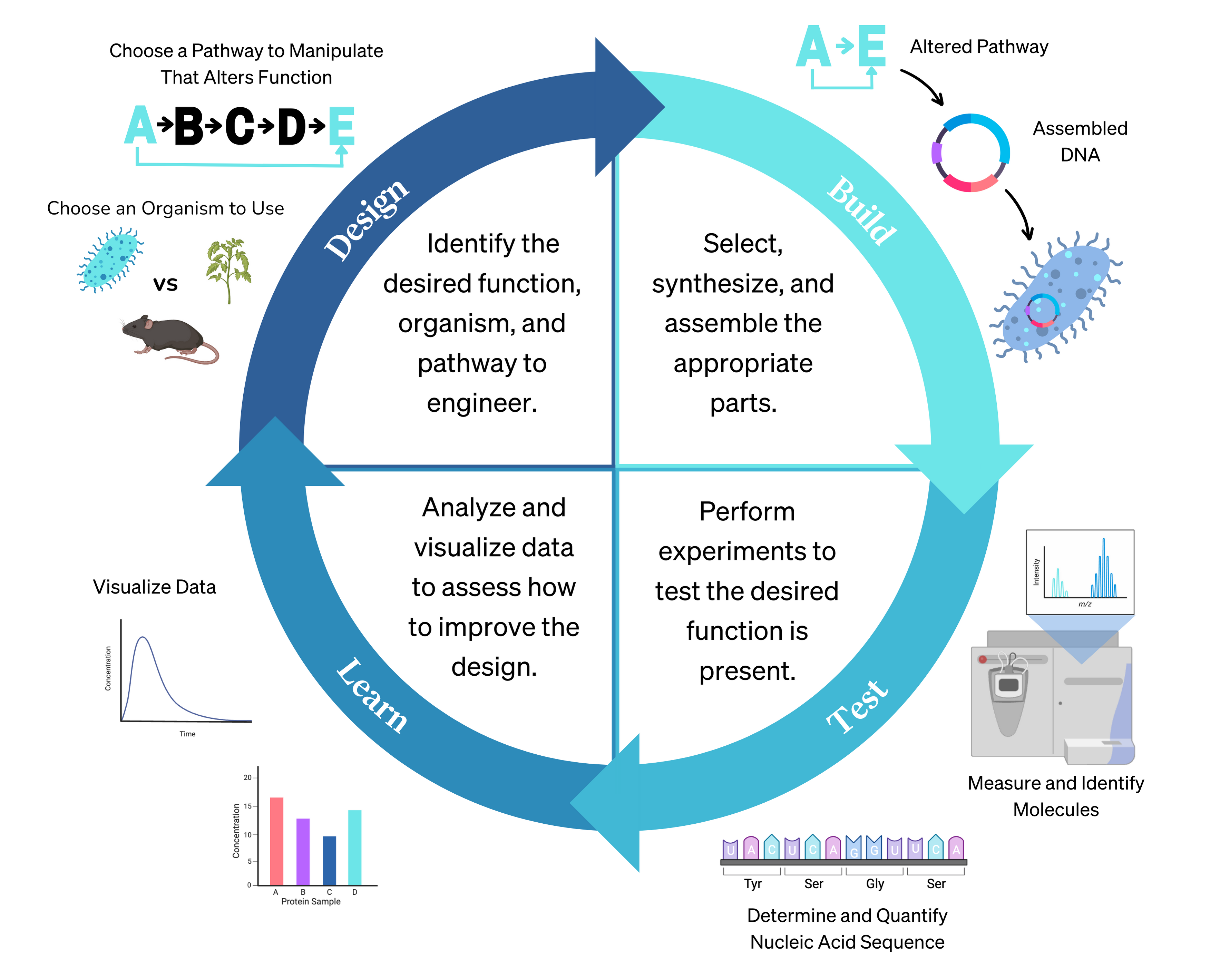
Synthetic biology is an interdisciplinary field of biology and engineering that manipulates DNA for the purpose of designing and redesigning systems such as genes, biological pathways, or organisms to solve society's major problems and understand biological principles. 

Synthetic biologists apply engineering ideas like design, build, test, and learn cycle to their projects, as depicted below:
CHB-Graphic-121223


Funding was provided by grants from the National Science Foundation (#2223678) and Rita Allen Civic Science Fellows. This infographic was produced by the Science and Technology Policy Program and the Center for Health and Biosciences at Rice University’s Baker Institute for Public Policy by Alicia L. Johnson, Ph.D., Kirstin R.W. Matthews, Ph.D., and Caroline Snider. Some elements of this infographic have been created with BioRender.com. 


This material may be quoted or reproduced without prior permission, provided appropriate credit is given to the author and Rice University’s Baker Institute for Public Policy. The views expressed herein are those of the individual author(s), and do not necessarily represent the views of Rice University’s Baker Institute for Public Policy.

© 2023 by Rice University’s Baker Institute for Public Policy
  • Print This Publication
  • Share
    • Facebook
    • Twitter
    • Email
    • Linkedin

Related Research

Artificial intelligence concept.
Center for Health Policy | Podcast

How Artificial Intelligence Affects Childhood Development

Read More
Flooded cars on the street of the city.
Center for Health Policy | Podcast

What FEMA’s New Flood Maps Mean for Houston Schools

Read More
CBD Hemp Infused Gummy Slices
Center for Health Policy | Podcast

How Texas Hemp Regulations Affect Youth Safety

Read More
  • Contact Us
  • Donate Now
  • Press
  • Membership
  • Careers
  • Student Opportunities
  • About the Institute
  • Rice.edu

6100 Main Street
Baker Hall MS-40, Suite 120
Houston, TX 77005

Email: [email protected]
Phone: 713-348-4683
Fax: 713-348-5993

  • Twitter
  • Facebook
  • instagram
  • Linkedin
  • Youtube
  • Newsletter
  • © Rice University's Baker Institute for Public Policy
  • Web Accessibility
  • Privacy Policy