


Author(s)

The Republican wave that swept Texas this past November has been widely discussed. Less analyzed has been how this wave amplified recent trends in the ethnic/racial profile of Democratic elected officials and composition of the Democratic electoral base.
At the state level, the Democratic Party’s delegation in the Texas House has evolved (see the figure below) from one where in 2001, Anglos accounted for 50 percent of the delegation and Hispanics for 32 percent to one 10 years later where Anglos will represent 18 percent of the delegation and Hispanics 51 percent. The African-American share of the delegation rose from 18 percent to 29 percent during this period.
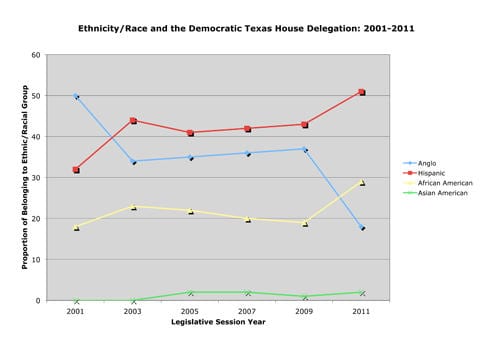
Of the 51 House districts that, beginning in January 2011, will be represented by Democrats, Anglos are an absolute majority of the voting age population (2000 Census) in only five. However, Anglos account for an absolute majority of the voting age population in 97 of the 150 Texas House districts.
The 2011 presence of Anglos in the Texas Senate will parallel that in the House, with 25 percent of the 12 Democratic senators Anglos. A majority (58 percent) of the senators will be Hispanics and 17 percent will be African-Americans. In 2001, 40 percent of the 15 Democratic senators were Anglos, 47 percent were Hispanics and 13 percent were African-Americans.
A similar distribution is found among the nine Democratic members of the 2011 Texas delegation in the U.S. House, 22 percent of whom are Anglos, 44 percent Hispanics and 33 percent African-Americans. This contrasts markedly with the situation a decade ago, when of the 17 Democratic U.S. House members, 59 percent were Anglos, 29 percent were Hispanics and 12 percent were African-Americans.
While the Texas population has become increasingly diverse over the past two decades, the state’s voters continue to be largely Anglo, with exit polls indicating that in the past four general elections (2010, 2008, 2006, 2004) an average of more than two-thirds of Texas voters (68 percent) were Anglos, while Hispanics consistently accounted for around one-fifth of voters (18 percent) and African-Americans slightly more than one-tenth of voters (12 percent). In these elections, the leading Democratic statewide candidates have received the support of only around a quarter of Anglo voters (Bill White [2010]: 29 percent; Barack Obama [2008]: 26 percent; Rick Noriega [2008]: 27 percent; and John Kerry [2006] 25 percent).
The lack of diversity among the Republican Party’s elected officials has received considerable attention. Even after the substantial gains in this past election, which saw the election of five Hispanics and two African-Americans, 91 of the party’s 99 Texas House members will be Anglos (as will every one of its 19 senators and 21 of its 23 U.S. House members [if Bill Flores is classified as Hispanic]). However, from the perspective of electoral success in the short to medium term, this lack of diversity within the Republican Party is far less pernicious than the Democratic Party’s limited support among Anglo voters, and the reality that in spite of having a limited number of Hispanic elected officials (as well as several legislators advocating legislation that is viewed as anti-Hispanic by a majority of Hispanics), Republicans have consistently garnered more than a third of the Hispanic vote in recent statewide elections (Rick Perry [2010]: 38 percent; John McCain [2008]: 35 percent; John Cornyn [2008]: 36 percent; George Bush [2004]: 49 percent).
Mark P. Jones is the James A. Baker III Institute for Public Policy’s fellow in political science as well as the Joseph D. Jamail Chair in Latin American Studies and chair of the Department of Political Science at Rice University.
This material may be quoted or reproduced without prior permission, provided appropriate credit is given to the author and Rice University’s Baker Institute for Public Policy. The views expressed herein are those of the individual author(s), and do not necessarily represent the views of Rice University’s Baker Institute for Public Policy.


