


In the June 2015 parliamentary elections, Turkey’s AKP (Justice and Development Party) lost its majority status, a first for the party since it entered the electoral arena in 2002. After an initial, failed attempt at forming a coalition government, new elections were scheduled for November 1. Since polls have shown little change in public opinion, it appears that instability and uncertainty will continue to characterize Turkish politics for the near term. Though the future of Turkey’s AKP may be unclear at this point, the unprecedented durability of the party over the past 13 years remains a significant question for Turkish politics and for the MENA region more broadly. How did the AKP achieve and maintain its electoral dominance from 2002 to 2014? How has the party managed to rule the country alone despite many serious challenges — for example, corruption scandals, foreign policy disasters, diminishing economic growth, the Gezi Park protests and growing authoritarian tendencies?
Over the past decade or so, a number of studies have examined electoral behavior in Turkey in an effort to understand the AKP’s success. These studies have focused on factors like the economy, religiosity, ethnic voting and attitudes toward EU membership. However, existing studies have been unable to account for the party’s consolidation or durability, particularly in light of both increasing economic and political obstacles, and distinct shifts in policy priority and rhetoric that have largely moved the party away from its initial support base. There must be something beyond traditional explanations driving Turkish voters to support the incumbent AKP in successive elections since 2002. But what?
We think the answer lies partly in old-fashioned patronage politics — however, patronage in a new and significantly more potent form: housing. More specifically, we believe that the massive expansion of housing policy by the central government under the auspices of TOKİ (the Turkish Mass Housing Authority) created a new source of material resources that the AKP has strategically and effectively tapped to mobilize and reward its voters. With enhanced authority under the AKP government, TOKİ has dramatically increased its involvement in the housing sector, providing between 5 to 10 percent of all of housing in Turkey and becoming directly involved in the construction of social housing.
The salience of TOKİ housing projects and their relationship to electoral politics is clearly visible. For example, in his speeches President Recep Tayyip Erdoğan makes frequent reference to these projects and their socio-economic impacts. Furthermore, he often delivers these speeches at elaborate groundbreaking or ribbon-cutting ceremonies at TOKİ construction sites. These projects provide benefits not only to the prospective residents, but also to the municipal governments, local contractors and the workers they hire. We argue that the TOKİ contracts, awarded by the central government to local municipalities, have fueled distributive politics — in the form of jobs, contracts and subsidized housing — which have in turn played a key role in consolidating and expanding the AKP’s electoral base.
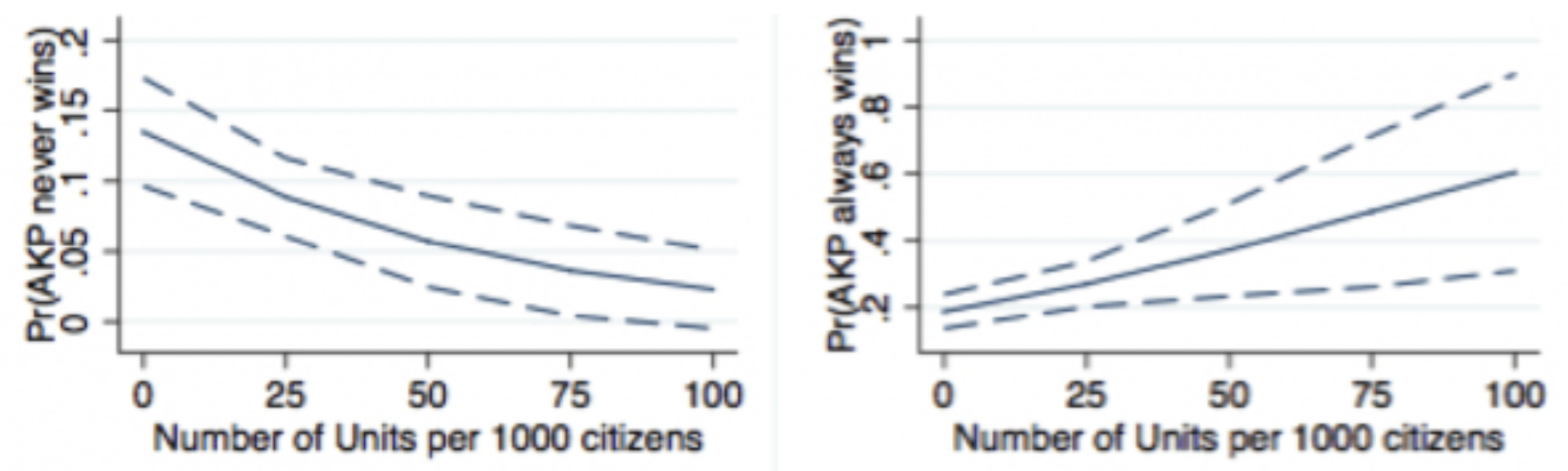
In a recent study,* we examined this claim by empirically analyzing whether and how the distribution of TOKİ housing contracts (equaling nearly one-half million units and over $11 billion in public expenditures) influenced the AKP’s success in mayoral elections in 2004, 2009 and 2014. Combining municipal-level election results with municipal-level measures of TOKİ housing units and expenditures as well as demographic, socio-economic and other contextual data, our analysis uncovers a robust linkage between TOKİ housing projects and the durability of the AKP’s electoral success. In districts where AKP constructs more housing units, the likelihood of winning all of the last three local elections is significantly higher compared to districts where TOKİ has made fewer investments in housing. As Figure 1 shows, the probability that the AKP never wins is about 14% when TOKİ makes no investments in a municipality. However, when TOKİ constructs 100 housing units (per 1,000 residents), the probability of never winning decreases to 2%. On the other hand, the probability of winning all three elections is about 20% if there is no TOKİ investment in a municipality compared 60% if there are 100 TOKİ housing units for every 1,000 residents.
Figure 1 — The Effects of TOKİ Housing Units on the Probability that AKP Always or Never Wins Mayoral Elections
These findings shed important new empirical light on how the AKP has consolidated its power and remained in office despite serious political and economic challenges. Via a housing and construction strategy, the AKP government has taken advantage of neoliberal policies that rely more heavily on land uses that maximize the exchange value of land to develop new, more potent modes of patronage politics. These findings also provide new insights about how future elections in Turkey might be more effectively studied and forecasted. For example, with a second round of parliamentary elections scheduled for November, we would expect the AKP to be strategically targeting the siting of future TOKİ housing projects in “critical” provinces — i.e., those where it previously won or lost a seat with a very narrow vote margin. Indeed, this is exactly what we see. TOKİ has very recently planned or is currently planning to initiate projects in 29 provinces. Of these, nearly two-thirds are proposed in ‘critical’ provinces. Since AKP needs only 18 more seats to regain its majority status, disproportionately awarding TOKİ housing contracts to these provinces, where only a small increase in the AKP’s vote share (less than 4%) would result in a seat gain for the AKP, makes strategic sense. Indeed, according to our analysis, this strategy has a proven track record of success.
Beyond forecasting elections, our study has important implications for democratization processes, not just in Turkey but in the MENA region more broadly. For example, our study suggests that with the discovery of new public sector resources such as housing, dominant parties can remain in office not by promoting programmatic platforms and staying the course with regard to political and economic reform, but instead by relying on traditional, patronage-based methods of governance. Unfortunately, patronage-based politics undermines democratic accountability, fair redistribution and fair competition between incumbents and the challengers. In this regard, the continuation and intensification of patronage would seem to have serious negative implications for democratic consolidation in Turkey. And, because Turkey is frequently held up as a model for the entire MENA region, this tendency toward “politics as usual” contributes to an increasingly pessimistic outlook for a real Arab Spring.
*This blog is based the article “Does Housing Create Votes? Explaining the Electoral Success of AKP in Turkey” by Melissa Marschall, Abdullah Aydogan and Alper Bulut, currently under review for publication.
Melissa Marschall, Ph.D., is a Baker Institute Faculty Scholar and a professor in the Department of Political Science at Rice University.
Abdullah Aydogan, Ph.D., is a postdoctoral research fellow at the Baker Institute and the Department of Political Science at Rice University.
This material may be quoted or reproduced without prior permission, provided appropriate credit is given to the author and Rice University’s Baker Institute for Public Policy. The views expressed herein are those of the individual author(s), and do not necessarily represent the views of Rice University’s Baker Institute for Public Policy.


