


Author(s)

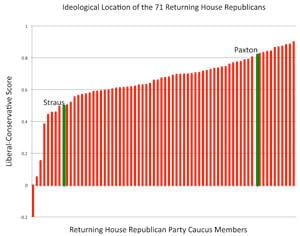
On Jan. 11, one of the first actions of the Texas House of Representatives will be to elect a speaker. Current speaker Joe Straus is being challenged by fellow Republicans Warren Chisum and Ken Paxton. While Paxton has received the backing of more than a dozen Republican House members, as well as several national political actors, Chisum’s support base is minimal.
As most observers of Texas politics are by now aware, Straus’ ideological orientation (based on his observed behavior) places him in the moderate wing of the House Republican Caucus, though still to the right of all Democratic representatives (see the figure at left or download a full-sized PDF). What has been less publicized is that Paxton’s ideological orientation places him in the conservative wing of the Caucus.
This January, the Texas House Republican Caucus will consist of 101 members, 71 of whom have previously served as representatives, and hence for whom we have comparable information on their ideological orientation based on their past floor voting record (for more information on this Liberal-Conservative Score, see “How liberal or conservative is your Texas state representative?”). Only eight of the 71 returning Republican representatives (including three former Democrats who switched to the Republican party in 2009 and 2010) have voting records that are more liberal than that of Straus, while 62 have voting records which are more conservative. At the same time however, only 10 Republicans have voting records that are more conservative than that of Paxton, with 60 possessing more liberal voting records.
A comparison of the ideological proximity (using the representatives’ respective Liberal-Conservative Scores) of Straus and Paxton to their 69 co-partisans reveals that 32 of the representatives are closer ideologically to Straus than to Paxton, with the obverse true for the remaining 39. While a review of the campaigns and pledge behavior of the 30 Republicans who will be serving their first term in the House suggests a majority may end up occupying a position on the liberal-conservative spectrum somewhat closer to Paxton than to Straus, this certainly will not be the case for all of them.
In the 2011 speaker’s race, the two most viable candidates have ideological positions that place them near the left and right edges of the Republican Party Caucus. As a result, when a majority of Republican House members scrutinize the legislative behavior of Joe Straus, they perhaps find it to be too liberal for their taste, but a majority of these same members possibly also consider Ken Paxton’s legislative behavior to be too conservative for their liking.
Mark P. Jones is the James A. Baker III Institute for Public Policy’s fellow in political science as well as the Joseph D. Jamail Chair in Latin American Studies and chair of the Department of Political Science at Rice University.
This material may be quoted or reproduced without prior permission, provided appropriate credit is given to the author and Rice University’s Baker Institute for Public Policy. The views expressed herein are those of the individual author(s), and do not necessarily represent the views of Rice University’s Baker Institute for Public Policy.


