


Author(s)

Data from eight University of Texas/Texas Tribune Polls conducted among registered voters between May of 2011 and June of 2014 allow us to estimate the mean ideological position of the voting public in 20 of the state’s 21 most populous counties — counties which combined contain almost three-fourths (73 percent) of the Texas population. Insufficient survey data exist at the present time for Webb County, the 19th most populous county in the state.
The UT/Tribune Poll contains an ideology variable based on a question asking respondents to place themselves on a seven-point ideology scale ranging from “Extremely Liberal” (1) to “Extremely Conservative” (7), with a 4 indicating the respondent considers their ideological position to be “In the Middle.” A mean ideological position for every county is calculated by averaging the valid self-reported ideological placement of its residents.
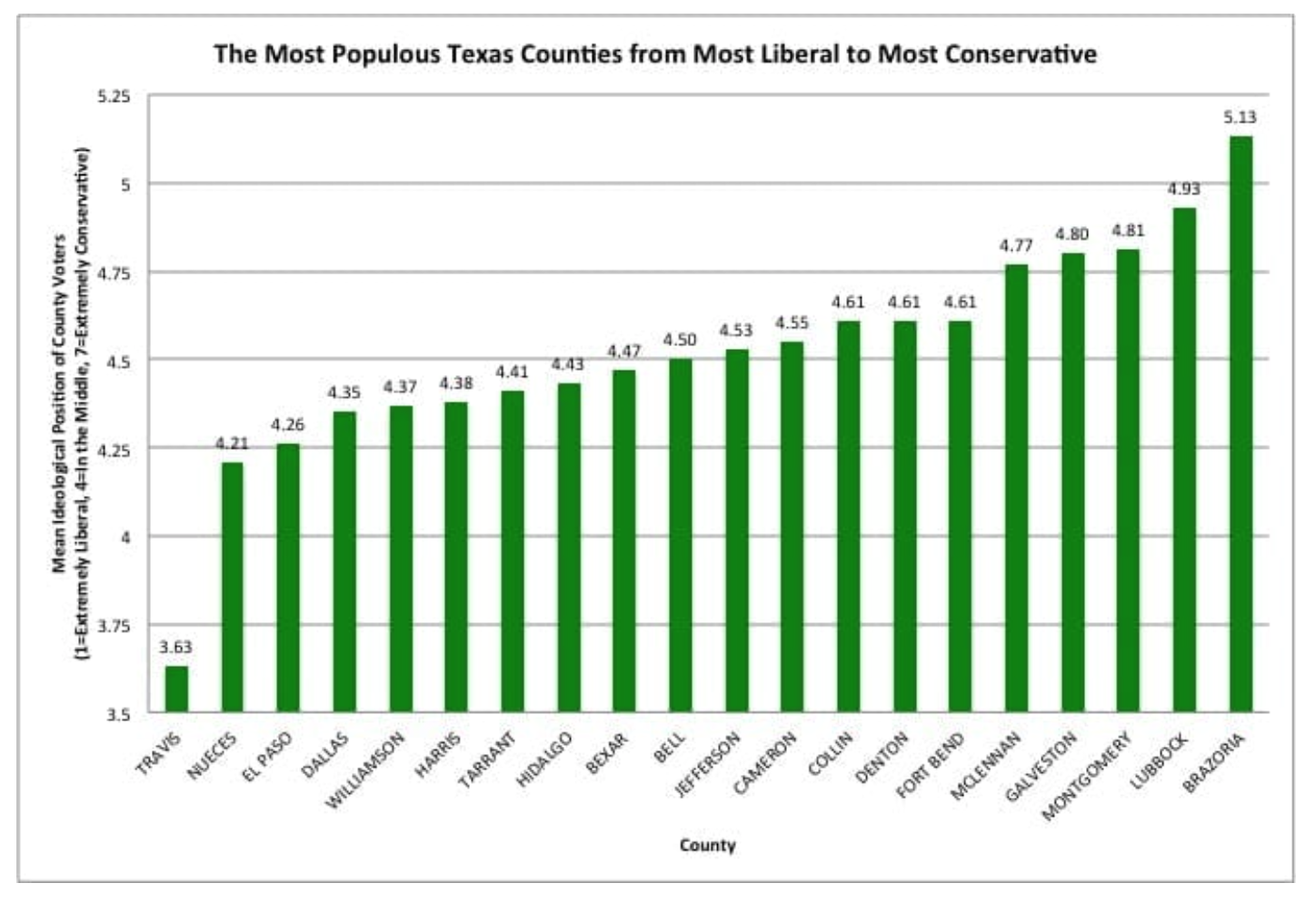
The figure arrays the 20 counties from left (most liberal) to right (most conservative) based on the respective mean ideological location of their registered voters. Travis County is a clear liberal outlier, with a mean ideological position of 3.63, substantially more liberal than the mean ideological position found in the next most liberal county, Nueces, which has a mean position of 4.21. The ideological gulf separating Travis County from Nueces County is greater than that separating Nueces County from all but the four most conservative counties in the figure.
An overwhelming majority of these counties have relatively proximate ideological profiles, with a mere 0.26 separating the fourth most liberal county (Dallas) at one end (4.35) from the sixth most conservative county (a three-way tie between Collin, Denton and Fort Bend) at the other end (4.61). The mean ideological position for the entire state is located within this 4.35 to 4.61 range at 4.56.
While among these 20 counties there does not exist a true conservative analog to liberal Travis County, Brazoria County comes closest with a mean ideological position of 5.13. In fact, the Houston metropolitan region contains three of the four most conservative large counties in the state: Galveston County (4.80), Montgomery County (4.81), and Brazoria County (5.13).
In May, using an earlier version of these data, I commented on how the liberal outlier status of Travis County residents should be a source of concern for Gov. Rick Perry and his legal team, since the members of Perry’s grand jury and the members of any future trial (petit) jury are drawn from a pool of Travis County residents. Following Perry’s indictment by a Travis County grand jury earlier this month, this concern undoubtedly remains, with a very real potential prospect of Perry’s fate being once again placed in the hands of Travis County residents — this time, members of a trial jury.
Travis County’s status as an ideological outlier in the Lone Star State is also likely to add further steam to efforts by Republicans in the Texas Legislature to modify the legislation governing the state’s Public Integrity Unit during the 2015 regular session. These reform efforts are expected to focus primarily on transferring the duties of the state’s Public Integrity Unit from the office of the Travis County District Attorney to another governmental unit such as the Office of the Attorney General or a newly created office run by an independent special prosecutor appointed through a bipartisan/consensual process, with the latter option certain to be more positively viewed by objective observers than the former.
This material may be quoted or reproduced without prior permission, provided appropriate credit is given to the author and Rice University’s Baker Institute for Public Policy. The views expressed herein are those of the individual author(s), and do not necessarily represent the views of Rice University’s Baker Institute for Public Policy.


