


Author(s)

The Big Picture
- Amid conflicts in Ukraine and the Middle East, it is vitally important that the United States maintain robust diplomatic, economic, and military engagement in the Indo-Pacific region postelection.
- The adverse impacts of deprioritizing the Indo-Pacific region would be immense, as the region is the geopolitical fulcrum upon which U.S. prosperity and national security rests.
- U.S. decision-makers must chart a course that balances American interests in other major regions while ensuring a strong, durable U.S. presence in the Indo-Pacific region.
- While concerns about the state of the U.S. economy tend to overshadow foreign policy issues in any presidential election, the next U.S. administration must ensure that the Indo-Pacific region remains a top priority of foreign policy.
Summarizing the Issue
The next U.S. president will face multiple simultaneous international crises. In Europe, the Russian invasion of Ukraine, which began in February 2022, continues with no clear end in sight. In the Middle East, the Oct. 7, 2023, Hamas attack on Israel and the resulting Israeli military response have led to concerns over a wider conflict involving neighboring countries.
Domestically, there is rare consensus between both major U.S. political parties that China is a strategic competitor and that “de-risking” from China in a range of areas is desirable. In foreign capitals, decision-makers are attempting to forecast the repercussions of U.S. election results on their countries’ future outlooks. While the overall contours of China policy are less likely to be impacted, other areas of Indo-Pacific policy are subject to change depending upon whether the new administration is Democratic or Republican.
The core tenets of America’s post-1945 U.S. national security strategy — which have long underpinned a liberal international order — can no longer be taken for granted. The incoming president will inevitably make choices based on their own priorities as well as risk perceptions. The Indo-Pacific region will be competing for attention and resources amid a crowded global landscape.
While concerns about the state of the U.S. economy tend to overshadow foreign policy issues in any presidential election, it is essential that the U.S. maintain robust diplomatic, economic, and military engagement in the Indo-Pacific region postelection.
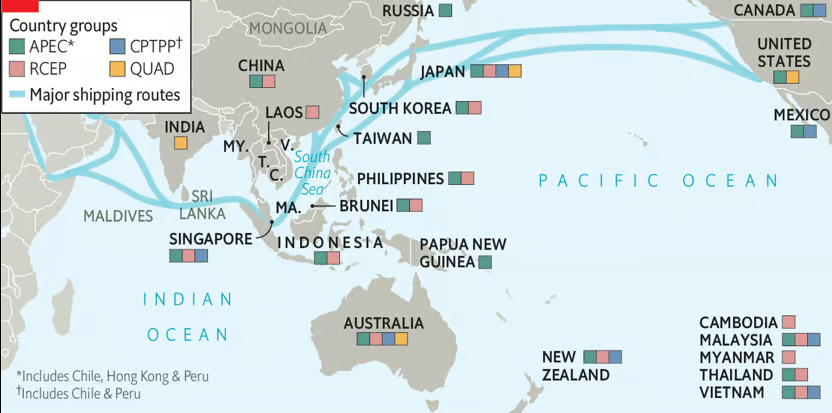
Figure 1 — Indo-Pacific Region’s Country Groups and Primary Shipping Routes
Expert Analysis
The first 100 days of any U.S. presidency are fundamental in shaping the new administration’s policy agenda and are indicative of their main areas of focus. In order to ensure that the Indo-Pacific region remains a priority for the next president, planning must begin prior to the election as well as during the transition period.
Insufficient attention on the Indo-Pacific region by the new administration could have the following adverse consequences:
- Security risks: A signal from the U.S. that Indo-Pacific security is not a vital national interest imperils not only Taiwan but also treaty allies and partners and could result in a seismic U.S. economic downturn. If U.S. security guarantees are no longer perceived as credible, the consequences would be profound and even have the potential to lead to regional nuclear proliferation.
- Strategic drift: A perceived unwillingness by the U.S. to address the China challenge across the spectrum of comprehensive national power risks another lost decade of necessary investment in areas critical for the U.S. to deter China similar to the period following the announcement of the pivot to Asia in 2011.
- Economic and trade stagnation: The greatest share of world GDP derives from the Indo-Pacific region, accounting for 46% in purchasing power parity terms as of 2024. Demographic projections and trends in international trade suggest that future global economic growth will stem predominantly from the Indo-Pacific region. If the U.S. is not actively involved in shaping regional trading architecture, American enterprises and workers will be left behind.
Policy Actions
While benign neglect of the Indo-Pacific region by the next president would not lead to abrupt changes in the regional landscape, leaders in those countries will ultimately alter their decision-making if they perceive that their concerns are not valued in Washington.
The new U.S. president and senior officials should therefore:
- Complete and release a strategic review of Indo-Pacific policy within the first 100 days. A comprehensive strategic review with concrete benchmarks for success would signal to domestic and international audiences the importance that the U.S. places upon the region. This review should encompass every element of national power to include diplomatic, economic, and military instruments.
- Participate actively in all major regional summits. The U.S. must participate at the most senior levels possible in all major regional summits and contribute to deliberations on the future of the Indo-Pacific region. Domestic political developments cannot detract from the need to prioritize attendance at these vital gatherings.
- Strengthen Indo-Pacific basing arrangements. While innovative and reinvigorated diplomacy should be the core of U.S. strategy in the region, robust military basing arrangements will continue to be necessary to ensure the security of treaty allies and partners in coming years. Investment in dispersed military bases that feature hardened aircraft shelters will be essential for protecting America’s air power and responding to any contingencies that could arise.
The Bottom Line
For the sake of America’s economic and national security interests, the next U.S. administration must ensure that the Indo-Pacific region remains a top priority of foreign policy.
This material may be quoted or reproduced without prior permission, provided appropriate credit is given to the author and Rice University’s Baker Institute for Public Policy. The views expressed herein are those of the individual author(s), and do not necessarily represent the views of Rice University’s Baker Institute for Public Policy.


