


This brief is part of “Election 2024: Policy Playbook,” a series by Rice University and the Baker Institute that offers critical context, analysis, and recommendations to inform policymaking in the United States and Texas.
The Big Picture
- America is losing the race for global science, technology, engineering, and mathematics (STEM) leadership.
- The incoming administration must make federal investment in science initiatives a priority and provide the leadership needed to unite both parties and the nation around this issue.
- If the United States is to continue to lead in innovation, policymakers must develop a coordinated plan to increase investment in scientific research and development (R&D) to a level significantly above inflation.
Summarizing the Issue
In her “State of the Science” address on June 26, Marcia McNutt, president of the National Academy of Sciences, summarized America’s current science challenge: “U.S. science is perceived to be — and is — losing the race for global STEM leadership.” However, she also added a note of confidence in America’s resiliency, saying, “Our country has a remarkable ability to adapt, and to learn, and to try new things. Loss of scientific leadership is a significant concern for the American public.”
President McNutt made clear in her remarks why the American people and policy makers should be concerned: “Since World War II, U.S. public investments in science have driven economic and job growth and led to many new products that have improved Americans’ quality of life. Being a global leader has enabled the U.S. to effectively protect its national security, benefit from economic growth, establish ethics and standards for the deployment of new technologies, and exercise soft power and diplomacy.”
Expert Analysis
McNutt’s statements are backed by decades of science and technology (S&T) policy research as well as studies and reports published by well-respected nongovernment organizations such as the National Academies of Sciences, Engineering, and Medicine; the American Academy of Arts and Sciences; the Council on Competitiveness; and other non-government bodies.
“The Perils of Complacency: America at a Tipping Point in Science and Engineering,” a report from Rice University’s Baker Institute for Public Policy and the American Academy of Arts and Sciences, outlines the reasons behind the scientific community’s concerns:
- The U.S. is losing its global leadership in S&T and innovation to other nations, primarily China.
- Retaining that leadership will require substantial increases in federal support for research, primarily in universities — where the next generation of scientists and engineers are trained.
- America must develop a coordinated national strategy for identifying science-related government priorities and actions.
- The U.S. pre-K–12 education system is inadequate to meet the needs of a diverse STEM workforce that most future jobs will require. Further, there is a serious shortage of women and minorities in many areas of science.
- America must reverse current trends and encourage talented individuals from around the world to come to the U.S. for their advanced education and stay to establish their careers.
- The U.S. urgently needs a national energy and industrial policy. While free market dynamics have been a fundamental underpinning of our nation, it is becoming increasingly apparent that we need a clearer strategy towards energy and climate change as well as a pathway to reclaim manufacturing across various sectors.
- It is also clear that we, as a nation, always rise to a global challenge, be it in the space race, a pandemic of historic proportions or the rapidly emerging issues of climate change. Such a “Yes, we can” ethos needs to be tapped into. The scope of the challenges needs to be defined (as moon shots) and executed with a concerted “all of the nation” approach.
What the American Public Believes
As can be seen in Figure 1, Americans are concerned about the state of U.S. science. The public assigns a high priority to S&T and STEM education, especially pre-K–12, as reported by a recent survey of a broad spectrum of society, carried out by the non-government Science and Technology Action Committee (STAC):
Figure 1 — Public Concern About America’s Science Competitiveness

Note: As reported in the survey, 3% of respondents indicated they were “Not Sure.”
Figure 2 — Public Support of Proposed Science Initiatives
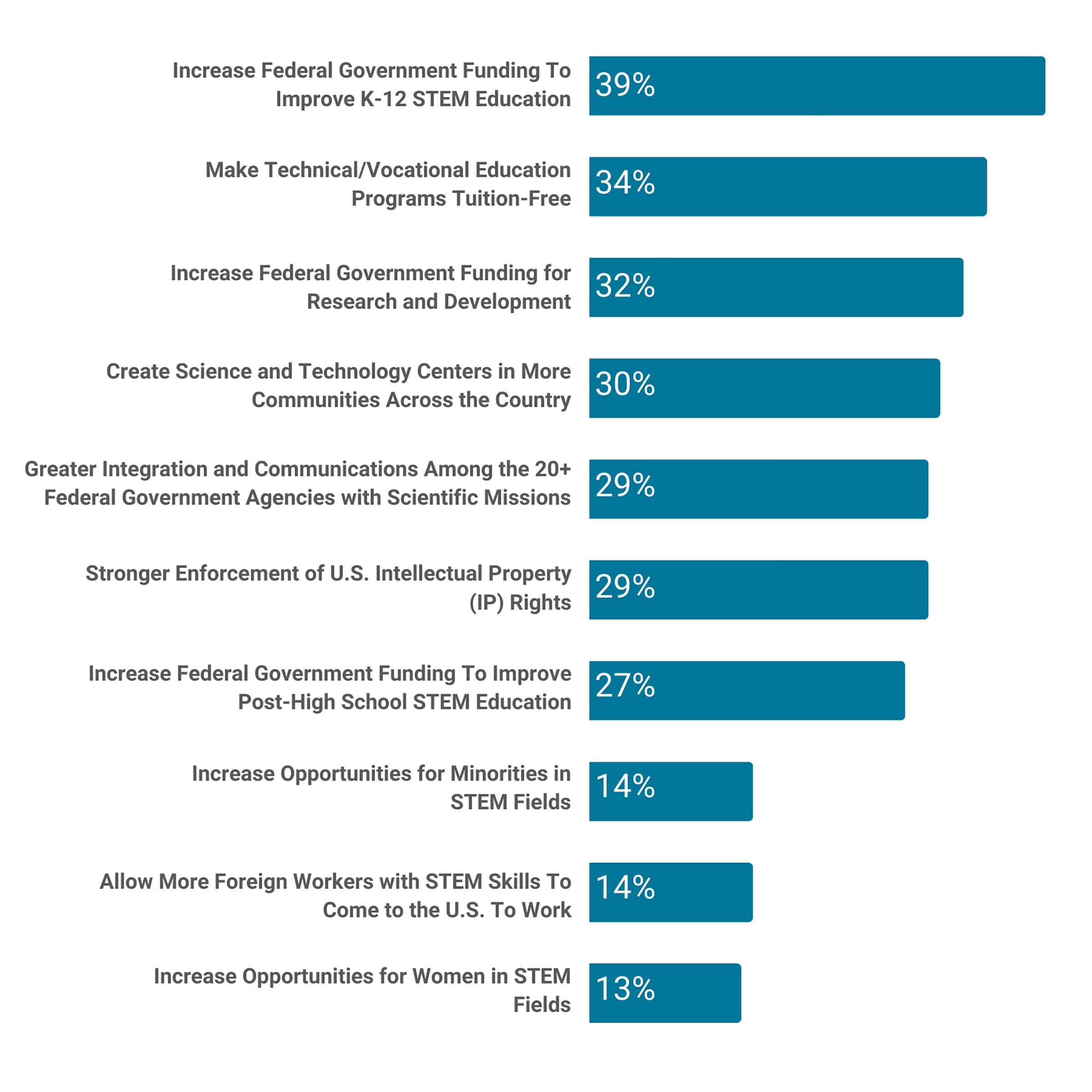
Note: As reported in the survey, 9% of respondents wrote in an answer, and 3% of respondents chose “None of the Above.”
Policy Actions
No simple policy actions will satisfy all these perceived needs. But significant progress can be made by the next president if they take the following actions early in their administration:
- The president should expand the role and mission of the Office of Science and Technology Policy (OSTP) and direct the office to:
- Recommend to the president, as a routine part of the process of developing the annual budget request to Congress, specific allocations for the agencies and programs that provide federal R&D and STEM education funding.
- Develop a strategic plan with objectives for federal R&D and STEM education funding and report on progress as part of each year’s budget preparations.
- Significantly enhance the authority and effectiveness of the National Science and Technology Council (NSTC) to coordinate critical interagency initiatives in R&D and STEM education.
- The president should increase the annual operating budget of OSTP as justified by its expanded role and mission.
- The president should direct that, as a part of each year’s budget process, the Director of OSTP work with the Director of OMB to develop an analysis of how the budget request prepared by OMB advances the nation’s science, technology and innovation primacy, consistent with the administration’s priorities.
- The president should work with Congress to secure National Science Foundation (NSF) appropriations, as called for in the CHIPS and Science Act.
- The president should elevate the role of scientific leadership by promptly (within the first two or three months in office) selecting and nominating an OSTP director as a member of the president’s cabinet, appointing chairs and members for the President’s Council of Advisors on S&T, and tasking this council with studies that support OSTP’s mission and strategic plan.
- The president should identify key areas of critical national need outside of defense, in partnership with Congress. This should include energy, water, and food security; climate change; information security and electronics; and national health care and pandemic preparedness as core elements of the national strategy.
- We urge the incoming president to lay the foundations for the next generation of moonshots. Prior administrations have demonstrated that identifying ambitious projects or goals and going after them in a concerted manner is a core principle woven into the American ethos.
The Bottom Line
America’s leadership in science and technology now faces challenges unprecedented in scope and magnitude. Addressing them will require interagency cooperation at a scale never before seen in the nation’s history. The health and prosperity of the U.S. depends on the establishment of a more united federal government led by a president willing to bring together the public and both parties in Congress in order to develop a plan that restores America’s standing.
This material may be quoted or reproduced without prior permission, provided appropriate credit is given to the author and Rice University’s Baker Institute for Public Policy. The views expressed herein are those of the individual author(s), and do not necessarily represent the views of Rice University’s Baker Institute for Public Policy.


