


This brief is part of “Election 2024: Policy Playbook,” a series by Rice University and the Baker Institute that offers critical context, analysis, and recommendations to inform policymaking in the United States and Texas.
The Big Picture
- Basic scientific research is the foundation upon which revolutionary technologies are invented and built.
- The federal CHIPS (Creating Helpful Incentives to Produce Semiconductors) and Science Act of 2022 authorized increased funding for basic research and science, technology, engineering, and mathematics (STEM) education, which is essential to American technological and economic competitiveness.
- Appropriations have drastically lagged behind the levels authorized by the act and cuts to STEM education have been particularly severe — including funding for graduate and postdoctoral researchers.
- To fulfill the promise of the CHIPS and Science Act, it is critical that appropriations match the act’s authorizations, including doubling the National Science Foundation (NSF) budget over five years.
Summarizing the Issue
In 2022, Congress passed the landmark CHIPS and Science Act to enhance American semiconductor manufacturing. Beyond direct investment in chipmaking, the bill was meant to increase investment in domestic research from basic science to more technology-related efforts. The bill was also intended to support the education and workforce development needed to underpin the planned resurgence of the domestic semiconductor industry. Proposed funding increases in the bill included doubling the NSF budget.
Significance of the National Science Foundation
The NSF is the flagship agency for basic scientific research in the United States. It is the only agency with a mission that explicitly includes education and training of the next-generation scientific and engineering workforce.
The doubling of the NSF budget in the act was to occur over the course of five fiscal years (FY), from 2023–27, which entails an increase of around 15% annually. The funds include proposed large investments in basic research and STEM education as well as workforce development.
- While the FY23 appropriation was close to the level in the CHIPS authorization, the FY24 appropriation for NSF was reduced by $814 million instead — an 8% decrease of the agency’s $9 billion annual operating budget. This cut arrived at a time when inflation continued to raise the cost of performing research and funding student and postdoctoral researchers.
- Additionally, STEM education within NSF (which includes workforce training) was reduced by 17% from the previous year.
- The current House-proposed appropriation would reduce STEM education by a further 14.7%.
In addition to the NSF, the act directed funding increases toward the Department of Energy (DOE), the Department of Defense (DOD), the National Aeronautics and Space Administration (NASA), and the National Institute for Standards and Technology (NIST) and their appropriations are also lagging.
Expert Analysis
Funding Shortfalls
Funding shortfalls that are below authorization levels undercut each agency’s ability to fulfill its statutory obligations as mandated by the act and fail to support the legislation’s overarching mission to train the next generation of American scientists and engineers.
- Numerous reports — including from Brookings, the Federation of American Scientists, and the Center for Strategic Studies — determined that, even accounting for the funding increases in FY23, appropriations fell well below levels authorized by the act, especially at NSF.
- In FY24 and FY25, the act authorized $15.6 billion and $16.7 billion, respectively, to NSF. Congress appropriated only $9.1 billion in FY24 and the White House requested only $10.2 billion for FY25, falling roughly 40% below established targets.
- Similarly, the Department of Energy (DOE) Office of Science and the National Institute for Standards and Technology (NIST) appropriations missed their CHIPS and Science Act targets by nearly $4 billion total across FY24–25.
Figure 1 — Agency Appropriations Versus CHIPS and Science Act Authorizations
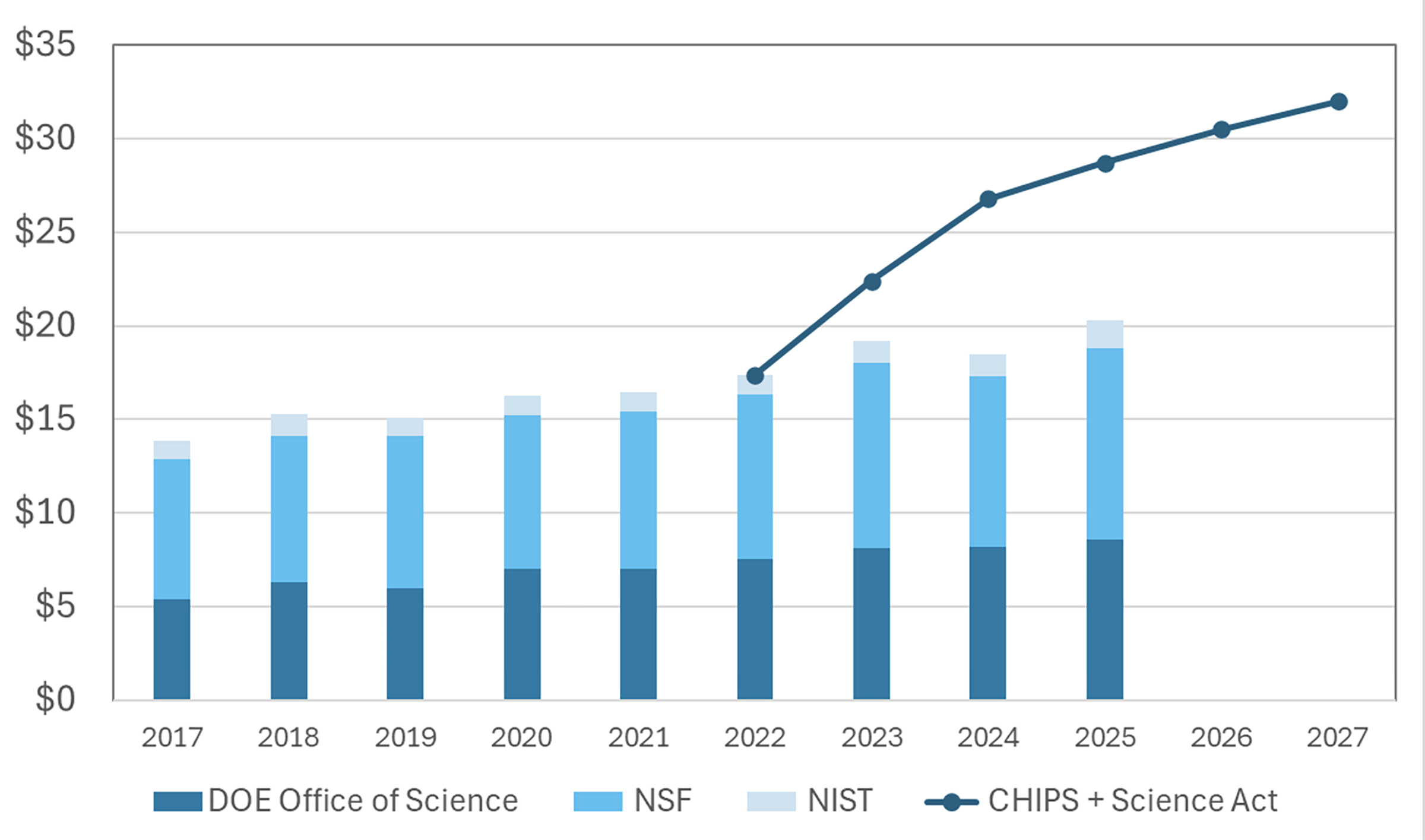
Note: FY25 data are authorization levels from the president’s annual budget request to Congress, not congressional appropriations. Vertical axis figures are in billions of dollars.
Support Needed for US Semiconductor Industry
Since its passage, the CHIPS and Science Act has encouraged large-scale economic investment in the U.S. semiconductor industry. To realize the promise of this investment, however, and to position the U.S. for sustained gains in this and related sectors, support for both basic research and training of the next generation technological workforce are essential.
A Generational Opportunity
Failure to invest adequately in a timely manner risks squandering a generational opportunity to secure American competitiveness in high technology development and manufacturing. Meanwhile, economic competitors like China continue to invest heavily.
Science the Endless Frontier, the landmark 1945 report presented to President Franklin D. Roosevelt by Vannevar Bush, director of the Office of Scientific Research and Development, promoted the government’s role in supporting scientific research. Since then, investments in basic research have repeatedly led to remarkable economic and societal benefits. It is time to capitalize on the unique circumstances afforded by this act to position the NSF and other supporters of basic research for the next decades of progress.
Policy Actions
Our essential recommendation is to follow up the authorizations contained in the CHIPS and Science Act with matching appropriations. Specifically, the recommendations are that the incoming administration and the U.S. Congress:
- Reaffirm the goal of the act to double NSF support over the next five years. This will require an allocation $81 billion over the next five fiscal years, in a manner that adds to the base allocation for the agency (rather than as a one-off supplement).
- Ensure that STEM education and workforce training within NSF and other agencies are supported via appropriations at the levels authorized in the act. Despite a $2.5 billion authorization, only $1.17 billion was appropriated for FY24 —45% of the authorized amount.
- Support the DOE Office of Science at the levels authorized in the act via appropriations. In the act, the Office of Science — which funds both basic research and STEM workforce efforts at DOE — was authorized to grow by 21.6% by FY27. Thus far, with FY24 appropriations, the Office of Science is instead 8% lower than what the act authorized for FY23.
The Bottom Line
To ensure America’s technological and economic competitiveness, and to fully realize the generational opportunity presented by the CHIPS and Science Act, the next administration and Congress must enact appropriations for basic research, STEM education, and workforce development at a level consistent with the act’s authorizations.
This material may be quoted or reproduced without prior permission, provided appropriate credit is given to the author and Rice University’s Baker Institute for Public Policy. The views expressed herein are those of the individual author(s), and do not necessarily represent the views of Rice University’s Baker Institute for Public Policy.


