


Introduction
Iraq’s power generation paradox is striking: In one of the world’s most oil- and gas-rich countries, the government has consistently struggled to provide dependable electricity to homes and businesses. Reliable power supply has been elusive for over three decades, with shortfalls beginning in the wake of the first Gulf War in 1991. Electricity shortages remain widespread despite significant government spending and international engagement. As summer temperatures reach new and more dangerous extremes, the complex task of fixing Iraq’s power grid is more urgent than ever.
One of the root causes of Iraq’s electricity shortfall is pricing. The government provides electricity far below cost. A World Bank estimate found that revenue collected by the Iraqi Ministry of Electricity only covered about 10% of the cost of operating Iraq’s power sector.[1] Each additional unit of electricity sold increases the government’s losses, undercutting incentives to improve service and meet demand.
Meanwhile, vast amounts of natural gas that could supply relatively clean-burning fuel for power generation are flared off at wellheads — wasted. Such flaring exacerbates pollution and climate change, while eliminating a source of government revenue and depriving Iraqi power generators of a valuable feedstock. This has contributed to the power sector’s reliance on importing gas from Iran, along with burning dirty and expensive liquid fuels.
Additionally, Iraq lacks the capacity to fully transport even the limited power it generates to load centers. The country’s transmission and distribution grid only has about half the capacity required to meet current power demand.
While some progress has been made, Iraq’s generation capacity and grid infrastructure continue to lag behind the country’s fast-growing power demand. As a result, Iraqis rely heavily on costly and polluting private generators, while the national grid remains vulnerable to inefficiencies, underinvestment, and external supply disruptions.
Over the past two decades, the Iraqi government — with support from the U.S. and other international partners — has tried to modernize its power generation and transmission sector to ensure a reliable electricity supply. Despite extensive investments, these attempts have failed, with reconstruction programs and infrastructure projects struggling due to mismanagement, threats to security and even sabotage. The failure to create a self-sustaining power sector has left Iraq dependent on temporary solutions that do not address underlying challenges.
The electricity sector’s inefficiencies stem from a range of structural issues, including outdated physical infrastructure, inadequate fuel supplies, financial instability, subsidy-distorting demand, and regulatory constraints. Additionally, Iraq’s reliance on imports for electricity and natural gas has made the sector susceptible to regional supply fluctuations and geopolitical volatility. Addressing these challenges requires comprehensive policy reforms, targeted investments, and a strategic transition towards energy diversification, including renewables.
This report examines the root causes of Iraq’s electricity crisis and explores potential solutions to enhance grid stability and energy security. The findings are based on a Middle East Energy Roundtable workshop hosted by the Baker Institute in January 2025 that featured the following experts: Hisham Mahmood, a research engineer at the Pacific Northwest National Laboratory who leads a team assisting the Iraqi government; James (Jim) Jewell, former senior advisor at the U.S. Department of Energy’s Office of African and Middle Eastern Affairs; David M. Satterfield, director of the Baker Institute and its Edward P. Djerejian Center for the Middle East; and a Western diplomat based in the region who requested anonymity.[2]
Structural Reasons Behind Iraq’s Perennial Power Shortage
Iraq’s fragile electricity sector faces systemic inefficiencies across generation, transmission, and distribution. Financial constraints, political instability, and security challenges are complicating the expansion and modernization plans. Dependence on imported fuel or power from Iran, Jordan, and autonomous Iraqi Kurdistan add complexity, while government subsidies on power generation feedstocks — natural gas and oil-based liquids — and discounted electricity sales tariffs have incentivized increases in power demand while undermining the business case for expanding the grid.
This opening section examines the root causes of Iraq’s power shortages, outlining the economic, structural, and security-related barriers that impede progress. Understanding these foundational issues is essential for identifying viable solutions and policy interventions that can help Iraq achieve long-term energy security and stability.
Economic Structures and Disincentives
Iraq’s electricity sector operates under a heavily subsidized tariff system that distorts market incentives and undermines financial sustainability. The first tranche of electricity consumption is priced at 10 Iraqi dinars (IQD) — less than one U.S. cent — per kilowatt-hour (kWh), about 6% of the average U.S. price of 16 cents per kWh.[3] This tariff allows the government to recover no more than 10% of its costs of fuel provision and power generation. These hardships are largely borne by the Ministry of Electricity (MoE). As a result, the MoE lacks capital to invest in necessary infrastructure upgrades and expansion projects.[4] Power subsidy costs fluctuate with oil and gas prices, but a World Bank estimate for 2017 put the cost at more than 10 billion U.S. dollars.[5]
Table 1 — Power Tariffs in Iraq in 2025

Note: Costs depends on usage; no maximum for category.
Compounding this issue, a large proportion of Iraqi households lack functioning electricity meters, making accurate billing impossible.[6] Even when bills are issued, collection rates remain low — only about 20% of bills are paid in full — due to weak enforcement and a widespread public perception that electricity should be a free public service.[7] Without tariff reform and improved revenue collection, the financial deficit in the electricity sector will continue to grow, preventing much-needed investments in the grid. If generation and transmission improvements are made without tariff increases, demand growth of roughly 10% per year will continue to outpace capacity increases, resulting in continued load shedding — intentionally cutting off electricity to certain areas or customers to prevent overloading of the power grid.[8] In the summer of 2025, peak demand is expected to grow from 2024’s 45 gigawatts (GW) to a record high of 55 GW, highlighting the urgency of demand-side management reforms that can increase efficiency of consumption.[9]
Figure 1 — Collected Revenue Versus Metered and Supplied Electricity

Note: Out of IQD 4.2 trillion in supplied electricity value, only IQD 0.8 trillion was collected in 2020.
Private Generation and Associated Issues
Unreliable supply from the national grid has made private generation a critical, though problematic, part of Iraq’s electricity ecosystem. Small-scale generator set (gen-set) entrepreneurs —individuals or businesses who generate and sell electricity using generator sets (gen-sets), fueled by oil-based fuels, mainly diesel — play a key role in providing off-grid or backup power in areas with unreliable electricity supply. Each household or business has a separate connection — known as al-khat (the line) — to a nearby private generator that supplies electricity to those within a small radius when Iraq’s national grid (Al-Wataniya) goes down. Since the private generators cannot be connected to the available distribution network, the connections are often chaotic and unreliable.
Figure 2 — Chaotic Al-Khat Lines to a Private Generator
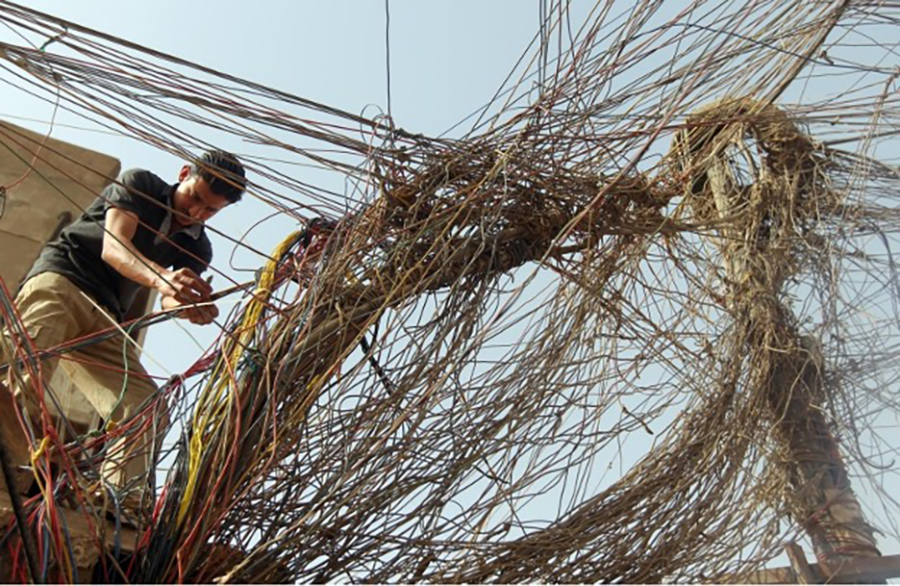
Entrepreneurs sell power based on desired amperes — the strength of available current — rather than kWh, which measure actual consumption. This helps control usage and avoid the cost of metering. It is the customer’s responsibility to buy and install a private wire from the home to the generator site. This wire is then connected to the generator through a circuit breaker set to a current threshold that corresponds to the number of amperes bought. This means that the breaker will trip whenever current drawn exceeds the agreed limit, completely disconnecting the customer.
In Iraq, these sales are often made on a take-or-pay basis, with customers paying up to US$500 per month regardless of their consumption levels.[12] Collectively, these private generators are estimated to have reaped some US$4 billion in revenue in 2018, which is four times the US$1 billion in charges levied by the MoE and about eight times the state utility’s collected revenue.[13]
Table 2 — Private Generator Pricing (Al-Khat)

Private Generators Skew the Electricity Market
Private generator sales reveal that many Iraqis — who may resist cost-reflective pricing from the state utility or avoid paying altogether — are nonetheless willing to pay full market rates for electricity from private sellers. Unlike the MoE, these private providers enforce strict payment policies, disconnecting customers who fail to pay.[14]
Iraq’s thousands of private generators are also distorting the electricity market in other ways.
Less Efficient, More Expensive — Power generation via small engines is considerably less efficient than that of utility-scale turbines, making the electricity produced significantly more expensive. These generators also pose serious risks to public health and the environment, with extreme noise and air pollution. One study from Brazil found that diesel generators cost three times more to operate and emit 53 times more particulates per unit of power than a typical combined cycle natural gas turbine plant.[15]
Entrenched Interests and Political Resistance — Private generator operators have a large stake in maintaining the status quo and often resist efforts to improve reliability in the state grid, as this would threaten their livelihoods.
Subsidized Fuel, Hidden Costs — Many municipalities have started to subsidize diesel fuel for private generators, which increases generators’ profits but imposes a further hidden subsidy burden on local governments — and indirectly, on the federal government.
Revenue Drain on Public Utilities — Moving revenue to private generators in this way reduces the ability of state-run utilities to invest in and improve services. Meanwhile, damage caused by makeshift connections and unpredictable load shifts increases the costs of maintaining the national grid.
Physical Infrastructure Deficiencies
The Iraqi power sector is also plagued by aging and inefficient generation plants, still damaged from decades of sanctions and war along with a lack of maintenance. While Iraq’s total generation capacity was 40 GW in 2023, maximum actual generation that year was just 27 GW, far short of peak demand, estimated at 45 GW.[16]
Power transmission is, in turn, severely constrained by bottlenecks and deficiencies in the transmission and distribution networks. Iraq loses more than 40% of the power it generates during transmission, due to faulty or outdated equipment and widespread electricity theft.[17] Without an effective transmission system, electricity cannot be reliably delivered to consumers, exacerbating the country’s chronic power shortages. Further deficiencies include overheating, sub-optimal fuel mixes, shortages of water for cooling, and others. As a result, generated supply falls significantly short of nameplate capacity of installed power plants.[18] For example, MoE-owned plants often operate below 60% of their rated capacities (Figure 3).
Figure 3 — Power Plants Nameplate Versus Actual Installed Capacity, 2021

Many Iraqi power plants were designed to run on natural gas but now burn crude or heavy fuel oil. This shift is due to inadequate transport capacity, despite plentiful natural gas resources in the country and broader region. Burning crude oil to generate power is inefficient in terms of output as well as in economic terms, given oil’s high export value on the international market. Diverting valuable crude to the low-value power sector carries a large opportunity cost in terms of export revenue foregone. Burning dirtier fuels also increases turbine maintenance requirements; when that is delayed or neglected, production capacity declines further.
While Iraq has some interconnections that allow power imports from neighboring countries, these arrangements are unreliable during peak summer months, when soaring demand across the region means no surplus electricity is available for Iraq. As a result, the country faces severe power deficits precisely when its needs are greatest.[20]
Additionally, the frequency fluctuations of alternating current on the Iraqi grid are far larger than those typically found in developed national grids. Fluctuations create a level of instability that makes it difficult to balance supply and demand or interconnect with grids in surrounding countries. Iraq’s 50 Hertz system commonly operates closer to 47 Hz, with fluctuations of 2.5 Hz common. By contrast, U.S. grids tend to allow fluctuations no larger than 0.7 Hz to preserve stability.[21]
Due to the ongoing frequency fluctuations, Iraq will not be able to full benefit from upcoming interconnections with neighboring states. These linkages require service areas to be isolated from the rest of the grid — commonly referred to as “islanding” —which prevents them from contributing to grid stability or supplying power to other areas.[22] For instance, Iraq’s planned 2025 interconnection with Kuwait depends on a stabilized grid frequency, whereas a separate link with Saudi Arabia — because it uses high voltage direct current power flows — will not be affected by Iraq’s frequency issues.[23]
Regional disparities further complicate Iraq’s electricity distribution. Basra, the main city in the oil-producing region in southern Iraq, enjoys more reliable power than other parts of the country. After the Basra municipality funded an upgrade to its regional generation and distribution network, it now receives a disproportionately high share of the national power supply at the expense of underserved regions. Given the national reliance on oil exports — 90% of the government budget — and the Basra region’s dominance in production, reliable power in this region is deemed necessary for Iraq’s economic survival. Likewise, Iraq’s Kurdish region operates a largely independent power network, with private generators supplying electricity to the Iraqi grid rather than depending on it.
Fuel Shortages Due To Flaring
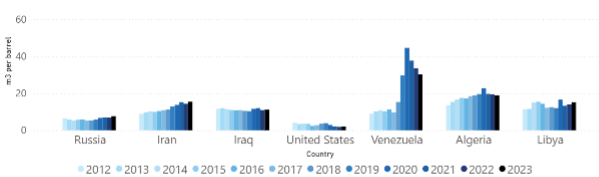
Despite being one of the world’s largest oil producers, Iraq wastes a significant portion of its potential energy supply through gas flaring.[24] In other words, gas associated with oil extraction is often burned off at the wellhead rather than being captured and sold as a source of energy for power generation or industry. Iraq has the third largest global rate of gas flaring, surpassed only by Russia and Iran.[25] In 2023 Iraq flared about 18 billion cubic meters of gas— over 11% of the global total — enough to generate approximately 33 GW of electricity in a typical gas-fired power plant (assuming a heat rate of 9Mbtu/MWh and a capacity factor of 0.8). This flaring alone released an estimated 36 million tons of carbon dioxide, more than the total annual emissions of Ireland.[26]
Figure 4A —Top World Gas Flaring Countries: Flaring Volume

Figure 4B —Top World Gas Flaring Countries: Flaring Intensity
Several factors contribute to the persistence of gas flaring in Iraq.
- One major issue is the lack of infrastructure to capture, process, and transport gas to demand centers such as power plants. Many of Iraq’s oil fields were redeveloped without adequate gas recovery systems and retrofitting them is costly and complex.[29]
- Bureaucratic inefficiencies, fragmented regulatory oversight, and insufficient investment incentives have delayed reductions in flaring.[30]
- Unrest and insecurity have also discouraged foreign and domestic investment in gas recovery projects.[31]
The Iraqi government says its commitment to fully eliminate gas flaring by 2030 is on track to capture 75% of flared gas by December 2025 and 100% by 2028, two years earlier than stated, despite technical and financial hurdles.[32] However, its prior flaring reduction targets have been missed. Newly captured gas is to be redirected to power plants.
The Basra Gas Company, a joint venture between Iraq’s state-owned South Gas Company, Shell, and Mitsubishi, now captures 60% of the associated gas produced in the giant Rumaila, West Qurna 1, and Zubair oil fields. Since start-up in 2013, BGC’s gas production has risen from 250 million standard cubic feet/day (mmscf/d) to 950 mmscf/d. Previously, the gas was flared off.[33] More investments and regulatory reforms are needed to scale up these efforts and fully integrate gas into Iraq’s energy mix. Further initiatives led by GE Vernova, Shell, Baker Hughes and TotalEnergies are underway to divert flared gas to power generation and reduce fuel imports.[34]
Security Issues
Iraq’s legacy of armed conflict continues to shape the political landscape, contributing to a climate of instability. Threats posed by criminals and armed political groups continue to discourage foreign contractors from investing in or deploying personnel to Iraq.[35] Additionally, for the U.S. and many international partners, political and energy-sector ties with Iran remain a significant deterrent. Investor reluctance limits access to advanced technologies and expertise, slowing the modernization of Iraq’s electricity infrastructure.
Theft of electricity, wires, scrap metal, and equipment further undermines grid reliability and increases operational costs. Addressing these security concerns through enhanced law enforcement, secure project sites, and improved governance is essential to attract investment and expertise.
Diversifying Beyond Fossil Fuel Generation to Solar Power
Iraq possesses immense solar potential, with abundant sunlight and vast tracts of unused land that are ideal for utility-scale solar farms. Solar power has become one of the world’s most cost-effective electricity generation methods, especially since Chinese overproduction has driven down the cost of solar panels. In many settings, the cost of solar infrastructure can quickly be offset by the savings in fuel combustion by idled conventional power plants. Solar generation also aligns well with Iraq’s daily demand curve, with generation peaking during midday when electricity consumption is highest due to air conditioning and industrial loads. Solar would be particularly welcome during hot summer months when demand surges.
Despite these advantages, solar power faces resistance from Iraqi engineers, primarily due to its low capacity factor — around 30% — resulting from intermittent generation, which necessitates backup generation capacity to maintain a stable power supply. Transmission infrastructure is already in short supply in Iraq, and more power lines would have to be built to connect solar farms to the power grid. But since these lines would only be used about 30% of the time, many engineers favor grid investments to connect dispatchable plants to the grid that can provide round-the-clock baseload power.[36] Underutilized infrastructure would increase the payback period to recoup capital investment costs.[37] However, transmission needs can be minimized by selecting sites for solar that are near existing baseload plants, which would improve utilization of new infrastructure.
Solar power would serve Iraq well by reducing fuel consumption, particularly that of expensive liquid fuels such as crude oil, heavy fuel oil, and diesel fuel, still consumed in Iraqi power plants. These liquids could achieve far higher value as export products. More solar power could also allow Iraq to wean itself off imports of natural gas, produce cleaner electricity and enhance risks around energy security. Solar may involve fewer technical issues than capturing and transporting associated natural gas from existing Iraqi oil wells. The reduced opportunity cost implied by exporting the saved crude oil and oil products would be sufficient to cover the cost of Iraqi solar farms in around half of the solar plant’s operating life.
Achieving dispatchability would require Iraq to combine solar generation with battery or other electricity storage as well as flexible backup generation to promote grid stability. To overcome public resistance, targeted training programs and demonstration projects should be implemented to build expertise and reveal solar energy’s economic and environmental advantages.[38] Total Energies, and U.S. based UGT are implementing a total of 4 GW of solar power in Iraq.[39]
Changes Underway to Fix the Grid
As highlighted above, Iraq’s electricity grid faces systemic challenges due to aging infrastructure, high transmission losses, and dependence on external energy imports. In an attempt to solve these challenges and address chronic electricity shortages, interconnections with other countries have been completed or are under consideration, and domestic reforms have been launched.
Iraq’s Recent Domestic Reforms
Since 2017, the Iraqi government has pursued a number of legal and policy reforms aimed at increasing power generation, improving transmission, rationalizing tariffs, and improving measurement and billing practices.
- Electricity price increases were imposed in 2016 and 2020, but substantial subsidies remain in place.[40]
- A 2024 reform added fixed subscription fees of IQD 2,000 per month to household electricity bills in an attempt to increase revenues without raising per-kWh rates.[41]
- The Ministry of Electricity began auditing high-consuming residential electricity accounts exceeding IQD 150,000 per month, equivalent to roughly 4,500–5,000 kWh.[42]
- In the Kurdish region, meanwhile, the regional government has proposed a major subsidy reform that would involve increases in power tariffs from IQD 18/kWh to IQD 156.[43] At the time of writing, however, the reform remained stalled.
The federal government has also sought to amend laws to render the country’s power sector more attractive for foreign investment, in particular allowing for privately owned and operated generation. Notable amendments include protections from state expropriation, support for independent dispute arbitration, and 10-year tax and customs exemptions. Still, there is a long way to go. The Ministry of Energy remains the sole operator and overseer of the system, creating policy and regulations, while owning and operating power plants, and transmission/distribution infrastructure.[44]
Regional Collaboration
Iran
Iran started selling electricity to Iraq in 2004, following the 2003 U.S. invasion of Iraq and months of difficulty restoring the electricity service.[45] Several Iranians were killed while building energy interconnections into Iraq during a period of high unrest.[46] Although Iran has been less of a player in the Iraqi market in terms of directly supplying electricity, it has significantly contributed to Iraq’s electricity grid through separate natural gas exports — about 20% of Iraq’s electricity was generated from Iranian gas.[47] Iranian electricity exports to Iraq ceased on March 9, 2025, after the Trump administration’s cancellation of an electricity sanctions waiver, which reimposed sanctions on Iranian exports to Iraq.[48] Iranian natural gas exports are still allowed for now, due to a U.S. legislative exception that covers Iranian gas exports to several countries.
Regardless, Iraq’s supply of Iranian electricity and natural gas was frequently curtailed by Iran due to domestic energy demands or infrastructure failures. In addition, U.S. policymakers have long opposed Iraqi energy imports from Iran, which crystalized in the Trump administration’s decision to block the trade. To mitigate the loss of Iranian power and gas, U.S. officials have urged Iraqis to seek alternate import providers and enhance domestic capacity. Decoupling from Iran requires more power generation — likely including renewables — as well as greater amounts of natural gas, some of which can be recovered from supply now being flared off. Even so, Iraq is seeking further imports of electricity. Development of natural gas fields in both federal Iraq and the Iraqi Kurdistan region, along with consideration of installing a floating storage and regasification unit at the port of Khor Al Zubair in the Basra region, are all underway but not expected to impact Iraq’s electricity production until late 2025 at the earliest.
Gulf Cooperation Council Interconnection Authority (GCCIA)
The GCCIA interconnection project, scheduled for completion in 2025, could offset some of the lost Iranian power imports with supplies from the GCC.[49] The GCC-Iraq interconnection aims to supply up to 600 MW of electricity in southern Iraq. The interconnection involves constructing 400-kilovolt double-circuit overhead lines from Kuwait’s Al-Wafrah Substation to Iraq’s Al-Faw Substation, a distance of 295 kilometers. The Al-Faw Substation will be upgraded with advanced circuit breakers, electrical reactors, and state-of-the-art control systems. However, the line cannot be directly connected to the current Iraqi grid due to its frequency and supply issues. Instead, power from the GCCIA will be used to supply local load areas that are isolated from the Iraqi grid. Funded by the Kuwait Fund for Arab Economic Development (KFAED) and the Qatar Fund for Development (QFFD), this $240 million project is part of a broader expansion of electricity trade under the Regional and Arab Electricity Market Framework.
Turkey
A 300 MW interconnection with Turkey to address power shortages in Iraq’s northern regions of Kirkuk, Nineveh, and Salahuddin is being developed.[50] After nearly two decades of delays, transmission lines connecting the Turkish grid to a power station near Mosul were completed in July 2024. The Turkish interconnection is expected to enhance grid reliability in areas undergoing frequent load shedding due to disruptions of Iranian-supplied power. More recently, after the U.S. administration ended the sanctions waiver allowing Iraq to import electricity from Iran, the Iraqi state news agency reported that Iraq would double electricity imports from Turkey to 600 MW.[51]
Jordan
The Jordan-Iraq electricity interconnection project was established in October 2022 and Jordan started supplying electricity to western Iraq in March 2024, after the first phase of the project was completed.[52] The first phase provided a token 40 MW to the town of Rutba and its region. The second phase, expected to be completed by the end of 2025, will extend the connection to the town of Al-Qa’im, next to the Syrian border, providing an additional 250 MW. This partnership aligns with Iraq’s strategy of diversifying energy imports and strengthening regional economic ties. Imports from Jordan, where in 2023 wind and solar power represented 27% of installed generation capacity and 18% of total power generated, would add a cleaner source of imported power than that supplied domestically or from other neighboring states.[53]
Saudi Arabia
In June 2023, Saudi Arabia and Iraq launched another GCCIA-led interconnection that would add a second tie-in to the GCC grid.[54] The proposed Saudi-Iraq interconnection involves constructing a 400-km dual-circuit direct current (DC) transmission line linking the border town of Arar in northern Saudi Arabia with Yusufiya, southwest of Baghdad. With an initial planned capacity of 1 GW, this project will provide much-needed electricity to the chronically power-short Iraqi capital and surrounding areas.[55] The advantage of using DC transmission line, other than allowing the interfacing of the 60 Hz Saudi network to the Iraqi 50 Hz grid, is that the DC transmission isolates the disturbances in the Iraqi grid frequency, preventing them from the affecting the Saudi grid.
Conclusion
Iraq’s struggling electricity grid stands as a challenge to the laws of economics and physics. The unstable operating frequency and constant outages make it a dangerous prospect for interconnections with more stable grids in neighboring countries.
Iraq’s Power Paradoxes
At least three paradoxes create barriers to a modern and sufficient supply of power.
- The ongoing waste of a key potential power generation feedstock — natural gas.
- The money-losing electricity tariff structure that disincentivizes the state from generating and delivering enough power to meet demand, while incentivizing the diesel gen-set entrepreneurs who sell power at exponentially higher prices and emissions.
- The need to upgrade and expand outdated and run-down infrastructure, including transmission lines, substations, and grid management systems, to improve overall grid performance.
By implementing cost-reflective tariffs, enacting legal changes, and prioritizing strategic investments, Iraq can attract private capital, reduce reliance on external energy sources, and finally create some domestic energy security in a country that has rarely experienced such a phenomenon. The phased elimination of private generators, coupled with infrastructure upgrades, smart meter deployment, and gas flaring reduction, are steps toward a sustainable electricity sector capable of supporting long-term economic growth.
Environmental and Social Impacts
These reforms will also have significant environmental and social impacts.
- Reducing gas flaring and increasing the use of renewable energy will help Iraq meet its climate commitments and improve air quality, a benefit to public health.
- Reliable electricity supply will support critical sectors such as healthcare, education, and industry, contributing to a higher quality of life and increased productivity.
- Transparent metering and billing systems, along with fair tariffs and robust bill collection, will foster public trust and encourage efficient energy consumption rather than the wasteful practices incentivized now.
Regional Partnerships
Regional energy partnerships can assist Iraq while improving economic cooperation and — one hopes — political stability in the Middle East. Tie-ins with neighboring Kuwait, Turkey, Jordan, and Saudi Arabia, and perhaps even Iran, can position Iraq as a key player in the regional electricity market. This interconnected network will facilitate electricity trade that can enable growth in renewable power generation, optimize resource utilization, and create opportunities for cross-border investment.
Ultimately, the success of all these initiatives depends on sustained political commitment, effective governance, and collaboration between public and private stakeholders. By aligning its energy policies with long-term economic, social, and environmental goals, Iraq can build a resilient and inclusive energy sector that supports sustainable development and enhances the well-being of its citizens. This holistic strategy, informed by regional best practices and expert recommendations, is essential for Iraq’s future prosperity and energy independence, laying the foundation for a more stable and prosperous future.
Policy Recommendations
The following policy recommendations are offered for consideration by Iraqi policymakers.
- Cost-Reflective Tariff — Gradual adjustments to electricity tariffs are essential to cover the full costs of generation, transmission, and distribution. Eventually the goal should be to increase tariffs to profitable levels, to incentivize private and public investment in new infrastructure. Drawing inspiration from Saudi Arabia’s tariff reform, Iraq should implement targeted cash subsidies to assist low-income households in managing higher electricity costs.
- Phasing Out Small-Scale Private Generators — Private stand-alone diesel generators, widely used due to grid unreliability, are costly, inefficient, and environmentally harmful. Iraqi Kurdistan’s phased approach serves as a model for the rest of Iraq, combining improved grid reliability with financial incentives to encourage consumers to transition away from small diesel generators. Roundtable participants emphasized that eliminating private generators will reduce pollution, lower consumer costs, and stimulate investment in renewable energy, including rooftop solar and home batteries.
- Legal and Regulatory Reforms — Establishing a stable investment environment requires clear regulations that protect investors’ rights while ensuring government accountability. Key legal reforms should address sovereign immunity, streamline permitting processes, and enhance contractual enforcement, aligning with international best practices.
- Privatization of Retail Power Sales: Although many Iraqis are unwilling to pay the government a cost-reflective price for their power consumption, they are prepared to pay very high prices under restrictive take or pay contract terms with neighborhood diesel generator entrepreneurs. Partial privatization of the state utility sector and encouraging investment by utility-scale Independent Power Providers (IPPs) could render price reforms more palatable to the public, while also improving operations and bill collection enforcement.
- Investment Priorities
- Grid Development — Expand high-voltage transmission lines to connect Iraq’s southern, central, and northern regions. Upgrade medium-to-low voltage distribution lines to reduce technical losses and improve supply reliability.
- Smart Meter Deployment — Replace outdated meters with smart digital meters to combat electricity theft, enhance bill collection, and improve consumer transparency.
- Solar Power Integration — Develop solar projects near baseload power plants and load centers to capitalize on Iraq’s abundant solar resources, reduce fuel consumption in conventional plants, and improve transmission utilization. Prioritize sites that minimize the need for new infrastructure and address local concerns about underused grid capacity.
- Gas Infrastructure and Flaring Reduction — Eliminating routine gas flaring is critical to improving energy security and economic prosperity while minimizing environmental impact. The government should encourage accelerated investment in gas capture and processing, including expansion of current projects led by the Basra Gas Company and TotalEnergies. Addressing pipeline pressure variations and compatibility issues will enhance the efficiency of gas transport, reducing reliance on expensive liquid fuels.
Acknowledgements
For their assistance in researching and reviewing this report, the authors would like to thank Hisham Mahmood, a research engineer at the Pacific Northwest National Laboratory; James (Jim) Jewell, former senior advisor at the U.S. Department of Energy’s Office of African and Middle Eastern Affairs; Rice University’s Amir Zouaoui; and Michael D. Maher, chief of research operations, Baker Institute Center for Energy Studies.
Notes
[1] The World Bank, “Iraq Electricity Services Reconstruction and Enhancement Project (P162454),” April 19, 2019, https://documents1.worldbank.org/curated/en/504001557108087756/pdf/Iraq-Electricity-Services-Reconstruction-and-Enhancement-Project.pdf.
[2] The Middle East Energy Roundtable (MEER) convenes workshops with a broad range of participants and discussion topics (“Middle East Energy Roundtable, Rice University’s Baker Institute for Public Policy, https://www.bakerinstitute.org/middle-east-energy-roundtable).
[3] Iraq’s tiered electricity tariff starts at 10 Iraqi dinar (IQD) per kWh for the first 2550 kWh per month, rising to IQD 35 (about 3 US cents) per kWh for the next 2550 kWh, and IQD 84 (6.5 US cents) for extreme consumption levels beyond 5100 kWh per month. By comparison, average US household consumption is about 1,000 kWh/month. The average US residential tariff was 17.11 US cents (IQD 224) per kWh in March 2025, while the overall average tariff — including commercial and industrial customers — was 13.27 US cents/kWh (U.S. Energy Information Administration [EIA], Electric Power Monthly, May 22, 2025, https://www.eia.gov/electricity/monthly/epm_table_grapher.php?t=epmt_5_6_a). Note that Globalpetrolprices.com reports Iraqi residential power prices at IQD 19 per kWh, about 1.5 US cents, with commercial prices at 4.6 US cents/kWh (“Iraq Electricity Prices,” Globalpetrolprices.com, updated March 2025, https://www.globalpetrolprices.com/Iraq/electricity_prices/).
[4] MEER, workshop presentation, Rice University’s Baker Institute for Public Policy, January 30, 2025.
[5] “Iraq Electricity Services Reconstruction and Enhancement Project.”
[6] The Ministry of Electricity began installing smart meters in 2024, but as of the time of writing these were not connected to a backbone meter data management (MDM) system. U.S.-based Itron was awarded a pilot project to install and trial its MDM system. By 2026, it remained possible that Iraq could have a functioning smart meter network that can control and monitor electricity usage in parts of the country. On nonmetered consumption and more generally the electricity situation in Iraq, see Roman Jamal, “Iraq’s Electricity Crisis: Could Interconnected Smart Grid be the Answer?” Innov8, February 23, 2025, https://tinyurl.com/4f8uukkf.
[7] MEER, workshop presentation.
[8] “Iraq Electricity Services Reconstruction and Enhancement Project.” For a definition of load shedding, see Nick Barney and Meredith Courtemanche, “Load Shedding,” TechTarget, May 25, 2023, https://www.techtarget.com/searchdatacenter/definition/load-shedding.
[9] Sherif Tarek and Khalid Al-Ansary, “Iraq Inks Deals with US Companies to Expand Power Plants,” Rigzone, April 10, 2025, https://www.rigzone.com/news/wire/iraq_inks_deals_with_us_companies_to_expand_power_plants-10-apr-2025-180193-article/.
[10] International Monetary Fund (IMF), Middle East and Central Asia Department, “The Fiscal Cost of Iraq’s Electricity Sector and Potential Gains from Reform,” Iraq: Selected Issues 2023, no. 76 (2023), https://doi.org/10.5089/9798400231759.002.
[11] Lizzie Porter et al., “Electricity Crisis Worsens as Iran Cuts Supply and Minister Resigns,” Iraq Oil Report, June 29, 2021, https://www.iraqoilreport.com/news/electricity-crisis-worsens-as-iran-cuts-supply-and-minister-resigns-43838/.
[12] The $500 figure comes from reported charges for large power volumes in upper-income neighborhoods (MEER, workshop presentation).
[13] IMF.
[14] MEER, workshop presentation.
[15] José Luz Silveira et al., “Combined Cycle Versus One Thousand Diesel Power Plants: Pollutant Emissions, Ecological Efficiency and Economic Analysis,” Renewable and Sustainable Energy Reviews 11, no. 3 (2007): 524–35, https://doi.org/10.1016/j.rser.2004.11.007.
[16] MEER, workshop presentation.
[17] “Iraq Electricity Services Reconstruction and Enhancement Project.”
[18] Nameplate capacity refers to the maximum rate output of a power plant or generator, and is normally specified on an name plate attached to the equipment (EIA, “Generator Nameplate Capacity (Installed),” Glossary, accessed June 4 2025, https://www.eia.gov/tools/glossary/index.php?id=Generator%20nameplate%20capacity%20(installed)).
[19] IMF.
[20] Umud Shokri, “Strengthening Energy Security: The GCC-Iraq Electrical Interconnection Project,” Gulf International Forum, 2023, https://gulfif.org/strengthening-energy-security-the-gcc-iraq-electrical-interconnection-project/.
[21] MEER, workshop presentation.
[22] For an outline of islanding, see Brian Dobb, “Understanding Power System Islanding,” Hubbell Power Systems Blog, March 20, 2018, https://blog.hubbell.com/en/hubbellpowersystems/power-system-islanding.
[23] Saudi Arabia operates a 60 Hz system which must be converted to 50 Hz before being exported to Iraq.
[24] “What Countries Are the Top Producers and Consumers of Oil?” EIA Frequently Asked Questions (FAQs), updated April 11, 2024, https://www.eia.gov/tools/faqs/faq.php?id=709&t=6.
[25] The World Bank, “Global Gas Flaring Tracker Report,” June 2024, https://thedocs.worldbank.org/en/doc/d01b4aebd8a10513c0e341de5e1f652e-0400072024/original/Global-Gas-Flaring-Tracker-Report-June-20-2024.pdf.
[26] Energy Institute, “2024 Statistical Review of World Energy,” statistical database, 2024, https://www.energyinst.org/statistical-review.
[27] The World Bank, “Global Gas Flaring Data,” June 2024, https://www.worldbank.org/en/programs/gasflaringreduction/global-flaring-data.
[28] The World Bank, “Global Gas Flaring Data.”
[29] Iraq’s power, oil and gas infrastructure was damaged during the 1990–91 Gulf War with US-led coalition forces and was never fully repaired. Some of the deficiencies that plague Iraq today date from 35-year-old unrepaired war damage.
[30] MEER, workshop presentation.
[31] MEER, workshop presentation.
[32] Agence France Presse (AFP), “Iraq Says to Eliminate Pollutant Gas Flaring by End of 2027,” Barron’s, December 23, 2024, https://www.barrons.com/articles/iraq-says-to-eliminate-pollutant-gas-flaring-by-end-of-2027-ef0bd59c.
[33] Shell Iraq, “Basrah Gas Company,” press release, https://www.shell.iq/about-us/projects-and-sites/basrahgascompany.html.
[34] TotalEnergies, “GGIP: A Multi-Energy Project to Support Iraq Towards Its Energy Independence,” press release, January 10, 2025, https://totalenergies.com/company/projects/gas/ggip-multi-energy-project-Irak.
[35] Marsin Alshamary and Hamzeh Hadad, “Iraq’s Search for Security and Sovereignty After Assad’s Collapse,” Brookings Insititution, January 21, 2025, https://www.brookings.edu/articles/iraqs-search-for-security-and-sovereignty-after-assads-collapse/.
[36] For an introduction to dispatchable sources of electricity, see “Dispatchable Source of Electricity,” Energy Education, 2024, https://energyeducation.ca/encyclopedia/Dispatchable_source_of_electricity.
[37] MEER, workshop presentation.
[38] MEER, workshop presentation.
[39] Nadim Kawach, “TotalEnergies Starts Building Iraq’s Largest Solar Plant,” Arabian Gulf Business Insight, March 7, 2025, https://www.agbi.com/renewable-energy/2025/03/totalenergies-starts-building-iraqs-largest-solar-plant/.
[40] Hamada Dara Zahawi et al., “Legal Guide to Investing in Power Generation in Iraq,” Commercial Law Development Program, Office of the General Counsel, US Department of Commerce, https://tinyurl.com/4myysjn2.
[41] “Additional Electricity Bills Are Only 2,000 Dinars per Month for Households, According to a Responsible Source,” +964 Media, June 8, 2024; https://964media.com/384079/.
[42] Author interview with Western government official based in Iraq, on condition of anonymity.
[43] Shafaq News, “Kurdistan’s 24/7 Power Project Faces Backlash Over Price Hike,” March 18, 2025, https://shafaq.com/en/Kurdistan/Kurdistan-s-24-7-power-project-faces-backlash-over-price-hike.
[44] “Iraq Electricity Services Reconstruction and Enhancement Project.”
[45] “A New Transmission Line Synchronizes Iran, Iraq Power Grids,” Tehran Times, June 10, 2020, https://www.tehrantimes.com/news/448712/A-new-transmission-line-synchronizes-Iran-Iraq-power-grids; “Iraq: Still in the Dark,” Alzajeera, February 6, 2004, https://www.aljazeera.com/news/2004/2/6/iraq-still-in-the-dark.
[46] “A New Transmission Line.”
[47] “Deep Data: GCC Electricity and Iraq’s Reliance on Iran,” Amwaj.media, July 20, 2022, https://amwaj.media/en/article/electricity-deal; Nadia Al-Faour and Robert Edwards, “Is US Pressure on Iraq over Reliance on Iranian Electricity a Blessing in Disguise?,” Arab News, March 26, 2025, https://www.arabnews.com/node/2594960/middle-east.
[48] Humeyra Pamuk, “Trump Administration Ends Iraq’s Waiver to Buy Iranian Electricity,” Reuters, March 9, 2025, https://www.reuters.com/world/trump-administration-ends-iraqs-waiver-buy-iranian-electricity-2025-03-09/.
[49] “The GCC Interconnection,” GCC Interconnection Authority, 2024, https://gccia.com.sa/gccia-grid/projects-under-construction-2/.
[50] Umud Shokri, “Powering Up: Turkey-Iraq Transmission Line Is Part of a Broader Strategic Shift,” Middle East Institute, August 7, 2024, https://mei.edu/publications/powering-turkey-iraq-transmission-line-part-broader-strategic-shift.
[51] “Iraq Set to Double Electricity Imports from Turkey to Address Shortages,” The Arab Weekly, March 17, 2025, https://thearabweekly.com/iraq-set-double-electricity-imports-turkey-address-shortages.
[52] “Jordan-Iraq Electrical Interconnection Expected to Complete by End of July,” Jordan Times, March 26, 2025, https://jordantimes.com/news/business/jordan-iraq-electrical-interconnection-expected-complete-end-july.
[53] MEES, “Jordan Looks To Upgrade Grid As Renewables Capacity Hits 2.7GW Target,” vol. 67 no. 42 (2024), http://archives.mees.com/issues/2081/articles/63865.
[54] Rebecca Anne Proctor, “Electrical Transmission Line Connecting Afar in Saudi Arabia to Yusufiya in Iraq Inaugurated,” Arab News, June 24, 2023, https://www.arabnews.com/node/2327481/business-economy.
[55] Staff Writer, “Iraq, Saudi Arabia Agree to Advance Electrical Interconnection Project,” Zawya, April 12, 2023, https://www.zawya.com/en/projects/utilities/iraq-saudi-arabia-agree-to-advance-electrical-interconnection-project-wcolaycm.
This publication was produced on behalf of Rice University’s Baker Institute for Public Policy. Wherever feasible, the material was reviewed by external experts prior to its release. Any errors are the responsibility of the author(s) alone.
This material may be quoted or reproduced without prior permission, provided appropriate credit is given to the author(s) and Rice University’s Baker Institute for Public Policy. The views expressed herein are those of the individual author(s) and do not necessarily represent the views of Rice University’s Baker Institute for Public Policy.

