


In a November 2021 speech [1], President Biden touted small business growth in the U.S. economy. He stated, “We’ve gone from an economy that was shut down to an economy that is leading the world in economic growth. We’ve gone from small businesses being shuttered to a record number of new small businesses starting up.” As 2022 moves forward, how does Biden’s statement line up with data on business growth over the two years since the pandemic began, particularly in Texas?
Prior to the pandemic, in 2019, the U.S. Small Business Administration (SBA) called small businesses the lifeblood of the U.S. economy, accounting for 44% of overall economic activity.[2] In Texas, 3 million businesses defined as “small” by the SBA[3] made up 99.8% of businesses in the state.[4] Based on these reports, small businesses are clearly an important contributing factor to economic growth at the national and state levels.
So what did 2021 business growth look like in Texas, the second largest state economy in the U.S.[5]? To evaluate this question, it is helpful to review current business formation data from the U.S. Census. The business formation statistics (BFS) provide an early estimate of business formation activity based on the EIN applications from the IRS Form SS-4.[6] Understanding that the majority of businesses in the Texas economy are considered small, Census data serves as an indicator of overall business startup and small business expansion and health for the state.
The most recent March 2022 business applications data release shows:
- A 49.4% increase in Texas business applications over the past two years, from 25,271 in January 2020 to 37,757 in February 2022.
- A 59.7% surge in business applications between June 2020 and July 2020 from 31,793 up to 50,772, even amid the pandemic.
- A 38.8% rise in applications between December 2020 and January 2021. However, applications fell from 44,541 in January 2021 to 36,326 in February, an 18.4% drop.
- In May of 2021, Texas entrepreneurs submitted 45,815 new business applications — a 26.1% increase from the February decline and a record number for 2021.
Figure 1 — Total Texas Monthly Business Applications for All Industries February 2019-February 2022
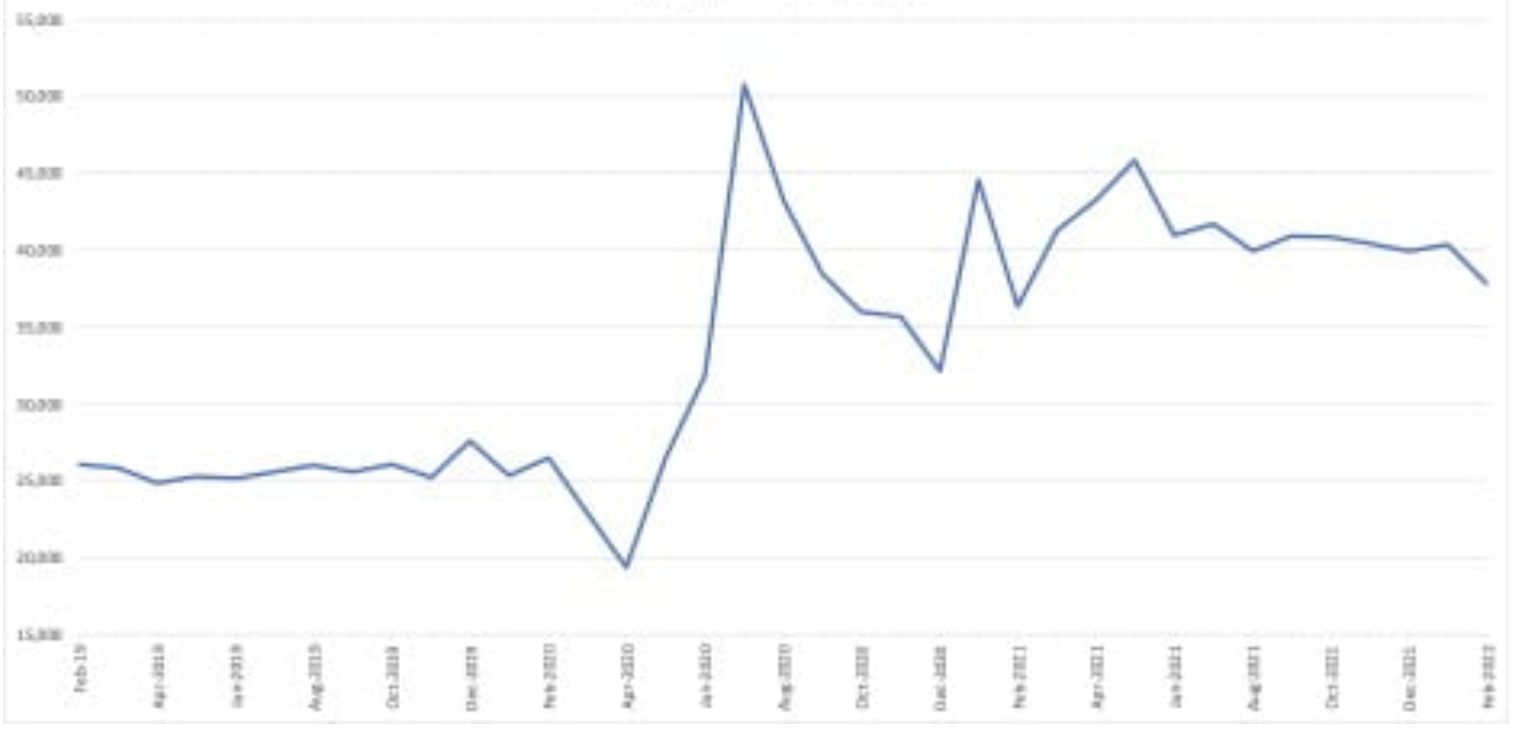
Figure 2 — Percentage Change in Texas Monthly Business Applications for All Industries February 2019-February 2022
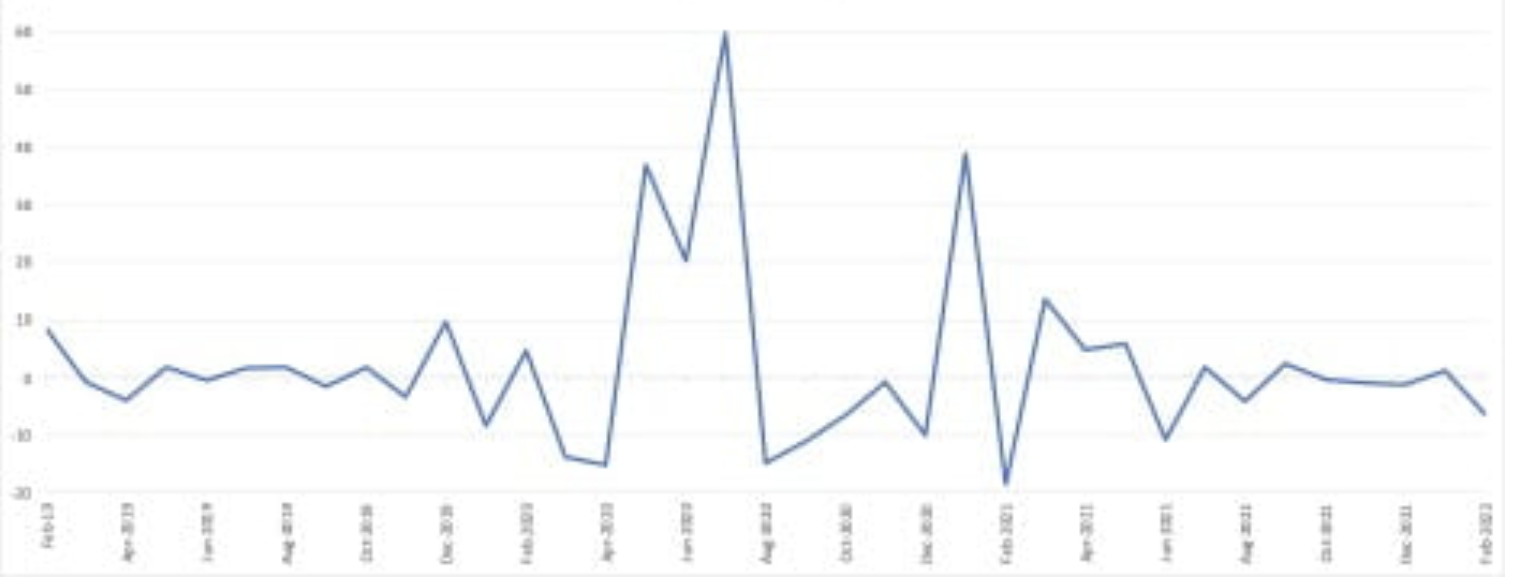
Business startups have been on the rise in Texas since the initial shutdown of March 2020. Monthly applications have remained at steady levels, staying near the 40,000 mark going back to June 2021. Moreover, recent monthly startup levels have been higher than before the pandemic, when applications had settled at around 26,000 applications.
Texas business starts have made a strong recovery after the initial pandemic related decline in 2020. The entrepreneurial spirit of prospective business owners is thriving in Texas. Whether the current robust levels are temporary or here to stay, it is nevertheless driving economic growth — and that’s good news for the Lone Star State.
References
[1] Biden, J. (2021) Remarks by President Biden Announcing his Nominees for Chair and Vice Chair of the Board of Governors of the Federal Reserve System. [Transcript]. Retrieved from https://www.whitehouse.gov/briefing-room/speeches-remarks/2021/11/22/remarks-by-president-biden-announcing-his-nominees-for-chair-and-vice-chair-of-the-board-of-governors-of-the-federal-reserve-system/
[2] Kobe, K., and Schwinn, R. (2018). Small Business GDP, 1998–2014. U.S. Small Business Administration Office of Advocacy.
https://cdn.advocacy.sba.gov/wp-content/uploads/2018/12/21060437/Small-Business-GDP-1998-2014.pdf
[3] The SBA’s Office of Advocacy defines a small business as an independent business having fewer than 500 employees.
U.S. Small Business Administration Office of Advocacy. (2016). Frequently Asked Questions. https://www.sba.gov/sites/default/files/advocacy/SB-FAQ-2016_WEB.pdf
[4] U.S. Small Business Administration Office of Advocacy. (2021). Small Business Economic Profile. https://cdn.advocacy.sba.gov/wp-content/uploads/2021/08/30143722/Small-Business-Economic-Profile-TX.pdf
[5] U.S. Bureau of Economic Analysis. (2021). Gross Domestic Product by State, 3rd Quarter 2021. https://www.bea.gov/sites/default/files/2021-12/qgdpstate1221_1.pdf
[6] The data on business applications are based on applications for an Employer Identification Number (EIN) through filings of IRS Form SS-4.
US Census Bureau, US Census Bureau BFS Definitions Page. https://www.census.gov/econ/bfs/definitions.html
US Census Bureau, US Census Bureau Business Formation Statistics. https://www.census.gov/econ/bfs/methodology.html
This material may be quoted or reproduced without prior permission, provided appropriate credit is given to the author and Rice University’s Baker Institute for Public Policy. The views expressed herein are those of the individual author(s), and do not necessarily represent the views of Rice University’s Baker Institute for Public Policy.

