


To access the full paper, download the PDF on the left-hand sidebar.
By Jim Blackburn, Megan Parks, Henk Mooiweer, Sam Zapp, Andrew Keat and Elizabeth Winston-Jones
The SSPEED Center at Rice University has been working for some time on a non-structural flood damage risk reduction concept that is centered on creating new economic opportunities for the owners of land lying below the 20-foot elevation line in the Houston-Galveston region. This land is subject to inundation by hurricane surge flooding, and most of it is currently in agricultural use with very limited human infrastructure. In studying Hurricane Ike, the SSPEED Center team observed that millions of acres of ranchland were inundated and proved to be quite resilient. Little short-term and virtually no long-term damage resulted to ranch lands, in contrast to areas with dense infrastructure like housing and homes, which were inundated. Indeed, the saltwater wetlands and coastal prairies recovered to full ecological function and economic productivity after a period of time. However, this region is also among the, most rapidly fragmenting regions in the country because of urbanization. One method to avoid future hurricane flood damages on the Texas Coast is to help keep these ranches in traditional land uses – uses that do not require dense human infrastructure and can therefore be inundated without incurring substantial damages. William J. Merrell, professor of Marine Sciences at Texas A&M Galveston and Father of the Ike Dike Proposal, agrees, stating in his research that one strategy for addressing vulnerability to storm surge is to limit or reduce human infrastructure. The approximately two-million-acre area originally targeted by SSPEED Center for non-structural flood damage mitigation is shown in the darker shading on Figure 1.
Figure 1
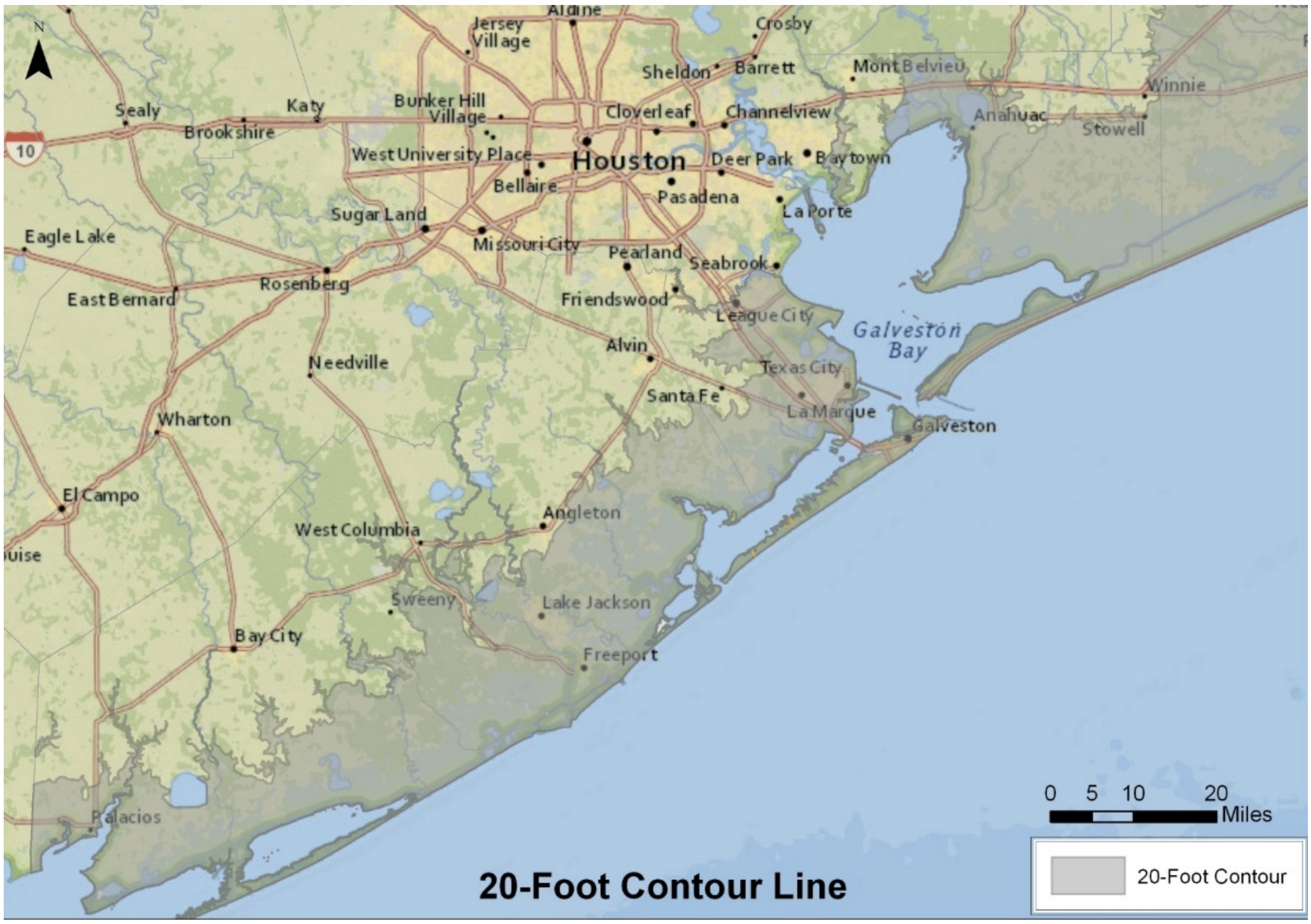
Recently, Hurricane Harvey dealt the City of Houston, the Houston-Galveston region and the Texas Coast a devastating blow. A similar, but less damaging, “Tax Day Flood” event was experienced in April 2016. How Houston and the region respond to this terrible historic flood event will be crucial for the region’s future. Harvey’s damage resulted mainly from torrential rains and resulting Bayou and drainage system flooding. Although the SSPEED center focused initially on hurricane surge, we realized we need to expand our attention to include the prevention of watershed induced flood damage.
In many areas of the United States, zoning or other land use controls might be proposed to keep natural, flood-prone areas from being developed. However, land use regulations are unpopular on the Texas Coast and are unlikely to be adopted even if Texas county governments had the authority to implement such regulations. For this reason, the SSPEED Center research looked to innovation and the market system to find a creative solution to protect these important natural areas.
In seeking a market-based solution, the research focused on identifying additional sources of income for landowners that could be generated from land uses that do not require much infrastructure and could survive inundation. This focus led us toward land management, cattle grazing and stewardship – concepts with the potential to generate new streams of revenue. Here, we focused on ecological services which are defined as the “goods” produced by natural ecosystems. Traditional ecological services familiar to landowners would include raising cattle on grasslands, leasing land for quail or deer hunting or selling timber produced by the land. Some of the less traditional ecological services include the sequestration of atmospheric carbon dioxide in soil and biomass, the reduction of flooding by absorption and storage of rainfall within the soil and wetland depressions, the enhancement of water supply as rainfall stored in the soil migrates, restoring and maintaining seeps and springs, and the enhancement of fish and wildlife values. With the development of an ecosystem services marketplace, economic and hazard resilience could be provided over large landscapes essentially by restoring and maintaining traditional landscapes, including native prairie, grazing lands and forests and wetlands.
This material may be quoted or reproduced without prior permission, provided appropriate credit is given to the author and Rice University’s Baker Institute for Public Policy. The views expressed herein are those of the individual author(s), and do not necessarily represent the views of Rice University’s Baker Institute for Public Policy.


