Home
Home

  • People
  • Events
    AI in Health Conference_Banner Image
    Science and Technology Policy
    Tue, Sep. 15 - Thu, Sep. 17, 2026 | 8 am - 6 pm
    AI in Health Conference See Details
    SynBio-Crop
    Science and Technology Policy
    Fri, Sep. 18, 2026 | 9 am - 5 pm
    Synthetic Biology at the Intersection of Science, Ethics, and Policy See Details
    Ellen Ochoa Image
    Science and Technology Policy
    Mon, Nov. 02, 2026 | 5:30 pm - 7:30 pm
    Joni Sue Lane Lecture Series — Exploring Space: A Conversation With Astronaut Ellen Ochoa See Details
  • Podcasts
  • Research Programs
  • Research & Commentary
  • Press
  • Support
  • About
  • Newsletter
  • Search
  • Research
  • Twitter
  • Facebook
  • instagram
  • Linkedin
  • Youtube
  • Newsletter
  • Economics & Finance
  • Energy
  • Foreign Policy
  • Domestic Policy
  • Health & Science
  • All Publications
Science and Technology Policy | Center for Health Policy | Infographic

Using Engineered Bacteria to Detect Viruses in Wastewater

November 1, 2023 | Alicia L. Johnson, Kirstin R.W. Matthews, Caroline Snider
Covid

Table of Contents

Author(s)

Alicia L. Johnson

Civic Science Postdoctoral Associate

Kirstin R.W. Matthews

Fellow in Science and Technology Policy

Caroline Snider

Student Intern

Share this Publication

  • Facebook
  • Twitter
  • Email
  • Linkedin
  • Download PDF
  • Print This Publication
  • Cite This Publication

    Alicia L. Johnson, Kirstin R.W. Matthews, Caroline Snider, “Using Engineered Bacteria To Detect Viruses in Wastewater” (Houston: Rice University’s Baker Institute for Public Policy, November 1, 2023).

    Copy Citation

Tags

HealthCoronavirusBiotechnology

Download the infographic in the left-hand sidebar.

The COVID-19 pandemic revealed a gap in our ability to track and stop the spread of infectious diseases. During the pandemic, wastewater monitoring helped track COVID-19 infection rates. Now, with funding from the National Science Foundation, a Rice University research team is engineering bacteria to sustainably and continuously monitor wastewater for viruses.

Why look for viruses in wastewater?

Viruses are shed when a person is sick. These viruses can be found in wastewater from sick people using toilets, sinks, and washing machines connected to the municipal water supply. Scientists can test this wastewater and identify viruses when the virus levels are high enough. High virus levels may point to an outbreak. This data can identify communities in need of screening to identify the source of a disease outbreak — before it can infect more people. Early screening can help communities enhance their awareness and preparedness.

What are genetically engineered bacteria, and how are they made?

When the genetic material of bacteria is altered, either by introducing genes from another organism or modifying the bacteria’s existing genes, it is genetically engineered. Genetic engineering can enhance an organism’s capabilities beyond what is normal or add new abilities. When researchers genetically engineer bacteria to detect viruses in wastewater, they engineer the bacteria to emit an electrical current when it senses key components of a virus (for example, a COVID-19 spike protein).

What is this technology being used for, and why?

Engineered bacteria hold a lot of potential for use in biotechnology, medicine, and environmental applications. For the project at Rice University, scientists are manipulating bacteria to sense viruses in wastewater (see picture below).
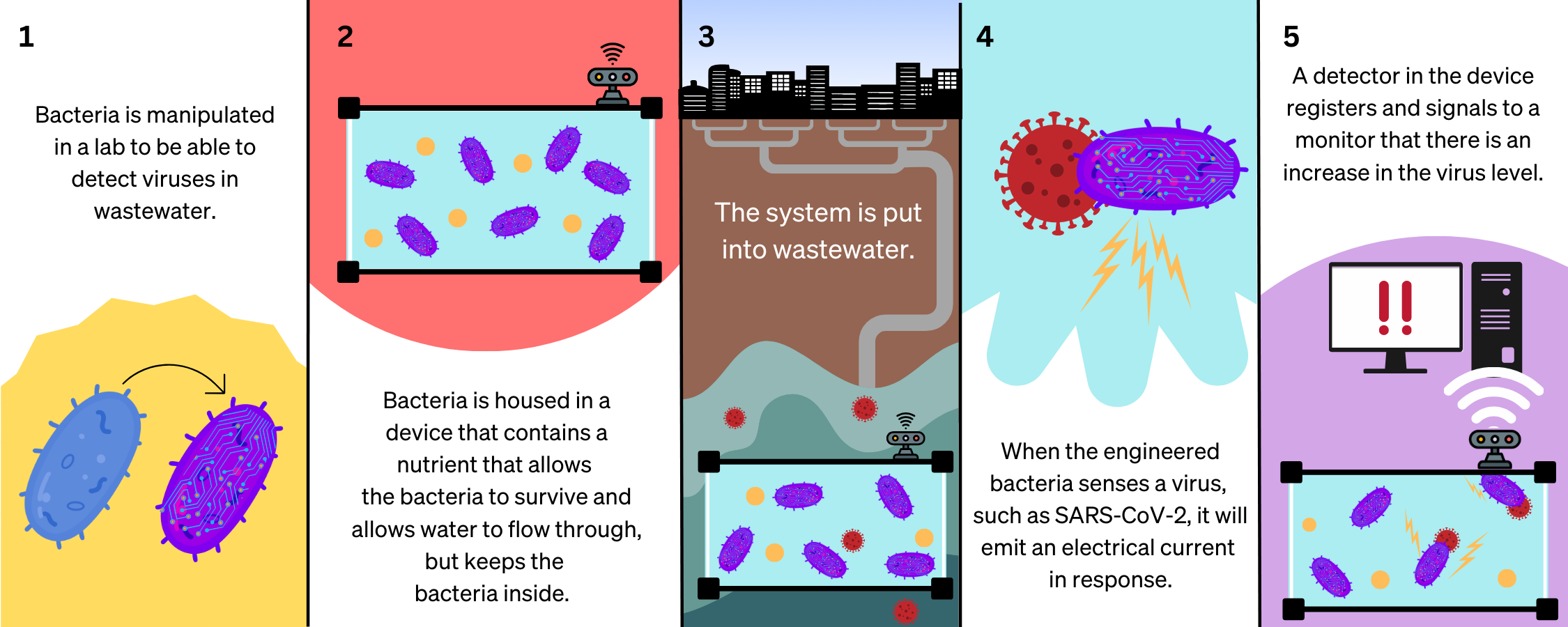
Bacteria Wastewater
Source  Authors.


Funding was provided by grants from the National Science Foundation (#2223678) and Rita Allen Civic Science Fellows. This paper was produced by the Science and Technology Policy Program and the Center for Health and Biosciences Biomedical Research Program at Rice University’s Baker Institute for Public Policy by Alicia Johnson, Ph.D., Kirstin Matthews, Ph.D., and Caroline Snider.

This material may be quoted or reproduced without prior permission, provided appropriate credit is given to the author and Rice University’s Baker Institute for Public Policy. The views expressed herein are those of the individual author(s), and do not necessarily represent the views of Rice University’s Baker Institute for Public Policy.


© 2023 by Rice University’s Baker Institute for Public Policy
  • Print This Publication
  • Share
    • Facebook
    • Twitter
    • Email
    • Linkedin

Related Research

A child eats an apple in the garden.
Center for Health Policy | Podcast

How WIC, Medicaid, and SNAP Support Children’s Health

Read More
Parents hold the baby's hands
Center for Health Policy | Podcast

The Thriving Texas Families Program and State Support for Maternal Health

Read More
Child at play on colorful playground equipment
Center for Health Policy | Podcast

How Public Policy Can Nurture Childhood Resilience

Read More
  • Contact Us
  • Donate Now
  • Press
  • Membership
  • Careers
  • Student Opportunities
  • About the Institute
  • Rice.edu

6100 Main Street
Baker Hall MS-40, Suite 120
Houston, TX 77005

Email: [email protected]
Phone: 713-348-4683
Fax: 713-348-5993

  • Twitter
  • Facebook
  • instagram
  • Linkedin
  • Youtube
  • Newsletter
  • © Rice University's Baker Institute for Public Policy
  • Web Accessibility
  • Privacy Policy